

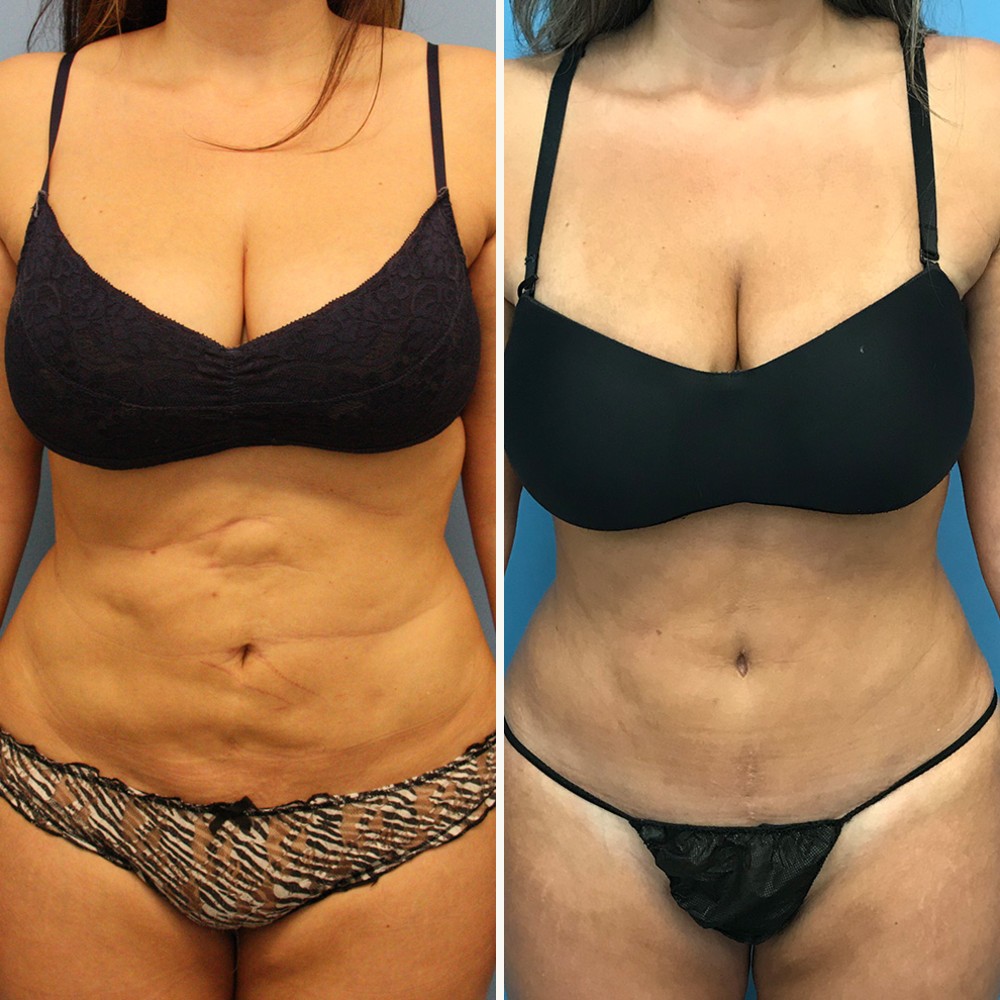
What is a revision tummy tuck?
A revision tummy tuck is a second abdominoplasty on an abdomen that has already been operated on. A first tummy tuck removes the loose skin below the navel, repairs the separated muscles and rebuilds the belly button; a revision corrects what that surgery did wrong or left undone, through the scar tissue it created and with whatever skin remains. Dr. Cat also revises tummy tucks that did not hold after a later pregnancy or weight change, and abdomens left sagging and uneven by liposuction of loose skin. In her words, a revision tummy tuck is an extremely challenging surgery that requires detailed pre-operative planning, meticulous technical skill and experience.
Patients come to Dr. Cat from other practices across Los Angeles and from out of state and abroad to correct a first surgery done elsewhere. A tummy tuck looks worse at two months than at twelve; our page on a botched tummy tuck separates normal healing from a result that needs correcting.
What a revision tummy tuck corrects
- A scar too high to hide under a bikini bottom, uneven, wide or raised
- A belly button that is round, stretched, slit-like, too large, too high or too low
- Dog ears at the ends of the scar
- Loose skin left above the navel or at the flanks
- A muscle separation (diastasis recti) never repaired or recurred, a bulge, or a hernia
- Dents, waves and steps in the contour
- A mons pubis left full under a flat abdomen
Who is a good candidate for a revision tummy tuck?
The test is a healed result that is still wrong at twelve months. Dr. Cat reviews the operative note from your first surgery and examines what remains before she says what a revision can do.
You may be a good candidate if
- Your first tummy tuck was at least twelve months ago and the scar still sits high, wide or uneven, or the belly button looks operated on
- The muscles were never repaired or the repair has loosened, so the belly still rounds out
- Loose skin remains above the navel or at the sides, or dog ears still stand
- Liposuction or a non-surgical fat treatment left you sagging and uneven
- Your weight is stable within 10 to 15 pounds of your goal with a BMI of about 30 or less, no pregnancy is planned, and you can stop nicotine for two months
Not yet, or a different plan, if
- Your first surgery was less than twelve months ago: swelling, a red scar and a fullness above the incision are normal while the result settles
- An incision has opened, fluid keeps collecting, or there is fever: a complication is treated at once
- Your weight is still changing. A GLP-1 medication such as semaglutide or tirzepatide is stopped 1 to 2 weeks before surgery and resumed once healed, at 2 to 3 weeks
- Only the scar is wrong and it sits in the right place: a raised or red scar often responds to silicone, steroid injections or laser
Tummy tuck scar revision for a high, wide or uneven scar
A well-placed tummy tuck scar sits low enough to hide under a bikini bottom and runs level. A high scar means the incision was marked high or too little skin was removed to bring it down; an uneven one was closed unevenly; a wide or raised one was closed under tension or healed poorly. In a tummy tuck scar revision Dr. Cat excises the old scar and the scar tissue beneath it, removes the residual excess skin so the new line sits lower, closes in layers so the deep layers carry the tension, and tapers each end. A C-section scar leaves with the excess skin; our post on C-section scar revision covers that scar on its own. Silicone strips start at two weeks and the revised scar fades over about 12 months; our tummy tuck scar guide shows each stage. The scar is revised, not erased.
Belly button revision after a tummy tuck (umbilicoplasty)
A natural navel is a small vertical oval, centered where yours sits, with a slight hood above it and the scar hidden inside. The navels patients bring to Dr. Cat are round, a flat slit, a hole with a circular scar, too large, stretched, too high, or pulled too low: the umbilical float, in which the first surgeon cut the navel free and pulled the skin down over it. A belly button revision after a tummy tuck, an umbilicoplasty, rebuilds it as her signature "innie": an oval in proportion to your frame, with a dimple, the incision inset deep at its base, and no sutures crossing the line. A navel cut free and left too low is rebuilt with skin flaps in the proper position, as in case RTK-5538.
Dog ears after a tummy tuck
Dog ears after a tummy tuck are puckers of skin and fat at each end of the scar, formed when the incision was too short for the skin removed or its ends were not tapered. Those still standing at six months do not flatten on their own. Dr. Cat removes a dog ear by extending the scar slightly beyond it and thinning the fat beneath, with conservative liposuction of the flanks where the fullness continues. When loose skin wraps around the sides because the first incision stopped at the hips, the correction is an extended pattern that carries the incision past the hip bones, as on our extended tummy tuck page; when the excess is vertical as well, a fleur-de-lis pattern adds a midline incision.
Loose skin, a failed muscle repair, a bulge or a hernia
A full tummy tuck lifts the skin to the ribs so the upper abdomen tightens with the lower. When the skin was not lifted high enough, or too little was removed, the upper belly still folds when you sit, which is how a mini done on the wrong anatomy disappoints; Dr. Cat lifts the skin as she would in a first surgery and removes the remaining excess. If the belly still rounds out after healing, the muscles were never repaired, the repair loosened or tore, or there is a hernia. She redoes the repair with her double-layer technique, tight but never over-pulled; our page on diastasis recti explains the repair, and our post on torn internal stitches after a tummy tuck covers the signs that one has given way. A hernia is repaired at the same operation by a general surgeon, quoted separately.
Revision after liposuction or a non-surgical fat treatment
Some of the most challenging revisions Dr. Cat performs are for patients who had liposuction of loose skin elsewhere and were left thin, sagging and uneven, with dents where fat was over-removed and pockets where it was left; the same follows a non-surgical fat treatment such as CoolSculpting, which the practice does not offer. Liposuction relies on the skin to shrink over the new shape, and loose skin does not. The correction is a tummy tuck of that abdomen: the skin is lifted, the irregular fat is feathered with conservative liposuction, depressions are filled with fat grafting, and the excess skin is removed. When the skin is still firm and only the fat is irregular, the answer is revision liposuction with fat grafting; some patients need both, staged, as in case RTK-0418. Our comparison of a tummy tuck against liposuction explains how Dr. Cat tells skin from fat.
What a revision tummy tuck cannot do
In Dr. Cat's own words, sometimes the damage is so great that not every error can be repaired. Tissue that was removed cannot be put back: when a first surgery took too much skin, or too much fat from under the flap, a revision smooths what remains, with fat grafting where it helps, but does not recreate what is gone. A scar is revised into a better scar, lower, thinner and level; it is not erased. The result depends on the tissue the first surgery left and on your weight staying stable, and a second surgery through scar tissue is longer, with a longer recovery, than a first. Dr. Cat says before surgery what a revision can correct and what it can only improve.
When to have a revision tummy tuck
At least 12 months after the first surgery. The scar is at its reddest between one and three months, a fullness above the incision comes and goes for six to twelve months, and the shape is final at about a year; a revision tummy tuck planned earlier corrects a healing result rather than the real one. A hernia and any wound problem, an open incision, an infection or a fluid collection, do not wait and are treated at once.
How Dr. Cat does it
Dr. Cat is a board-certified plastic surgeon who completed two surgical residencies, one in head and neck surgery, microvascular and facial reconstructive surgery, and advanced training in general plastic and reconstructive surgery, Harvard-educated and UCLA trained. She has developed a gentle revision technique with minimal pain and a quick recovery.
Planning: the operative note and the examination
The consultation is private and conducted by Dr. Cat herself. She reviews the operative note from your first tummy tuck, when you can get it, to learn how high the skin was lifted, whether the muscles were repaired, how the belly button was made and whether liposuction was added. She examines the scar, the skin, the abdominal wall lying down and sitting up, the navel for a hernia, the flanks and the mons, takes a complete medical history, and weighs age, health, emotional well-being and expectations. If she does not believe a revision will benefit you, she advises you on the alternatives.
The technique: through the first scar, under 3.5X magnification
Dr. Cat performs every step under 3.5X magnification operating lenses. She makes a low curved incision that aligns with the one from your first surgery and removes the old scar with it, so you end up with one line. She lifts the skin and fat off the abdominal wall, repairs muscles left separated or loosened, corrects irregularities of the wall, releases scar tissue that tethers the skin, removes the remaining excess and lays the skin back flat; the belly button is reshaped or rebuilt to fit it. The closure is layered and the ends are tapered so there are no dog ears, bunching or step-offs. Little to no bleeding during surgery is part of why her patients have little pain afterwards.
Anesthesia, surgery day and the first night
The surgery is performed under general anesthesia with a board-certified physician anesthesiologist in Dr. Cat's QUAD A accredited surgery center on Rodeo Drive. A full revision takes four to seven hours of surgery, depending on your anatomy, because the scar tissue, the muscle repair to redo and the belly button to reposition take longer than a first surgery; the operating room is booked for longer than the surgery itself, for anesthesia, positioning and the garment. Dr. Cat schedules one major surgery per surgical day and performs every step herself. After a revision, the first night is spent in a plastic surgery aftercare center with a nurse, with gurney transport from the surgery center; the center brings you to the office the next morning for your first visit.
Preparing for surgery
Dr. Cat's team gives you the pre-operative instructions: medical clearance and lab tests 14 days before surgery, no nicotine for two months, the medications and alcohol to stop two weeks before, a Hibiclens wash, nothing to eat or drink after midnight, and someone to drive you and stay with you after the aftercare night.
 Revision tummy tuck with pubic lift: Dr. Cat breaks down the surgery in the operating room
Real surgical footage, shown with the patient's consent.
Combining a revision tummy tuck with other procedures
Pubic lift and liposuction of the mons
A mons left full or hanging under a tight abdomen is one of the things Dr. Cat sees most often after a tummy tuck done elsewhere. In a revision she lifts it through the same incision, a pubic lift, never over-pulled and never so far that the pubic hairline sits too high, after conservative liposuction when there is excess fat.
Staged on a separate day
Dr. Cat does not perform aggressive or 360-degree liposuction with a tummy tuck, because the blood supply to the lifted skin travels through that fat. A Brazilian butt lift, a breast augmentation with implants and a labiaplasty are never done the same day, a breast lift is staged, and a mommy makeover is staged in the order Dr. Cat sets.
Revision tummy tuck recovery, week by week
Recovery after a revision tummy tuck follows a first tummy tuck with Dr. Cat, with more swelling because the skin has been lifted a second time. Our tummy tuck recovery guide covers each week.
- The night of surgeryYou wake with little to no pain and, after about an hour, go by gurney to a plastic surgery aftercare center, where a nurse gives your medication, monitors your drains and gets you up for a short walk that evening.
- Day oneThe center brings you to the office, where Dr. Cat checks the incision, the belly button and the drains. The abdomen feels tight rather than painful; most patients take Tylenol and leave the prescription pain medication unfilled. You walk slightly bent with a front-wheel walker.
- One weekYou stand almost straight, and Dr. Cat removes all or almost all of the drains, gently.
- Two weeksAny remaining drains come out, you stand straight, desk work resumes and silicone strips start. Out-of-town patients can fly home once cleared.
- One monthDaily activities and light exercise such as walking; nothing strenuous yet.
- Six to eight weeksFull exercise at six weeks, with no direct impact to the abdomen; sit-ups and planks wait until three months after a hernia repair. The binder comes off at six to eight weeks.
- Three months to one yearDr. Cat reviews your photographs at three months and scar care continues with silicone gel. The swelling clears over six to twelve months and the revised scar fades over about 12 months.
Revision tummy tuck before and after: what to look for
In revision tummy tuck before and after photos, look at how low and level the new scar sits, whether the navel looks as if it was always there, and whether the upper abdomen is as flat as the lower, in an after photo taken at six months or later. The cases on this page are revisions of surgery done elsewhere. RTK-0822: liposuction and a non-surgical fat treatment had left irregularities, corrected with a revision tummy tuck and a pubic lift. RTK-0601 and RTK-0693: over-aggressive liposuction, and a tummy tuck with liposuction, had left excess skin and uneven contouring. RTK-0418: deep indentations after liposuction, smoothed first with revision liposuction and fat grafting, then a tummy tuck. RTK-0528: a hernia repair and a pubic lift with the revision. RTK-5538: a first tummy tuck had cut the belly button free and left it abnormally low above a high scar; Dr. Cat revised the muscle repair, created a new belly button in the proper position and lowered the scar. See the revision tummy tuck before and after photos for the starting point closest to yours.
Risks of a revision tummy tuck, and how Dr. Cat reduces them
A revision carries the risks of any tummy tuck plus the ones scar tissue and a second lifting of the skin add. Here is what can happen and what Dr. Cat does to prevent it.
What can go wrong
- A fluid collection (seroma) or a blood collection (hematoma) under the skin, more likely when it is lifted a second time
- Infection, delayed healing, or a small opening of the incision at the center, where the tension is highest
- Skin or fat necrosis when lifted skin loses its blood supply, a greater risk through scar tissue and the reason nicotine is stopped
- A scar that heals wider or raised, asymmetry, residual loose skin, or a result limited by what the first surgery left
- A blood clot in the leg that can travel to the lungs, rare and serious, and anesthesia risks, which the anesthesiologist reviews with you
How Dr. Cat reduces these risks
- Timing: a revision planned at least 12 months after the first surgery, once the scar has matured
- Careful patient selection: weight, BMI, nicotine, diabetes control, GLP-1 timing, medical clearance and lab work, and the first surgery's operative note
- Every step by Dr. Cat herself under 3.5X magnification: little to no bleeding, muscles never over-pulled, skin removal measured to the millimeter, a layered closure
- No aggressive liposuction and no Brazilian butt lift in the same operation; one major surgery per surgical day
- A QUAD A accredited facility with a physician anesthesiologist, the first night with a nurse, walking every other hour, a compression binder, and follow-up visits from day one to three months
How much does a tummy tuck revision cost in Beverly Hills?
Dr. Cat's surgeon's fee for a revision tummy tuck is $75,000 to $95,000; the operating room and anesthesia are quoted at your consultation, because the operating time depends on your anatomy and on what is treated together. Surgeon's fees are typical ranges: a more complex case can cost more, and your fee is set at your consultation and is final only in your written quote. A revision costs more than a first tummy tuck, whose surgeon's fee with Dr. Cat is $40,500 to $60,500, because of what it works through: scar tissue, a muscle repair to take down and redo, a belly button to reposition or rebuild, and a longer surgery, four to seven hours depending on the anatomy.
Revision mini tummy tuck
A revision mini tummy tuck corrects the lower abdomen only: a high, wide or uneven scar from a first mini or a C-section, a pouch of skin below the navel, or dog ears, with the muscles and the upper abdomen already right. Dr. Cat's surgeon's fee for it is $35,500 to $45,500; it is a shorter operation, and the aftercare night is still required. Many patients who ask for a mini revision need the full revision, because the loose skin above the navel is what the first surgery did not reach.
Liposuction of the mons added to the revision is $3,500 plus one hour of operating room time, quoted at your consultation; a pubic lift and a hernia repair by a general surgeon are quoted separately. Your compression garment and Arnica are on every quote, which is itemized, covers the aftercare night and your follow-up visits, and is valid for six months.
The price reflects one surgeon who performs every step of a four-to-seven-hour operation herself, one major surgery per surgical day, a physician anesthesiologist for the whole case and an accredited facility. Our tummy tuck cost guide explains what a quote is made of. Insurance treats a revision tummy tuck as elective and cosmetic; Dr. Cat's office does not bill insurance but provides the paperwork if your plan makes an exception.
Consultation fee, deposit and financing
A revision consultation with Dr. Cat is $1,500, credited in full toward your surgery. Your surgery date is booked once the quote and the pre-op paperwork are signed and the $2,500 deposit is paid. To pay over time, the practice partners with Cherry, its primary financing partner, and also accepts CareCredit and Alphaeon Credit; see financing and payment plans.
Your revision consultation with Dr. Cat
It starts with a free 15-minute discovery call with our Patient Concierge, who books your consultation: in person on Rodeo Drive or, for out-of-town patients, a private video consultation through OnPatient, the HIPAA-secure patient portal. Bring your operative report from the first surgery if you have it and any photographs from before it. Dr. Cat tells you what a revision can correct, what it can only improve, or whether to wait longer, and you leave with an itemized written quote. Patients who travel stay in Beverly Hills about two weeks, until the drains are out and Dr. Cat has cleared them to fly.


