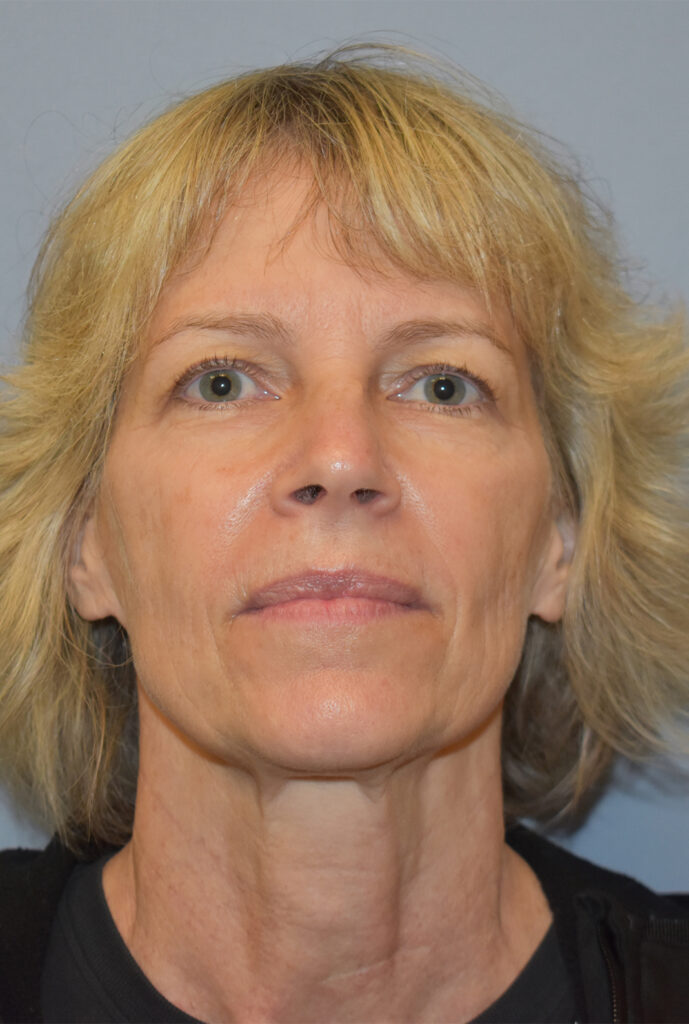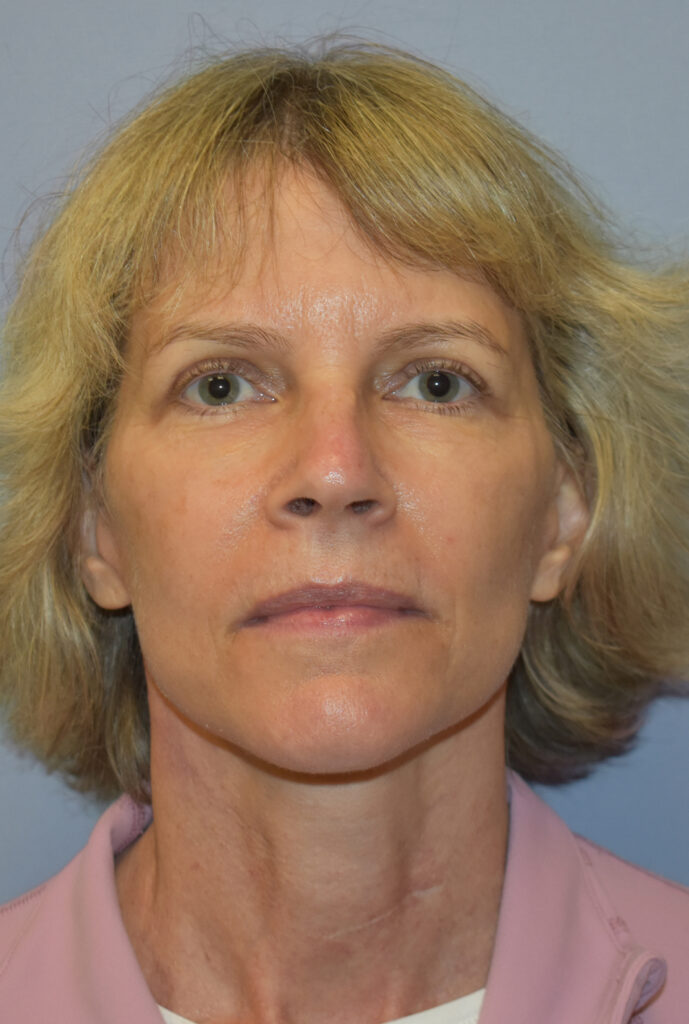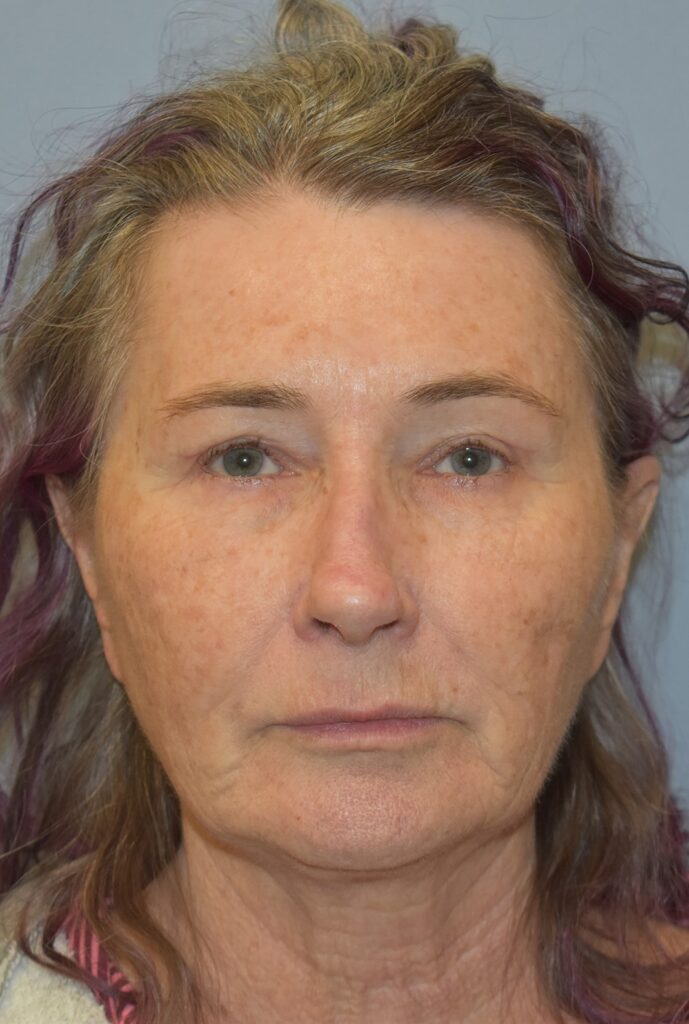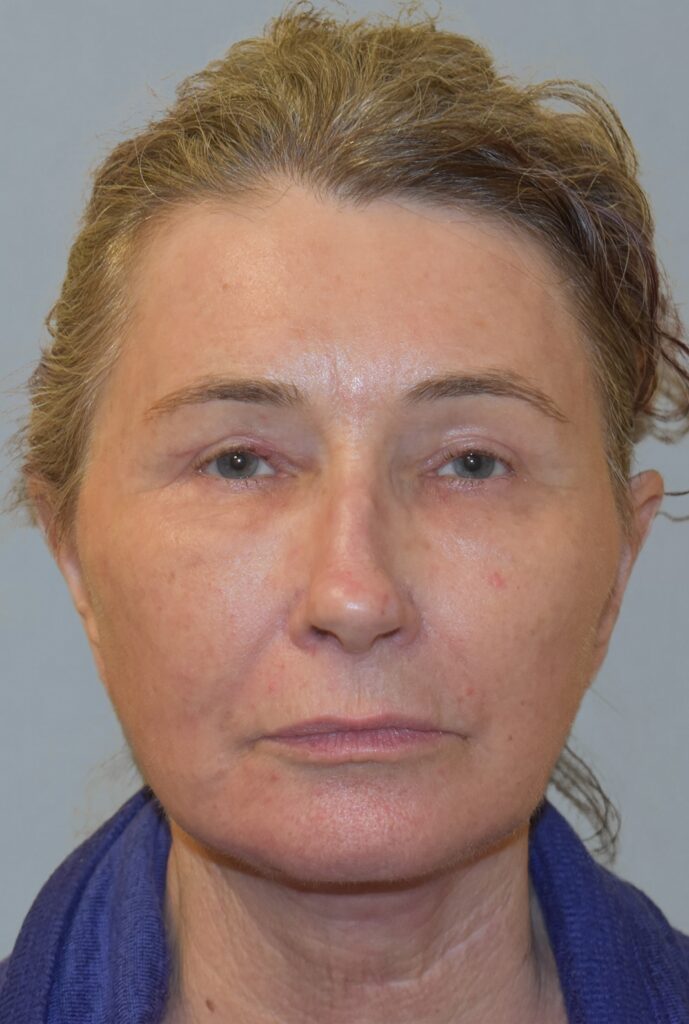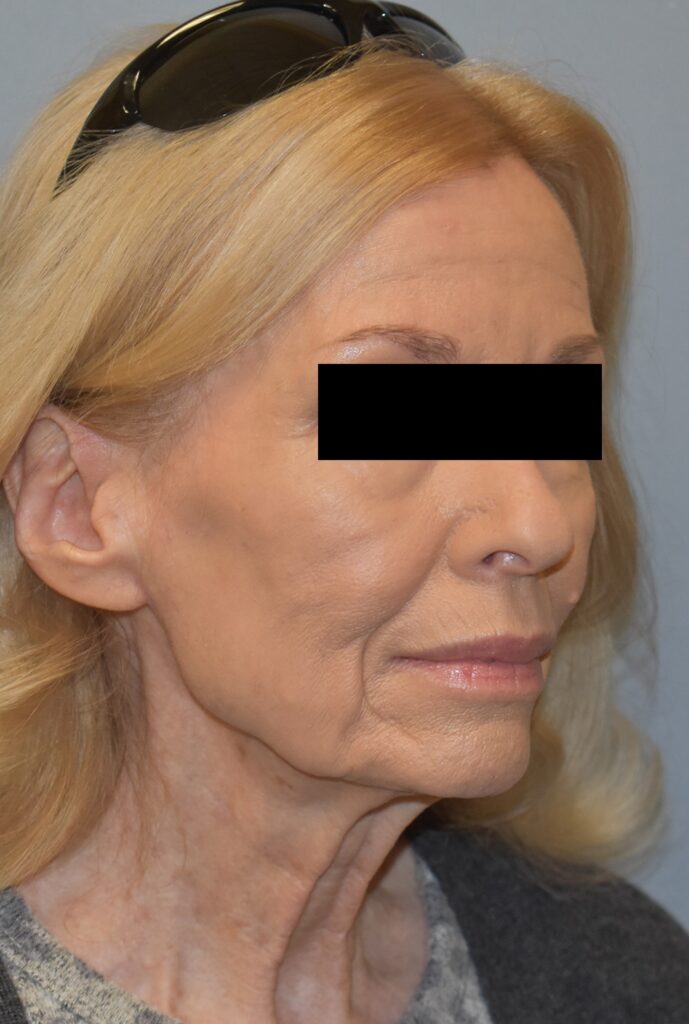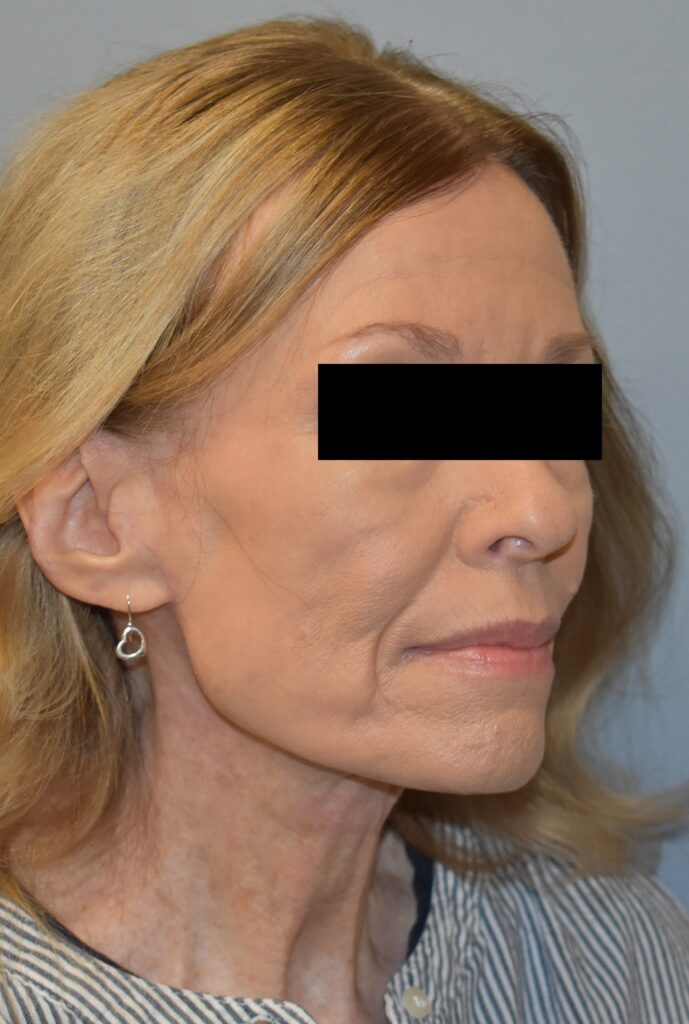


What is a facelift?
Rhytidectomy, the medical term for a facelift, is surgery for the changes of the lower face and neck that skin care and injectables can no longer manage: jowls, deep nasolabial folds, loose skin of the face and neck, and cheeks that have lost their position. The tissue that sags into the jowls is the same tissue that loosens under the chin, which is why the facelift at our practice is a face and neck lift: the SMAS (superficial musculoaponeurotic system) is repositioned so the cheeks, the jawline and the neck move up together, then the skin is laid back and the excess trimmed without pulling. Our page on sagging jowls explains why nothing applied to the skin can move that tissue back.
What a facelift treats
- Sagging jowls and a jawline that has lost its line
- Loose skin of the face and neck, including the skin left after significant weight loss
- Deep nasolabial folds and the marionette lines beside them
- Cheeks that have slid down and flattened, with fat grafting when the face is hollow as well as loose
- Platysmal bands and loose skin under the chin, treated in the same surgery
Who is a good candidate for a facelift?
Most facelift patients are in their late 40s to 60s, at the point where jowls, deep folds and a loose neck have moved past what skin care and injectables can manage. The short test: if the problem is tissue that has moved rather than skin texture or lost volume alone, a facelift is the operation. Our pages on turkey neck and the double chin cover the neck.
You may be a good candidate if
- Jowls, deep folds or loose skin along the jawline and neck that filler and Botox no longer disguise
- Skin that has lost tone with age, sun or weight loss but still has enough elasticity to redrape
- A significant weight loss that has been stable for several months, with loose skin left behind
- Good overall health, with your blood pressure controlled
- No nicotine for at least four weeks before and after surgery, longer depending on your smoking history
- Realistic expectations: a refreshed version of yourself, not a different face
Not yet, or a different plan, if
- Jowls in your 20s or 30s: usually a full lower cheek, a short chin, weight changes or bulky masseters rather than descent, and chin projection, filler or weight stability do more than a lift
- Heavy upper lids or under-eye bags are the main complaint: they do not move with a facelift; an eyelid lift is the operation
- Only the neck has changed: loose skin, bands or fat under a jawline that still holds may need a neck lift alone
- Your weight is still changing, or a recent weight loss has not settled
- Uncontrolled blood pressure, blood thinners that cannot be paused, or nicotine you cannot stop: the causes of a hematoma and of skin that does not heal
- Mild laxity with no real descent: ThermiSmooth Face or filler may be the right step first, and the consultation will say so
Types of facelift
Face and neck lift
The operation most facelift patients have. Through incisions that follow the hairline and run around the ear, the surgeon lifts the skin, repositions the SMAS beneath it so the deep layer carries the tension, then joins the facelift incisions to the neck lift incision and lifts the face and neck as one unit, tightening the platysma through a short incision under the chin. About four to six hours; our facial plastic surgeon's fee $45,500 to $65,500.
Deep plane facelift
A deep plane facelift lifts the skin and the SMAS together as one thick layer, releasing the ligaments that tether the cheek and the jowl to the bone; it suits moderate to advanced jowling and is the approach our facial plastic surgeon uses for most face and neck lifts, which is why the two carry the same fee. Whether the SMAS is tightened from above or lifted from below is decided on your anatomy at the consultation, not on the name of a technique.
Mini facelift
A mini facelift uses shorter incisions in front of the ear, lifts the lower cheek and jawline, and leaves the neck alone. It suits early, mild jowling with good skin elasticity and a neck that is still holding, with a shorter recovery; it does not buy a lifted neck, a corrected platysma band, or a result that lasts as long as a full lift. If a mini is enough, the consultation will say so; it is quoted at the consultation.
Revision facelift
A revision facelift corrects a previous facelift by any surgeon: a pulled or windswept look, an earlobe drawn down, a hairline moved up, jowls that returned early, or a neck that was never addressed. Our facial plastic surgeon's fee is $60,000 to $75,000 for a revision face and neck lift and $40,000 to $60,000 for a revision facelift without the neck; a revision consultation is $1,500.
How the facelift is done
Our board-certified facial plastic surgeon completed his training in facial plastic and reconstructive surgery and has operated alongside Dr. Cat for more than a decade. These are the steps of a face and neck lift, and the details that keep a face looking like itself.
The incisions: along the hairline and around the ear
The markings are drawn with you sitting upright, because a neck marked lying flat lifts in the wrong direction. The incisions follow the hairline and run around the ear: inside the tragus, under the earlobe and into the hairline behind the ear, where hair and the folds of the ear hide them. When the neck is part of the plan, a short incision in the crease under the chin gives access to the platysma and, if there is fat under the chin, to conservative liposuction, which comes first.
The lift: SMAS, not skin
The surgeon lifts the skin, then repositions the SMAS beneath it, moving the cheek fat back up over the cheekbone and the jowl back above the jawline, and secures it there so the deep layer carries the tension. In the neck, the separated edges of the platysma are brought back together in the midline through the chin incision and tightened. The skin is then laid back over the new contour and the excess trimmed without pulling, which keeps a face from looking tight, windswept or operated on.
The closure and the scars
The deep layers are closed so the skin closure carries no tension, and the incision line is closed with fine sutures inside the folds of the ear and along the hairline, which is why facelift scars are nearly invisible within a few months and hard to find within about a year. Scar care starts at the two-week visit with silicone strips, then a scar gel; our facelift scar guide follows the scar from the first week to a year.
Anesthesia, the facility and the first night
A face and neck lift is performed under general anesthesia with a board-certified anesthesiologist for the whole case, in the practice's QUAD A accredited surgery center on Rodeo Drive. A light dressing goes on, sometimes with a small drain for a day or two, and the first night is spent with a nurse or a responsible adult, never alone, because that is when a hematoma would declare itself.
Combining a facelift with other procedures
Facelift with neck lift
A neck lift (lower rhytidectomy) treats the area below the jawline: the neck skin, the platysma muscle and the fat under the chin. A facelift treats the mid and lower face: the cheeks, the folds and the jowls. When the aging is confined to the neck, a neck lift alone is the operation, quoted at the consultation; our neck lift cost guide covers it. When jowls have formed, a neck lift alone leaves a tight neck under a sagging jawline, which is why most neck lift patients have a face and neck lift.
Facelift with eyelid lift or brow lift
Heavy upper lids and under-eye bags do not move with a facelift, so an eyelid lift is often planned in the same surgery and quoted with it. A brow that has dropped and pushes skin into the lid is a brow lift. Our page on hooded eyes explains how to tell which you need.
Facelift with fat grafting
When the face is hollow as well as loose, fat transfer to the face is added in the same surgery: your own fat, placed in the cheeks and the hollow in front of the jowl. On its own, fat transfer to the face is performed by Dr. Cat and quoted at your consultation; added to a facelift it is quoted with the lift. A lip lift or buccal fat removal is planned at the consultation when it fits.
Facelift recovery timeline
Here is what recovery looks like for most face and neck lift patients. For the long version, read our facelift recovery timeline, week by week.
- The night of surgeryYou wake with a light compression dressing around your head and neck and, sometimes, a small drain in place, then spend the first night with a nurse or a responsible adult, who watches the first hours, gives your medication and helps you walk that evening.
- The first weekSwelling and bruising peak in the first two or three days and start to fade. Any drain comes out within a day or two and the stitches at about seven days, at your visits with our facial plastic surgeon; the neck feels tight for several weeks as the tissue settles.
- Two weeksThe dressing is off and silicone scar care starts. Most patients are presentable with makeup, back at a desk at about day 10 to 14 and at social events at two to three weeks; walking and a stationary bike can start. Out-of-town patients stay until they are cleared to fly.
- Four to six weeksVigorous exercise resumes once you are cleared. Most of the swelling has settled, the incisions are flat and fading, and silicone gel continues.
- Three to six monthsThe contour shows: a defined jawline, a clean angle under the chin and scars that are nearly invisible. Deep swelling after a deep plane lift takes the longer end of that range to settle.
- One yearThe scars have faded to a thin line that is hard to find. A well-performed facelift holds for about eight to fifteen years while aging continues from the new baseline.
Risks and safety
Every surgery carries risk, and a face and neck lift is a long operation on the most visible part of you. Here is what can happen and how the practice reduces it.
What can go wrong
- A hematoma, a collection of blood under the lifted skin, most often in the first night; a spike in blood pressure is the commonest cause
- Infection at an incision or around a drain
- Delayed healing behind the ear, or loss of part of the lifted skin when its blood supply fails, most often in smokers
- A scar that heals wider, raised or darker, a scar in front of the ear, an earlobe pulled downward or a hairline moved up
- Injury to a branch of the facial nerve that changes how you smile: rare, and usually temporary
- A pulled, windswept look from skin lifted without the tissue beneath it, asymmetry, or residual loose skin that may need a touch-up
- Anesthesia risks, which the board-certified anesthesiologist reviews with you before surgery
How the practice reduces these risks
- Careful patient selection: nicotine stopped, blood pressure controlled, blood thinners reviewed, a stable weight, and a full medical history
- Medical clearance and lab work for every patient, and a pre-operative appointment covering the medications, supplements and alcohol to avoid for two weeks before surgery
- Surgery in a QUAD A accredited facility with a board-certified anesthesiologist for the whole case
- A surgeon whose practice is facial surgery, a lift carried by the deep layer, skin trimmed without pulling, and incisions inside the folds of the ear and along the hairline
- Gentle technique with minimal bleeding and bruising, and a compression dressing for the first days
- The first night with a nurse or a caregiver who watches for a hematoma, then follow-up visits through the first weeks and months
How much does a facelift cost in Beverly Hills?
Our facial plastic surgeon's fee for a face and neck lift is $45,500 to $65,500, and for a revision face and neck lift, after a previous facelift by any surgeon, $60,000 to $75,000; a revision facelift without the neck is $40,000 to $60,000. Those are surgeon's fees: the operating room and anesthesia are quoted with them at the consultation, so your written quote is one figure, and it moves with what is combined. A mini facelift and a neck lift on its own are quoted at the consultation; an eyelid lift, fat grafting or a brow lift added to the plan is set in your quote. Every quote is itemized, from the surgeon's fee and the anesthesiologist to your follow-up visits, with no second invoice after surgery.
The price reflects what is behind it: a surgeon whose practice is facial surgery, a board-certified anesthesiologist, an accredited facility and a nurse for the first night. For context, the American Society of Plastic Surgeons puts the national average surgeon's fee for a facelift at $11,395, before anesthesia, the operating room and follow-up. Please do not fall for cheap or fast plastic surgery: a facelift at a fraction of this price is usually a skin-only lift, and revising it costs more than the original surgery would have done well. Our facelift cost guide explains what a quote is made of and the questions to ask any surgeon.
Consultation fee and financing
A consultation is $500, or $1,500 for a revision consultation, credited in full toward your surgery. To pay over time, the practice partners with Cherry, its primary financing partner, and also accepts CareCredit and Alphaeon Credit; see financing and payment plans. A facelift is cosmetic surgery and is not covered by insurance; the office does not bill insurance, but can give you the paperwork after surgery if you want to submit a claim.
Your consultation
It starts with a free 15-minute discovery call with our Patient Concierge, who answers your first questions and books your consultation with our facial plastic surgeon: in person on Rodeo Drive or, for out-of-town patients, by private video consultation through OnPatient, the HIPAA-secure patient portal. He examines the elasticity of your skin, the bone structure of the jaw and chin, how far the cheek fat has descended, the tone of the platysma and the neck, reviews your medical history and medications, and looks at photographs of similar patients with you. Then he tells you plainly which operation your face needs, and you leave with an itemized written quote.