


What is a breast lift?
Mastopexy, the medical term for a breast lift, treats sagging, which surgeons call ptosis: a nipple that has dropped to the level of the fold under the breast or below it, skin that pregnancy, breastfeeding, weight changes or time stretched and that never shrank back, and an areola that has widened. Dr. Cat removes the excess skin, tightens and reshapes the tissue that remains, moves the nipple and areola up to the center of the new breast and reduces a stretched areola in the same step. A lift does not add volume: it rearranges what you have, so the cup size stays the same or ends slightly smaller. Our page on saggy or deflated breasts after breastfeeding covers the causes.
What a breast lift changes
- The nipple and areola return to the front of the breast, level and pointing forward instead of down
- The stretched skin is removed and the breast is reshaped from its own tissue, so it holds its shape without a bra
- A widened areola is reduced in proportion, and a lower breast is brought level with the other (read about uneven breasts)
- No more push-up bras, easier exercise and clothes that fit, which is what Dr. Cat hears from her mastopexy patients most
Who is a good candidate for a breast lift?
Most of Dr. Cat's breast lift patients are mothers whose breasts deflated and dropped after pregnancy and breastfeeding, women who have lost a significant amount of weight, and women whose breasts have descended with time. Our comparison of a breast lift vs augmentation explains how Dr. Cat decides.
You may be a good candidate if
- Your nipple sits level with the fold under your breast or below it, with or without lost volume
- It is at least three months since you finished breastfeeding, with no nipple discharge and a settled shape
- You lost a significant amount of weight and are left with a loose envelope and little tissue in it
- One breast sits noticeably lower than the other, or the areolas have stretched
- You are in good health, a non-smoker, at a stable weight, and you understand that a lift restores position, not size
Not yet, or a different plan, if
- Your nipple sits above the fold and the complaint is emptiness rather than droop: that is a breast augmentation or a fat transfer
- You are still breastfeeding or finished less than three months ago; Dr. Cat operates on the settled breast
- You are planning another pregnancy, which stretches the tissue again; the ideal time is after your last pregnancy
- Your breasts are large and heavy as well as low: lifting a heavy breast without reducing it invites the sag to return, so the answer is a breast reduction
- You smoke or vape and cannot stop for the period Dr. Cat specifies; nicotine restricts the blood supply the nipple needs
- You want the lift on the same day as a tummy tuck; Dr. Cat stages the two on separate days
Breast lift incisions: crescent, donut, lollipop and anchor


Case BRL-0930, breast lift with breast reduction. Open the case for every angle.
Each pattern addresses a different degree of ptosis, and the pattern decides the scar. Dr. Cat's rule is the smallest scar pattern that will hold the new shape, because a lift that removes too little skin drops again.
Crescent lift
For minimal sagging: a small incision halfway around the top edge of the areola. It moves the nipple the least and leaves the least scar.
Periareolar or "donut" lift
For mild sagging, grade one, with the nipple level with the fold: a circular incision around the areola, at the border where the change in skin color hides it, and the areola is reduced with the same incision. It is also the lift Dr. Cat uses with an implant in tuberous breast correction.
Vertical or "lollipop" lift
For moderate sagging, grade two, with the nipple below the fold but still pointing forward: an incision around the areola and a vertical line down to the crease. It removes more skin than a donut lift and is one of the two patterns used with implants.
Inverted-T or "anchor" lift
For significant sagging, grade three, or a lot of skin after weight loss: around the areola, down to the crease and along it. It takes up the most skin; a periareolar lift cannot take up that much slack.
Lift, implants, or both?


Case BRL-0906, breast lift. Open the case for every angle.
Find the fold where the breast meets the chest and look at where the nipple sits against it. Above the fold with the breast full: no lift. Above the fold with the upper breast empty: an implant, or fat transfer for a modest change. At the fold: mild sag, a periareolar lift, or an implant alone when lost volume is the real complaint. Below the fold: a lollipop or anchor lift. The mirror is a screen, not a plan; Dr. Cat measures before she names a procedure.
Breast lift with implants
When the nipple has dropped and the volume has gone, a lift with implants in one operation is one of Dr. Cat's most requested combinations. She lifts and reshapes the tissue first and then places the implant, so it sits in a breast that has already been put back in position: one anesthesia, one recovery. Dr. Cat uses Mentor implants, placed with a no-touch technique, and tests sizes during surgery when the two sides differ; our breast implant sizes guide explains how the size is chosen.
When Dr. Cat stages them
A large volume increase under an aggressive lift pulls on fresh incisions and on the blood supply to the nipple, so a big implant and a big lift are safer in two steps, several weeks to a few months apart; a revision of someone else's surgery is often staged too. A lift with fat transfer is always two surgeries: fat adds about one cup size but does not move a nipple, so it follows the lift.
How Dr. Cat does it
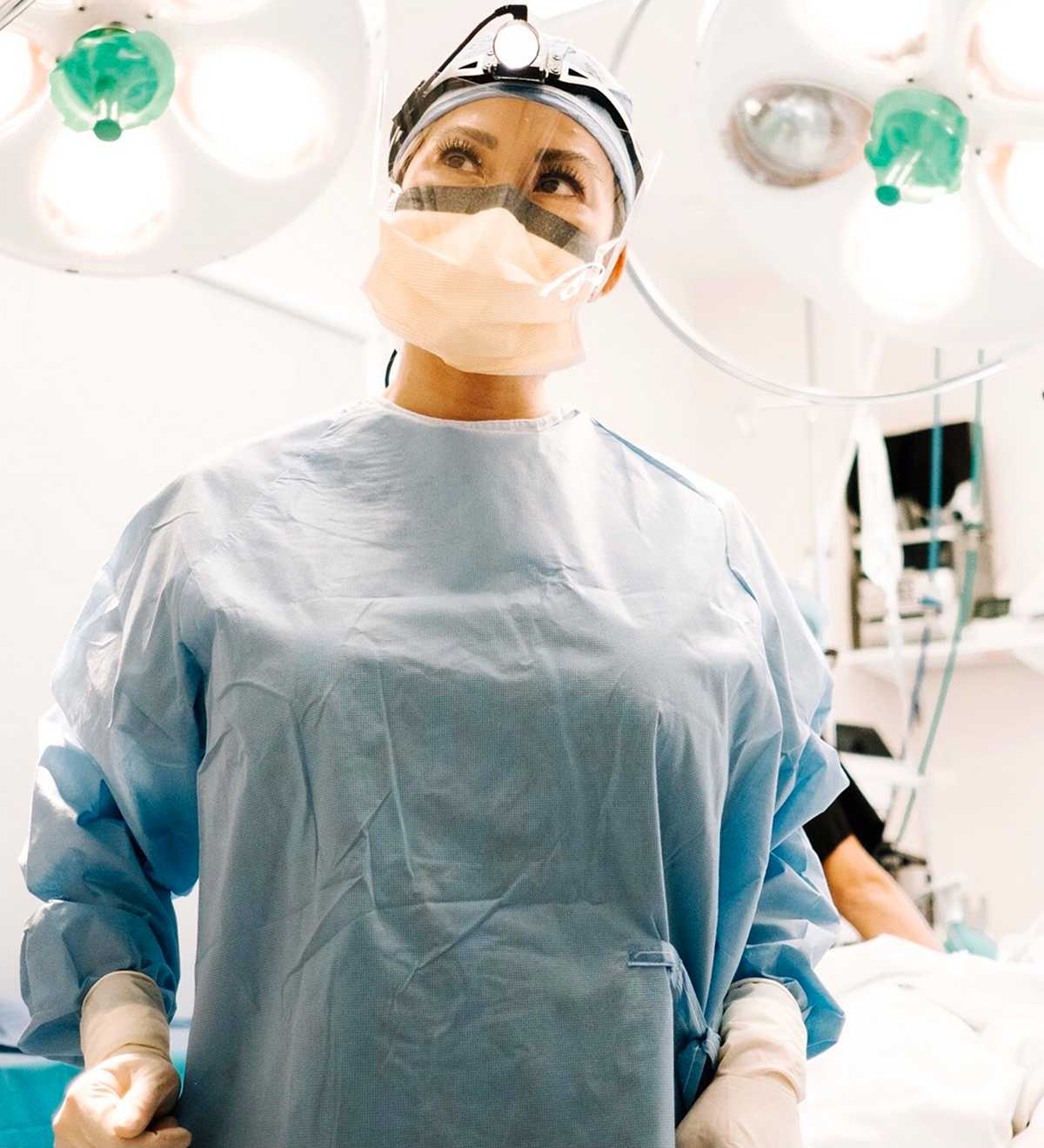
Dr. Cat is a board-certified plastic surgeon, trained in both head and neck surgery and plastic and reconstructive surgery, Harvard-educated and UCLA trained, and she has had breast surgery herself. She performs every breast lift herself, from the markings to the last suture.
The plan is measured, not guessed
Before any incision is chosen, Dr. Cat measures each nipple against the fold, grades the sag, assesses the skin and the tissue, and checks whether the two sides differ. The pattern follows the measurements: never a bigger scar than the breast needs, never a smaller one that will drop again.
The nipple and areola stay on their blood supply
The nipple and areola are never removed. They stay attached to the breast tissue and its blood supply throughout and are moved upward on that tissue while the skin around them is rearranged, which is why sensation and breastfeeding are usually preserved. A nipple graft is reserved for very large reductions, not for a lift.
The scar: thin, layered, hidden where it can be


Case BRL-2309, breast lift. Open the case for every angle.
The incision around the areola sits at the border of the pigmented skin, where the change in color hides it; the vertical line and, when needed, the line in the crease are closed meticulously, in layers, with the skin edges brought together without tension, because tension on a healing incision is what stretches a scar. Silicone strips start at the two-week visit, then silicone gel.
Surgery day
A breast lift takes about two to three hours, depending on complexity, under general anesthesia with a board-certified physician anesthesiologist in Dr. Cat's QUAD A accredited surgery center on Rodeo Drive. You wake in a supportive surgical bra and go home the same day with someone to stay with you; no aftercare-facility night is needed.
Breast lift with other procedures
Breast lift or breast reduction
A breast reduction is a lift that also removes volume: tissue is removed to make the breast smaller and lighter, and the operation then continues as a lift with the same lollipop or anchor pattern. The question that separates them is weight: a breast that is low but a size you like needs a lift; a breast that is large and heavy as well as low needs a reduction, or the sag returns under its own weight.
A lift with existing implants, or after implant removal
Implants placed years ago on a breast that has since sagged, or placed without the lift that was needed, are a breast revision question: a lift over the existing implants, or an exchange with a lift. Dr. Cat adds the lift when the nipple sits at or below the crease or there is a lot of loose skin; after an implant removal it can be staged a few months later. Our page on breast implant problems covers the signs.
Mommy makeover
In a mommy makeover the breast lift has its own surgical day, at least three months after you have finished breastfeeding. Dr. Cat never performs a breast lift on the same day as a tummy tuck: together the time under anesthesia is very long, a tummy tuck pulls the skin downward and puts tension on the lift scars, and after a tummy tuck you use your arms to pull yourself out of bed, which breast surgery does not allow for two weeks. Her post on a breast lift and a tummy tuck at the same time explains the reasoning.
Breast lift recovery timeline
Here is what recovery looks like for most of Dr. Cat's breast lift patients; a lift with implants follows the same timeline with more swelling at first. The week-by-week version is in our breast lift recovery guide.
- Surgery dayYou wake in a supportive surgical bra and go home the same day with someone to stay with you, up and walking within a few hours. Rest with your upper body slightly elevated and your arms at your sides. Mild discomfort is managed with the medication Dr. Cat prescribes at first and with Tylenol after that.
- The first weekDr. Cat sees you the day after surgery. The bra stays on around the clock, the arms stay below shoulder height, and nothing over 10 pounds is lifted, toddlers included. Most patients take five to seven days off work.
- Two weeksSwelling and bruising are subsiding and most patients are back at a desk. At the two-week visit Dr. Cat checks the incisions and starts silicone scar care, and the arm and lifting restriction ends.
- Three to four weeksModerate activity is typically allowed after three to four weeks; strenuous exercise and heavy lifting still wait. Dr. Cat sees you at one month.
- Six weeksStrenuous exercise and heavy lifting wait at least six weeks, and most patients are cleared for full activity between six and twelve weeks, at a follow-up visit.
- Three monthsDr. Cat sees you at three months. The shape is close to final, the scars are pink and fading, and silicone gel continues.
- Three to six monthsThe final result emerges as the tissue settles, and the incision lines keep fading. Most patients keep the result for 10 to 15 years or more.
Risks and safety
Every surgery carries risk, and Dr. Cat would rather you understand the risks of a breast lift clearly than hear only about results.
What can go wrong
- A fluid collection (seroma) or a blood collection (hematoma) under the skin in the first days, or infection at an incision
- Changes in nipple or breast sensation, usually temporary; rarely, partial or total loss of nipple sensation
- Loss of blood supply to part of the nipple or areola: rare, and the risk rises sharply in smokers
- A scar that heals wider, raised or darker than expected, including keloids in patients prone to them
- Asymmetry, a small loss of size, or a shape that may need a touch-up, and sag that returns with weight swings, pregnancy or time
- A blood clot in the leg that can travel to the lungs, rare and serious, and anesthesia risks, which the anesthesiologist reviews with you
How Dr. Cat reduces these risks
- Careful patient selection: a non-smoker, a stable weight, at least three months since breastfeeding, a review of your medical history, medications and supplements, and medical clearance and lab work for every patient
- The smallest scar pattern that will hold the new shape, the nipple and areola kept on their blood supply, and a meticulous layered closure without tension
- Staging where safety calls for it: a large implant with a large lift in two steps, a lift with fat transfer as two surgeries, never a breast lift with a tummy tuck
- A QUAD A accredited facility, a board-certified physician anesthesiologist, and a team dedicated to one major surgery that day
- A supportive surgical bra, two weeks of arm and lifting restrictions, silicone scar care, and follow-up visits at one day, one week, two weeks, one month and three months
How much does a breast lift cost in Beverly Hills?
Dr. Cat's surgeon's fee for a breast lift is $35,500 to $45,500, and $55,000 to $65,500 for a breast lift with implants. The operating room and the board-certified physician anesthesiologist are quoted at your consultation, once Dr. Cat has examined you and set the operating time your surgery needs: operating time varies with your anatomy and with the areas treated together, so it is set by her, not by a price list. Surgeon's fees are typical ranges: a more complex case can cost more, and your fee is set at your consultation and is final only in your written quote. A lift is more surgery than an augmentation, which is why it costs more; a lift with implants is priced as one surgery and costs less than the two done separately, because the anesthesia, the facility and the recovery are shared. Every quote is itemized: the surgeon's fee, the board-certified anesthesiologist, the accredited facility, the implants when they are part of the plan, your surgical bra and your follow-up visits.
For context, the American Society of Plastic Surgeons puts the national average surgeon's fee for a breast lift at $6,816, before anesthesia, the facility and follow-up. Dr. Cat's quote reflects one surgeon who performs every step herself, a physician anesthesiologist for the whole case and an accredited facility on Rodeo Drive. Please do not fall for cheap or fast breast surgery: correcting a lift that removed too little skin, or an implant placed where a lift was needed, costs more than the original surgery done well. Our mommy makeover cost guide explains how the parts of a staged plan combine.
Consultation fee and financing
A consultation with Dr. Cat is $500, or $1,500 for a revision, credited in full toward your surgery. To pay over time, the practice partners with Cherry, its primary financing partner, and also accepts CareCredit and Alphaeon Credit; see financing and payment plans. A breast lift is cosmetic and not covered by insurance.
Your consultation with Dr. Cat
It starts with a free 15-minute discovery call with our Patient Concierge. At the consultation, in person on Rodeo Drive or by private video consultation through OnPatient, the HIPAA-secure patient portal, for out-of-town patients, Dr. Cat examines the skin, the position of the nipples and areolas and the shape of each breast, takes the measurements that grade the sag, and reviews your medical history and your plans for pregnancy. Then she builds the plan: a lift, implants or both, which incision pattern, whether anything is staged, and the recovery. You leave with an itemized written quote. About 30 percent of her patients travel from out of state or abroad.


