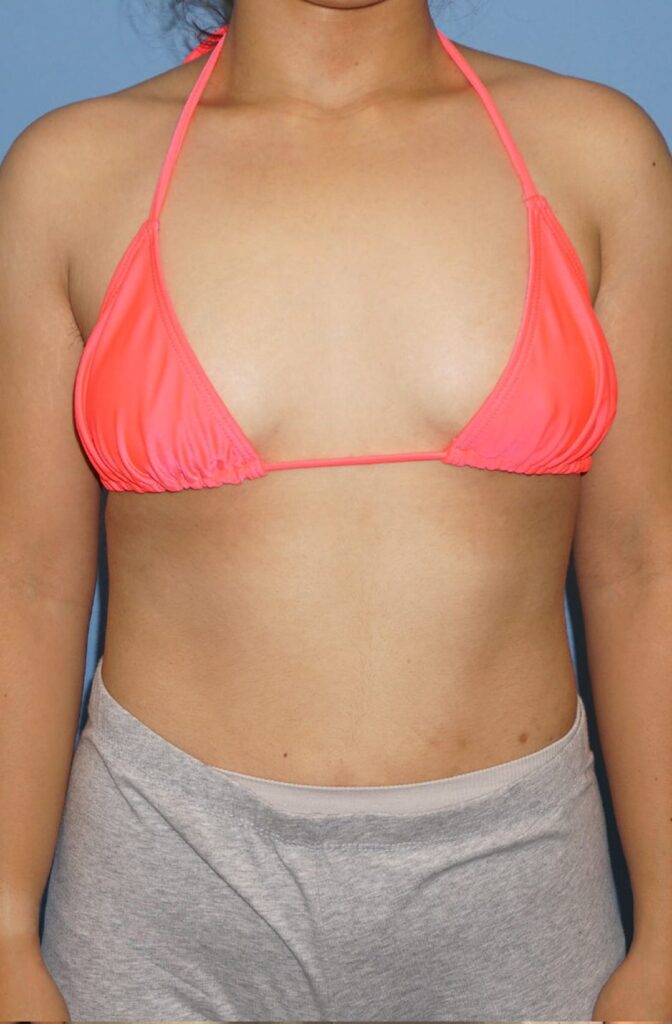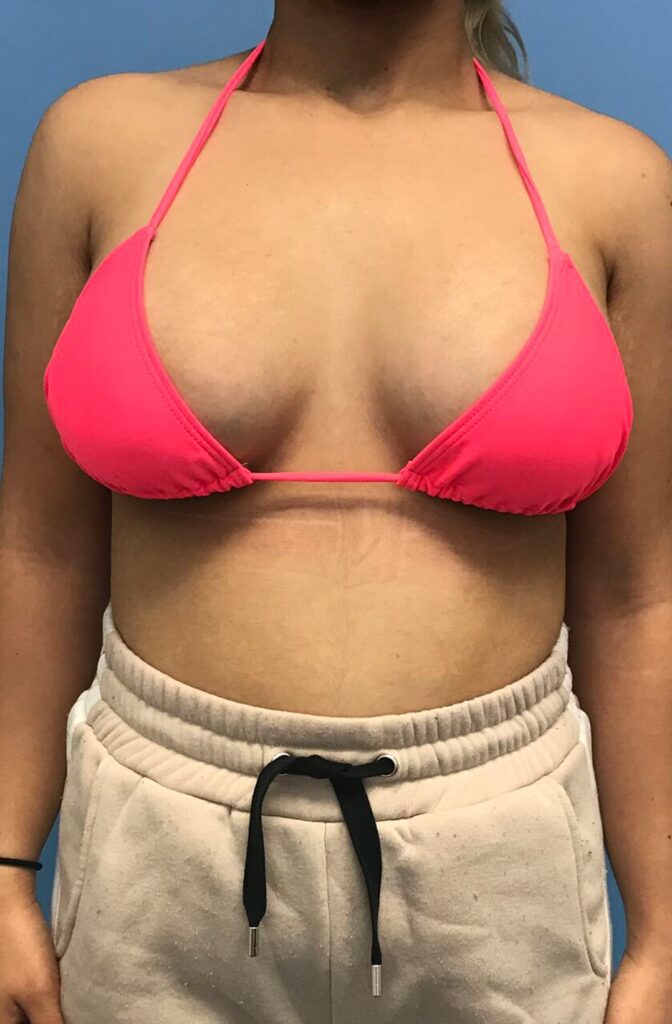


What is breast augmentation?
Breast augmentation, the surgery most people mean by "boob job", places a saline or silicone implant behind each breast to add volume, shape and fullness: for breasts that were always small for the frame, breasts that emptied after pregnancy, breastfeeding or weight loss, and uneven breasts, evened with a different implant on each side. Five decisions shape the operation, the filling, size, placement, incision and whether a lift belongs in the plan, and Dr. Cat makes each with you from measurements of your own chest, not from a chart.
What an implant does not do is lift. A nipple at the fold or below stays there on a larger breast, the "waterfall" look; that breast needs a breast lift, with or without implants, as our page on saggy or deflated breasts after breastfeeding explains.
Who is a good candidate for breast augmentation?
Most of Dr. Cat's patients are mothers whose breasts emptied after children, women with small breasts for their frame, and women with one side smaller than the other. Having had breast augmentation herself, she also asks how the implant will sit in your sport, your clothes and your family plans.
You may be a good candidate if
- You want more volume, upper fullness or cleavage, and your nipple sits at or above the breast fold
- At least three months have passed since you finished breastfeeding
- One breast is noticeably smaller, lower or a different shape than the other
- You are in good health, at a stable weight, and can stop nicotine as Dr. Cat specifies
- You are 18 or older for saline, 22 or older for silicone, the FDA-approved ages
- You accept that implants are not lifetime devices
Not yet, or a different plan, if
- Your nipple sits at or below the fold: an implant will not raise it, and you need a lift, alone or with implants (see breast lift vs augmentation)
- You want a subtle half-cup to one-cup increase with no device and have fat to spare: breast augmentation with fat transfer may serve you better
- You are still breastfeeding or planning a pregnancy soon
- You want a tummy tuck or a Brazilian butt lift the same day: Dr. Cat never combines either with a breast augmentation
Types of breast implants, placement and incisions


Saline breast implants
A saline implant is a silicone shell placed empty and filled with sterile salt water in the pocket, so the incision can be shorter and the fill adjusted on the table when the two sides differ. A leak is harmless and obvious: the breast deflates over a day or two and the body absorbs the salt water. Water does not behave like gel, so the implant feels firmer, sits rounder at the top and can ripple in a slim patient.
Silicone breast implants
A silicone implant is the same shell filled at the factory with cohesive gel that holds together even if the shell tears. It feels closest to breast tissue, drapes with a natural slope and ripples least, in round and teardrop shapes; the firmest gels are the "gummy bear" implants. A rupture can be silent, so the FDA recommends an ultrasound or MRI at five to six years and every two to three years after that, and Dr. Cat recommends exchanging silicone implants about every 8 to 10 years to reduce the chance of a leak. Dr. Cat recommends silicone for most patients and uses Mentor implants; our comparison of saline vs silicone implants goes through every point.
Implant size and profile
Implants are measured in cubic centimeters, not cups: every 150 to 200 cc adds about one cup, but the same 300 cc reads a full cup apart on two women with different chests. Dr. Cat calls the base diameter the most important measurement, because an implant wider than the footprint of your breast sits into the armpit or toward the middle and thins the tissue at its edges; she fits the width first and reaches the volume through the profile. Dr. Cat places implants tailored to each patient's anatomy and aesthetic preferences; they range from small "ballet breasts" at 175 cc to as full as 700 cc. An implant too large for your frame stretches the tissue, invites bottoming out and rippling, and is a common reason for a revision; her own view is that implants do not need to be big to add shape and femininity. Our guide to breast implant sizes has a cc chart by frame.
Over or under the muscle
The implant sits over the chest muscle (subglandular) or under it (submuscular). Over the muscle suits a patient with ample breast tissue to cover the implant, with an easier first week, but nothing softens the edge in a thin patient and capsular contracture is more common. Under the muscle is the placement Dr. Cat uses for most patients with thin tissue: when the pinch test over the upper breast is under about two centimeters, the muscle softens the implant's edge, hides rippling, reduces capsular contracture and makes mammograms easier to read, at the cost of a tighter first 72 hours and a longer settling.
The incision
Dr. Cat uses one of two incisions. The inframammary incision sits in the crease under the breast, hidden by the fold and away from the nipple; it is the usual route for a silicone implant, which goes in already filled. The periareolar incision follows the lower edge of the areola, hidden in the change of skin color; it suits a saline implant, filled after placement, and carries a small risk to nipple sensation. Armpit and belly-button incisions are not part of her technique. Either way the closure is precise and meticulous, in layers, for a scar you have to search for in her breast augmentation before and after photos.
How Dr. Cat does it

Dr. Cat is a board-certified plastic surgeon who completed two surgical residencies, one in head and neck surgery, microvascular and facial reconstructive surgery, and advanced training in general plastic and reconstructive surgery, Harvard-educated and UCLA trained. She has had breast augmentation herself, more than two decades ago, and gives her patients the care she wishes she had received. In her words: "As a woman, I understand the importance of using a meticulous technique to create precise symmetry and a thin, barely visible incision."
In the operating room, and home the same day
Surgery takes about three to four hours under general anesthesia with a board-certified physician anesthesiologist, with local anesthetic in the breast so you wake numb rather than sore, in Dr. Cat's QUAD A accredited surgery center on Rodeo Drive. She schedules that time for one patient rather than the hour many practices allot and performs every step herself. Where the two breasts differ, she tests different sizes before the final implants are placed, and she inserts each implant with a no-touch technique to minimize contamination. After one to two hours in recovery you go home with the person driving you, and someone stays the first 24 hours; no aftercare-facility night is needed. Dr. Cat sees you the day after surgery, and her gentle technique and the local anesthetic are why most patients manage the first days with Tylenol.

Combining breast augmentation with other procedures
Breast augmentation with a lift, and tuberous breasts
When the nipple has dropped and the volume has gone, a lift with implants in one operation is one of Dr. Cat's most requested combinations: she lifts and reshapes the tissue first, then places the implant; a big implant under an aggressive lift is safer in two steps. With a periareolar lift Dr. Cat's surgeon's fee is $30,000 to $35,000, with a full lift $55,000 to $65,500; see the breast augmentation with lift gallery. Tuberous breasts, constricted by tight internal fibers, get a double bubble from an implant alone; Dr. Cat's tuberous breast correction releases the fibers and adds a periareolar lift, with a surgeon's fee of $19,500 to $24,500.
Fat transfer instead of an implant
A patient who wants a subtle half-cup to one-cup increase with no device may be better served by natural breast augmentation with fat transfer, with a surgeon's fee of $56,500 to $63,500 including the lipo 360 harvest. It cannot produce a large or rounded change, and Dr. Cat does not combine an implant with fat transfer in the same operation. Our comparison of implants vs fat transfer sets out what each can do.
Mommy makeover: the breast surgery has its own day
In a mommy makeover, breast surgery has its own day, at least three months after you finish breastfeeding. A tummy tuck is never done on the same day as a breast augmentation with implants: after a tummy tuck you rely on your arms, after breast surgery on your core, and combining them makes recovery much harder. A Brazilian butt lift is never on the same day either; a labiaplasty can be combined with a breast augmentation.
Breast augmentation recovery timeline
Here is what recovery looks like for most of Dr. Cat's patients; for the long version, read our breast augmentation recovery guide, week by week.
- Surgery dayYou wake numb rather than sore, spend one to two hours in recovery in your surgical bra, and go home with the person driving you; someone stays 24 hours. Implants that look far too high are normal.
- Days one to threeTightness across the chest, more under the muscle, managed with Tylenol. Sleep on your back propped up, wear the bra day and night, and walk around the house often. First shower at about 48 hours.
- One weekOff pain medication and back at desk work with the arms kept close to the body; drive once off any prescription. Arms below shoulder height for two weeks, no lifting, no underwire.
- Two to four weeksDr. Cat checks the incisions at two weeks and starts silicone sheets, then scar gel. The implants begin to drop and most swelling is gone by a month. Lower-body cardio without arm swing from about week two to three.
- Six weeksThe restrictions end: all exercise, chest and shoulders included, a supportive wireless bra instead of the surgical bra, and side sleeping.
- Three to six monthsDrop and fluff: the lower breast rounds out, cleavage improves and the implants feel soft, later under the muscle than over it. Buy new bras at month four or five, not before.
- One yearThe scar has faded to a pale line and the result is the long-term one. From here: check-ups, the FDA screening scans for silicone, and a planned exchange about every 8 to 10 years.
Risks and safety
Every surgery carries risk, and an implant is a device with a device's obligations; Dr. Cat goes through the FDA's boxed warning at every implant consultation. What can happen and what she does to prevent it:
What can go wrong
- A hematoma in the first days (one breast suddenly larger, tighter and more painful) or an infection at the incision
- Capsular contracture: the scar capsule tightens until the breast turns firm, rides higher or looks distorted, most often in the first year
- Rupture: saline deflates over a day or two; a silicone rupture can be silent for years, hence the FDA screening scans
- Malposition: bottoming out, a double bubble, drift toward the armpits, or pockets that join in the middle
- Rippling or a visible edge, most common with saline, over-the-muscle placement and little tissue cover
- Changes in nipple sensation, usually temporary, and size regret, the most common reason for a revision that is not a complication
- BIA-ALCL, a rare lymphoma of the capsule tied almost entirely to textured implants, and the symptoms some women report as breast implant illness
- A blood clot in the leg, and anesthesia risks
How Dr. Cat reduces these risks
- Sizing by measurement: an implant no wider than the base of your breast, at a volume your tissue can carry for decades
- Under the muscle when the pinch test is under about two centimeters, which hides rippling and lowers the rate of capsular contracture
- Silicone for most patients and smooth round implants as the default, with the boxed warning and the screening and exchange schedules explained first
- A no-touch technique to minimize contamination, and sizes tested in the operating room before the final implants go in
- One surgeon for every step over three to four hours, a physician anesthesiologist for the whole case, a QUAD A accredited facility
- A meticulous layered closure and silicone scar care from two weeks, the surgical bra without an underwire, and follow-up visits from the day after surgery, then yearly
How much does breast augmentation cost in Beverly Hills?
Dr. Cat's surgeon's fee for a breast augmentation with implants is $17,500 to $22,500. The implants (Mentor; silicone costs more than saline), the operating room and the board-certified physician anesthesiologist are quoted at your consultation, once Dr. Cat has examined you and set the operating time your surgery needs: operating time varies with your anatomy and with the areas treated together, so it is set by her, not by a price list. Surgeon's fees are typical ranges: a more complex case can cost more, and your fee is set at your consultation and is final only in your written quote. The quote is itemized in writing and includes your surgical bra and your follow-up visits. Related surgeries, in surgeon's fees: augmentation with a periareolar lift $30,000 to $35,000 and with a full lift $55,000 to $65,500, a simple implant exchange $19,500 to $21,500, a revision with capsule work $60,000 to $75,500, and an explant with capsulectomy $19,500 to $23,500.
For context, the American Society of Plastic Surgeons puts the average surgeon's fee at $4,875, without anesthesia, the facility, the implants or follow-up, and most websites quote $6,000 to $15,000 all in; a cheap augmentation done poorly becomes a revision that costs more than the first surgery would have, so if the budget is not there yet, Dr. Cat's advice is to save and wait. Our breast augmentation cost guide explains what a quote is made of.
Consultation fee, insurance and financing
A consultation with Dr. Cat is $500, or $1,500 for a revision, credited in full toward your surgery. The practice partners with Cherry, its primary financing partner, and also accepts CareCredit and Alphaeon Credit; see financing and payment plans. Cosmetic breast augmentation is not covered by insurance; the silicone screening scans and a future exchange are real costs to plan for.

Breast revision and implant removal
Dr. Cat is sought after for breast revision, correcting implants placed elsewhere that have hardened, shifted, rippled or ruptured. Patients who want their implants out have breast explant surgery, in almost every case with the whole capsule removed. Our page on breast implant problems explains what each problem looks like; the revision consultation is $1,500, credited toward surgery.
Your consultation with Dr. Cat
It starts with a free 15-minute discovery call with our Patient Concierge, who books your consultation: in person on Rodeo Drive or, for out-of-town patients, a private video consultation through OnPatient, the HIPAA-secure patient portal, with the sizers tried in person before surgery. Dr. Cat measures you, examines the tissue and the skin, asks about pregnancy plans, sport and work, has you hold a saline and a silicone implant, and shows you the candidate sizes on your own frame with sizers in a bra under a fitted top. She tells you plainly whether you need a lift or whether fat transfer would serve you better, and you leave with a size, a profile, a placement, an incision plan and an itemized written quote.