
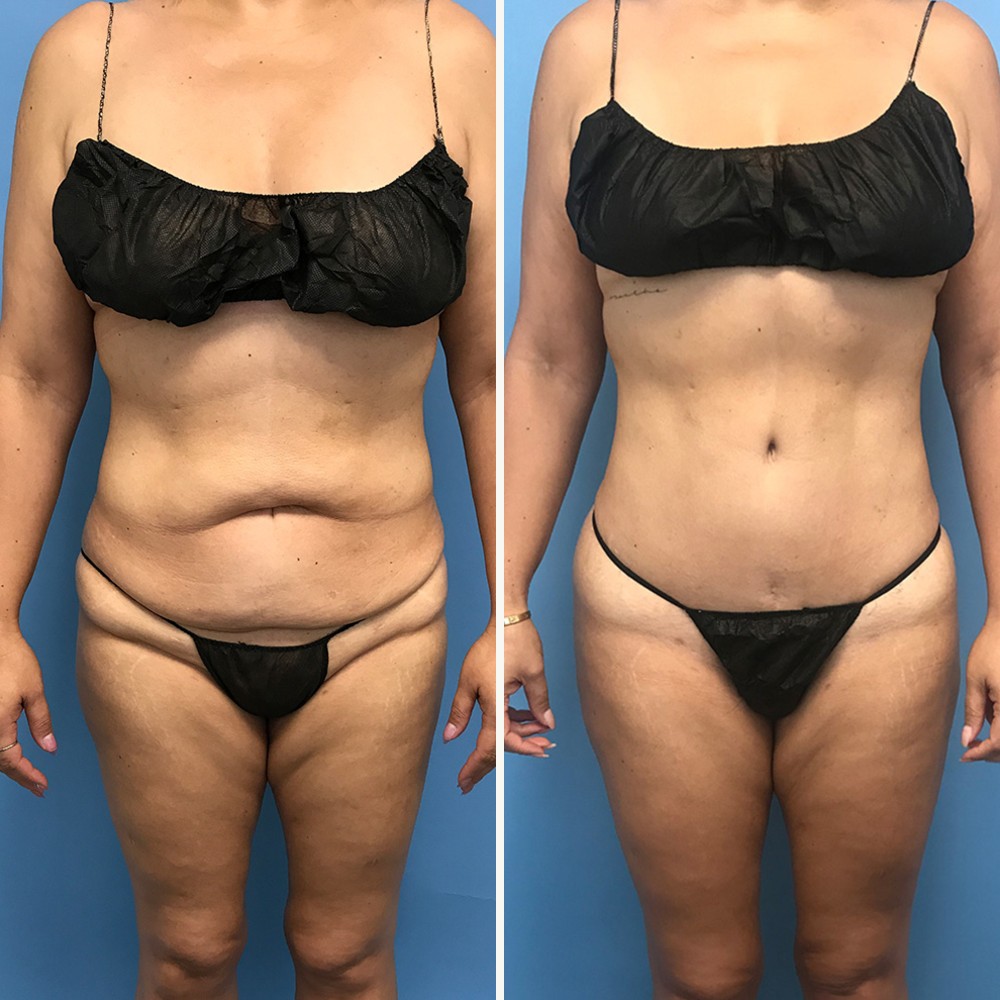
What is revision liposuction?
Revision liposuction is a second liposuction of an area already operated on. A first liposuction heals smooth only when the passes are even and a thin cushion of fat is left under the skin; done unevenly or too aggressively, it leaves asymmetries, irregularities, lumps or dents. A revision removes the fat left behind, releases the scar that pulls the skin down, blends the borders and grafts the depressions with your own fat. In Dr. Cat's words, it is an extremely challenging surgery that requires detailed pre-operative planning and meticulous technical skill.
Patients come to Dr. Cat from other practices across Los Angeles, from other states and from abroad to correct liposuction done elsewhere, from subtle contour irregularities to shelves of fat left behind and deep grooves adherent to the muscle. Many tell her they stopped wearing fitted clothes because the irregularities showed through. Our guide to liposuction gone wrong separates normal healing from a result that needs correcting.
What revision liposuction corrects
- Dents, divots and grooves where too much fat was removed
- Waves, ridges and cannula marks from uneven passes or aggressive cannulas
- A pocket of fat left behind, or a shelf at the border of the treated area, and asymmetry between the sides
- Lumps, fibrosis, and burns from heat devices
- Loose or crepey skin, and irregularities after a fat transfer or a non-surgical fat treatment
Who is a good candidate for revision liposuction?
The test is a healed result that is still dented, wavy, lumpy or asymmetric at six to twelve months.
You may be a good candidate if
- Your first liposuction was six to twelve months ago or longer and the dents, waves, pockets or asymmetry are still there
- The skin over the area still has some tone, and you have a little fat to spare for grafting
- Your weight is stable, you can stop nicotine for two months, and you expect a smoother contour, not a perfect one
Not yet, or a different plan, if
- Your first surgery was less than six months ago: swelling, firmness and uneven patches are normal while the tissue softens
- An incision is draining, fluid keeps collecting or there is fever: a complication is treated at once
- The skin itself hangs: that needs a revision tummy tuck for the abdomen or a thigh lift for the inner thighs
- Your weight is still changing; a GLP-1 medication such as semaglutide is stopped 1 to 2 weeks before surgery and resumed once healed, at 2 to 3 weeks
Liposuction irregularities Dr. Cat corrects
Liposuction irregularities come from a few repeatable mistakes, each with its own correction.
Dents, divots and grooves stuck to the muscle
Over-suctioning causes most of the bad liposuction Dr. Cat repairs: take too much and the skin sticks to the muscle underneath and heals as a dent, a groove or a fold. She releases the scar that tethers the skin with a custom-crafted instrument, so the dent can be lifted, then fills it with fat grafts and feathers the border so it blends in.
Waves, ridges and cannula marks
A wavy surface comes from passes uneven in depth or spacing; ridges and cannula tracks from large, aggressive cannulas and from working too close to the skin. Dr. Cat removes the high points with a thin cannula, grafts the low points and blends each area into the next.
The pocket and the shelf: fat left behind
Under-resection leaves the bulge the patient paid to remove: residual fat of the abdomen, a chunk around the belly button, or an area never reached. A shelf is its border form, a step where suction stopped without blending. Both are corrected the way a first liposuction should have been done: the fat removed gently with a thin cannula, every stroke counted on a precise grid, and the borders blended so there is no edge.
Lumps, fibrosis and burns
Large cannulas cause fibrosis and scar tissue, and heat devices such as laser lipo leave burns and scarred skin; both heal as firm lumps or stuck-down areas. Dr. Cat breaks up the fibrous tissue, removes the lumps and grafts the thinned areas; burned skin is improved, not restored.
Fat grafting: how a dent is filled
Removed fat cannot be put back except with your own fat from somewhere else. Dr. Cat harvests it from an area with a little to spare, washes it gently, and places it under the dent in many fine passes, so each deposit can take a blood supply. In Dr. Cat's experience more than 80 to 90 percent of the transferred fat survives. Fat grafted into scarred ground takes less reliably, so she grafts in fine passes rather than pools, protects the grafted areas with foam under the garment, and plans a second session when a correction is large. Fat to spare can go to the buttocks or the hips in the same surgery.
Loose skin after lipo, and skin tightening after liposuction
Liposuction removes fat and does nothing to skin, which has to tighten around the emptied area over four to six months. Skin that has lost its elasticity, or was emptied too aggressively, hangs or crepes over the new contour, and more liposuction makes it looser. The correction is then excision: a revision tummy tuck for the abdomen, staged on its own day, or a thigh lift for the inner thighs. Mild laxity over a smoothed area is treated once healed with ThermiSmooth Body, the practice's in-office radiofrequency skin tightening; read more on loose skin after lipo.
Revision after a non-surgical fat treatment or a Brazilian butt lift
Non-surgical fat reduction can leave the same dents and lumps as bad liposuction. Dr. Cat has performed many revisions after CoolSculpting, which the practice does not offer, and after other devices that create scar and irregularities in the tissue.
After a Brazilian butt lift done elsewhere, the complaints are a shelf where the lower back meets the buttock, dents in the donor areas, and one side higher than the other. Dr. Cat corrects the donor areas and the buttock in the same revision with your own fat; she does not place buttock implants or inject filler into the buttocks. Our page on a botched BBL separates the problems that can wait from the emergencies.
What revision liposuction cannot do
Dr. Cat is direct about the limits before surgery, not after. Removed fat is replaced only by grafting, which takes less reliably in scarred tissue, so a deep groove improves over one or two sessions rather than disappearing. Skin burned by a heat device or stretched past its elasticity is improved, not restored, and some irregularities soften but do not vanish. A revision through scar tissue is a longer operation than a first liposuction, although most of her patients tell her it was much less uncomfortable.
When to have revision liposuction
At least six to twelve months after the first surgery, once the swelling has settled and the scar tissue has softened; a revision planned earlier corrects a contour that is still changing, and Dr. Cat checks the healing before she sets a date. Avoid massage devices meanwhile; they can worsen irregularities in scarred tissue. An infection, a fluid collection or an open incision is treated at once.
How Dr. Cat does it
Dr. Cat is a board-certified plastic surgeon who completed two surgical residencies, one in head and neck surgery, microvascular and facial reconstructive surgery, and advanced training in general plastic and reconstructive surgery, Harvard-educated and UCLA trained. Revision liposuction cannot be approached like a first liposuction because of the scar tissue, and she has developed a multi-phase technique for it.
Planning: the operative report, the photographs and the markings
The consultation is private and conducted by Dr. Cat herself. She asks for the operative report from your first surgery, examines every area, and tells you what can be repaired and what can only be improved. On the morning of surgery she marks a detailed plan built on the dents, the irregularities and the pre-existing scarring.
The technique: scar release, blending and grafting
After the areas are numbed with a tumescent solution, Dr. Cat uses a custom-crafted instrument to break up the scar tissue and the irregularities and to obtain the fat grafts. The incisions are under 4 mm, reusing the ones from your first surgery wherever possible. With a thin cannula, lumps and shelves are gently removed and blended into the surrounding areas; dents are lifted and fat grafted; asymmetries are corrected by removing from the fuller side, grafting the flatter one, or both. She never uses laser, Vaser or other heat devices, leaves a thin cushion of fat under the skin, and performs every pass herself.
Anesthesia, surgery day and the first night
The surgery is performed under general anesthesia with a board-certified physician anesthesiologist in Dr. Cat's QUAD A accredited surgery center on Rodeo Drive, several hours for a typical revision with fat grafting, depending on how many areas are revised, with the time for your plan set at your consultation; the operating room is booked for longer than the surgery itself, for anesthesia, positioning and the garment. Dr. Cat schedules one major surgery per surgical day; this is not a liposuction factory. A compression garment with foam over the grafted areas goes on at the end of the surgery, the sutures dissolve on their own, and the first night is spent in a plastic surgery aftercare center with a nurse, with gurney transport from the surgery center.
Preparing for surgery
Dr. Cat's team gives you the pre-operative instructions: medical clearance and lab tests, no nicotine for two months, the medications, supplements and alcohol to stop two weeks before, nothing to eat or drink after midnight, and someone to drive you and stay with you after the aftercare night.
 Revision liposuction with fat grafting and scar release: Dr. Cat in the operating room
Real surgical footage, shown with the patient's consent.
Revision liposuction recovery, week by week
Recovery from revision liposuction is, in Dr. Cat's words, relatively easy. Our post on why she says no to lymphatic massage explains what replaces it.
- The night of surgeryOnce you are comfortable you go by gurney to a plastic surgery aftercare center, where a nurse gets you up to walk that evening. Tylenol for most patients.
- Day oneHome from the aftercare center with someone to stay with you. Walk a few minutes every couple of hours, keep the garment on, keep salt low.
- The first weekSwelling and some bruising are normal. Many patients return to desk work within a few days. No massage of any kind.
- Two to three weeksBruising fades and the dissolvable sutures come away on their own. Longer walks, then light cardio such as a stationary bike.
- Four to six weeksFull exercise once Dr. Cat clears you; the garment and foam come off at six weeks.
- Three to six monthsThe grafted fat that will survive has survived by about three months, the contours refine and the skin settles. A second session, when planned, is scheduled from here.
Revision liposuction before and after: what to look for
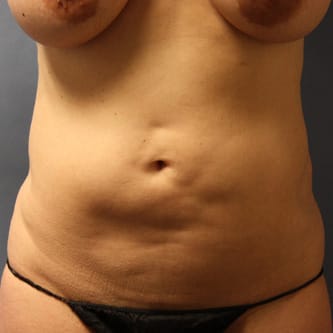
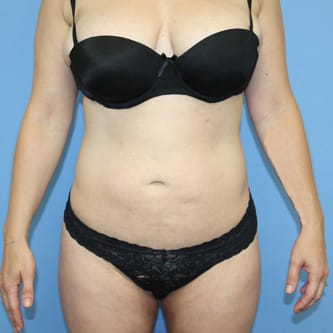
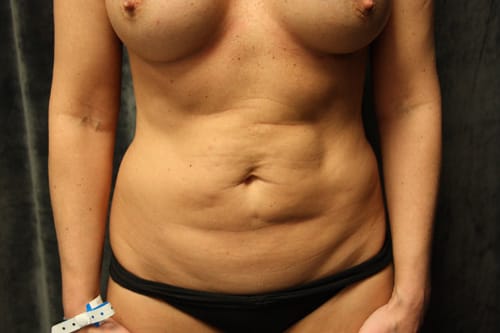
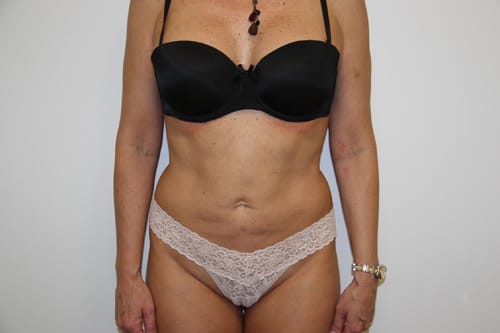
In revision liposuction before and after photos, look at the surface in side light: a good revision reads as one smooth plane into the untreated areas, with no edge, shelf or line where the grafts sit, in an after photo taken at six months or later. Every case on this page is a revision of liposuction done elsewhere: deep indentations and cannula marks grafted smooth (RLP-0763, RLP-0537 in two sessions, RLP-2633 on the calves, RLP-2665, and RLP-2625 with a dent down to the bone); fat left behind removed and dents grafted (RLP-2682, RLP-2641, and RLP-0325 with mons liposuction); fat transfer to the buttocks and hips with the revision (RLP-0343, RLP-0601); and revisions staged with a tummy tuck (RLP-0418, and RLP-0693 with a pubic lift). See the revision liposuction before and after photos for the starting point closest to yours.
Risks of revision liposuction, and how Dr. Cat reduces them
A revision carries the risks of any liposuction plus the ones scar tissue and grafting add.
What can go wrong
- Bleeding, a hematoma or a seroma (a fluid collection), and infection
- A new irregularity, asymmetry, loose skin or a dent that persists, when the correction is limited by what the first surgery left
- Grafted fat that does not take, or a firm lump or oil cyst where a graft was too large
- Skin or fat necrosis in scarred tissue, numbness, blood clots and anesthesia reactions, all rare
How Dr. Cat reduces these risks
- Timing: at least six to twelve months after the first surgery
- A detailed plan from the operative report and every dent and shelf, and a frank estimate of what can be repaired
- Every pass by Dr. Cat with thin cannulas and no heat devices, the scar released first, a thin cushion of fat left under the skin
- Fat grafted in fine passes rather than pools, protected by foam, with a second session planned when a correction is large
- A physician anesthesiologist in her QUAD A accredited surgery center, one major surgery that day, the first night with a nurse, and follow-up visits
How much does liposuction revision cost in Beverly Hills?
Dr. Cat's surgeon's fee for revision liposuction with fat grafting is $60,500 to $95,000; the operating room and anesthesia are quoted at your consultation, because the operating time depends on your anatomy and on what is treated together. Surgeon's fees are typical ranges: a more complex case can cost more, and your fee is set at your consultation and is final only in your written quote. Her rule is plain: the fee starts at $60,500 regardless of how many areas are treated, because every area has scar tissue to release, uneven planes to blend and fat to graft, and more complex cases run higher.
The quote is itemized: the surgeon's fee, the operating room and anesthesiologist, the aftercare night, your compression garment, the cannula fee and Arnica, a BBL pillow when fat goes to the buttocks and a second garment when the arms are treated, all quoted at your consultation, and every follow-up visit. It is valid for six months.
The price reflects one surgeon who releases the scar, removes the lumps and grafts the dents herself, one major surgery per surgical day, a physician anesthesiologist and an accredited facility. Our liposuction cost guide explains what a quote is made of; insurance does not cover a revision.
Consultation fee, deposit and financing
A revision consultation with Dr. Cat is $1,500, credited in full toward your surgery. Your date is booked once the quote and the pre-op paperwork are signed and the $2,500 deposit is paid. To pay over time, the practice partners with Cherry, its primary financing partner, and also accepts CareCredit and Alphaeon Credit; see financing and payment plans.
Your revision consultation with Dr. Cat
It starts with a free 15-minute discovery call with our Patient Concierge, who books your consultation: in person on Rodeo Drive or, for out-of-town patients, a private video consultation through OnPatient, the HIPAA-secure patient portal. Bring your operative report and photographs from before the first surgery if you have them; for a video consultation, send photographs of every problem area in good lighting. Dr. Cat tells you what can and cannot be corrected, and you leave with an itemized written quote. Patients who travel stay in town until she clears them to fly.