

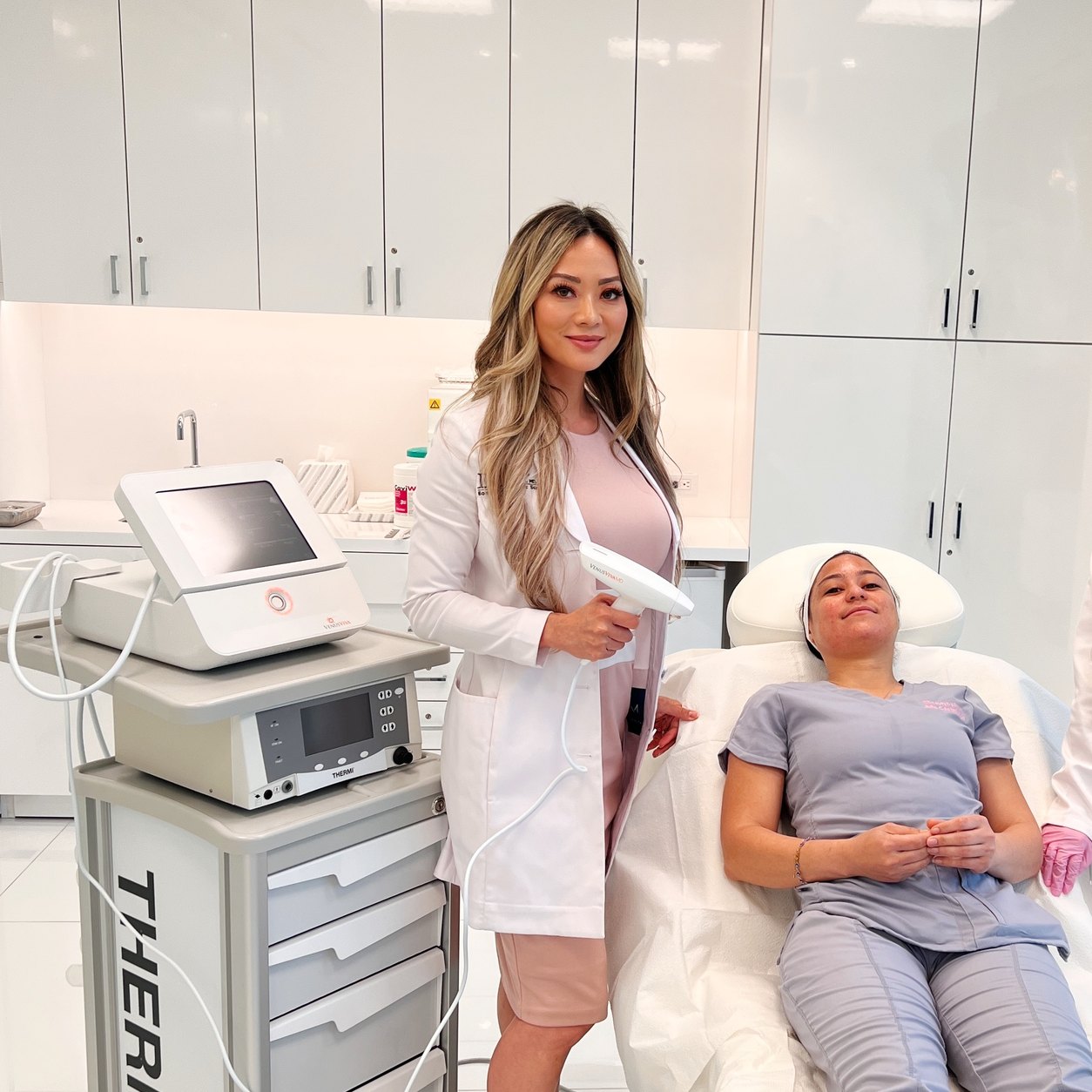
What is Venus Viva MD?
Venus Viva MD is a non-surgical skin resurfacing treatment. A handpiece with a tip of tiny pins is pressed onto the skin, and each pin delivers a burst of radiofrequency energy that heats a tiny column of tissue and creates a tiny wound at the surface, while the skin between the columns is left untouched. The untouched skin heals the treated columns within a day or two, and the heat below the surface prompts the skin to rebuild collagen and elastin over the weeks that follow, so texture smooths, scars flatten, pores tighten and pigment evens out. It is the treatment for the problems that sit in the surface of the skin, the ones that heat alone cannot fix: the manufacturer, Venus Concept, calls the technology NanoFractional Radio Frequency.
The device is used on the face, the neck, the eyes and forehead, and on the body for stretch marks. Because the energy is radiofrequency rather than light, it does not depend on the color of the skin the way a laser does, which is why Venus Viva MD is used on every skin tone and type, from very fair to deeply pigmented, and on normal, dry, oily, combination and sensitive skin, with the settings adjusted to each.
Skin that is loose rather than rough is a different problem. ThermiSmooth Face tightens mildly loose skin with a warm handpiece and no wound at all, and our post on skin resurfacing versus skin tightening draws the line between the two.
What Venus Viva MD treats
Venus Viva MD skin resurfacing is used for the surface problems that creams, peels and facials keep failing to shift:
- Acne scars and other scars. The resurfacing columns break up the tethered, pitted texture of old acne scarring and soften surgical and traumatic scars over a series of treatments.
- Fine lines and wrinkles. The new collagen plumps and smooths the fine lines of the cheeks, around the mouth and eyes, and on the neck; deep folds and movement lines are not resurfacing problems.
- Rough texture and enlarged pores. The surface is remodeled and the pores tighten, so the skin reads as smoother and more even, with or without makeup.
- Hyperpigmentation, sun damage and dark spots. The treated columns shed pigment-laden surface skin and the tone evens over the series.
- Rosacea and redness. Diffuse redness and the roughness that comes with rosacea can calm over a course, which is discussed at your consultation because active rosacea needs a plan.
- Stretch marks. On the body, the same columns treat the texture and color of stretch marks on the abdomen, hips, thighs and breasts, an area at a time.
- Uneven surface over cellulite. The surface texture can be smoothed; the dimpling itself is a structural problem beneath the skin, which our cellulite guide explains, so expectations are set at the consultation.
How radiofrequency skin resurfacing works
Radiofrequency skin resurfacing (also written RF skin resurfacing, or fractional RF resurfacing) is the ablative cousin of radiofrequency skin tightening. Where tightening heats the deeper layer through an unbroken surface, resurfacing deliberately opens the surface in a pattern of tiny columns and heats the tissue around each, which does two things at once: the surface is renewed as the columns heal, and the collagen beneath is rebuilt as the heat is repaired. The word fractional means only a fraction of the skin is treated at each session, which is what keeps the recovery to a day or two.
The Venus Viva MD tip carries the pins in a fixed pattern, and the device varies the depth and the energy of each pulse, so the same handpiece treats thin skin around the eyes gently and thick scarred skin on the cheek more deeply. The change builds over a series, and the number of treatments for your skin is set at your consultation.
The limit is as plain as the mechanism. Resurfacing renews the surface and rebuilds collagen; it does not lift tissue that has descended and it does not remove skin. A jowl, a heavy neck fold or a hood over the upper lid is beyond what any device can do, and the practice tells you so before a session is booked: the facelift and the eyelid lift exist for those.
Is Venus Viva a laser?
No. Venus Viva is not a laser, although it is often searched for as the Venus Viva laser because it does what people expect a laser to do. A resurfacing laser such as CO2 or erbium delivers light, which is absorbed by the water in the skin and vaporizes tissue; its energy is also absorbed by pigment, which is why deep laser resurfacing carries a risk of dark or light patches in darker skin. Venus Viva delivers radiofrequency, an electrical current that heats tissue through resistance regardless of its color, so it is used across every skin tone with a lower risk of pigment change and a shorter recovery than a deep laser peel.
The trade is depth per session. A full-field CO2 laser resurfaces more in one visit, at the cost of a week or more of raw, weeping skin; Venus Viva MD resurfaces in a series, a day or two of redness at a time. CO2 laser resurfacing is available at the practice through our board-certified facial plastic surgeon; the consultation matches the depth of the problem to the treatment.
Venus Viva vs microneedling and Morpheus8
Venus Viva vs microneedling is the most common question at the consultation, and the answer turns on what does the work. Plain microneedling rolls or stamps fine needles into the skin to trigger a healing response, with no energy; it improves texture modestly and needs many sessions. RF microneedling, of which Morpheus8 is the best-known brand, inserts insulated needles to a set depth and releases radiofrequency at the tip, heating the deeper layer to tighten and remodel it while the surface is barely touched. Venus Viva MD does the opposite: the energy enters at the surface through the pins and treats the surface and the layer just beneath it, which is where scars, pores, pigment and fine lines live.
So Venus Viva and Morpheus8 are not the same treatment, and neither replaces the other. For rough texture, acne scarring, enlarged pores, sun damage and fine lines, resurfacing with Venus Viva MD is the fit. For laxity of the lower face and neck and for deeper remodeling, a needle-based radiofrequency treatment or ThermiSmooth is the fit, and for a fold that stays when pinched, a lift. Some patients need two of the three, in sequence; the plan is set from the skin, not the brochure.
What happens during a Venus Viva MD treatment
A Venus Viva MD session takes place in a treatment room in the office at 421 N. Rodeo Drive, Beverly Hills, and is performed by one of the practice's surgeons or nurses. Before your first treatment a small patch test is performed, so the settings for your skin are known and your skin's response is seen before a full area is treated. Your appointment, including preparation and the consent forms, runs about 60 to 90 minutes; the treatment itself takes about an hour for the face, 45 minutes for the neck or the eyes and forehead, about 90 minutes for the face and neck together, and about 30 minutes per body area.
The skin is cleansed, and the handpiece is applied in overlapping passes across the area. You feel heat and a prickling, stinging sensation with each pulse, stronger over bony areas and scars, that fades as soon as the pass moves on; the settings are adjusted to your skin and your comfort. Afterward the skin is red and warm, like a sunburn, and your aftercare instructions and sunscreen guidance come with you.
Preparation is short. Arrive with clean skin and no makeup, stop retinoids, acids and other active skincare for the days before as instructed, avoid tanning and sunburn in the weeks before, and tell the staff about any implant, pregnancy, skin condition or medication.
Venus Viva MD before and after: what changes over a series
Venus Viva before and after photographs are read over a series, not after one visit. The redness of the first day gives way to a slightly dry, sandpaper-textured surface as the treated columns shed over the next few days, and the skin underneath is smoother once it has. The collagen change follows over the weeks after each session, so the fair comparison is a photograph before the first treatment against one a few months after the last. Look at the texture in raking light, the depth of acne scars on the cheek, the size of the pores across the nose and cheeks, the evenness of the tone, and the fine lines around the mouth.
The practice's public gallery holds no Venus Viva cases, so before and after photographs of the practice's own Venus Viva MD patients are shown at your consultation. Patient reviews of the practice are on Google; read them on our patient reviews page.
Recovery after Venus Viva MD
There is no real downtime, but there is a day you will want to plan around: the skin is red and warm like a sunburn for the rest of the day and usually settles within 24 hours, then feels dry or slightly rough for a few days as the treated columns shed. Makeup goes back on once the surface has closed, usually the next day or the day after, and most patients are back at work the next morning.
- The consultation and patch testYour skin is examined, the concern is named (scars, texture, pores, pigment, redness, stretch marks), the areas are chosen and the series is priced from the published list. A patch test comes before the first full treatment.
- The days beforeStop active skincare (retinoids, acids) as instructed, no tanning or sunburn, arrive with clean skin and no makeup.
- Treatment dayAbout an hour for the face. Heat and prickling during the passes; red and warm, like a sunburn, afterward. Your aftercare instructions and sunscreen guidance come with you.
- Days one to threeRedness settles, usually within 24 hours; the surface feels dry and slightly rough as the treated columns shed. Gentle cleanser, moisturizer, sunscreen, no scrubbing, no actives.
- The next sessionSessions are spaced weeks apart, so the surface has healed and the collagen response has begun before the next; the interval for your skin is set at the consultation.
- The months after the seriesSmoother texture, softer scars, tighter pores and a more even tone as the collagen matures, judged against your first photographs a few months after the last session.
- MaintenanceResults are long-lasting, not permanent; a maintenance treatment when the skin asks for it, daily sunscreen and a consistent routine extend them.
Risks and who should wait
Venus Viva MD makes a controlled, fractional wound; its risks are those of a wound and of the energy.
What can go wrong
- Redness, warmth and swelling for a day, dryness and flaking for a few days
- Small crusts or pinpoint marks that last longer than expected
- A patch of darker or lighter pigment, rare with radiofrequency and reduced by the patch test and sun avoidance
- A flare of acne, cold sores or rosacea in the treated area
- Infection of the healing surface, rare with clean aftercare
- Interference with an implanted electronic or medical device
- A change milder than hoped, when the problem was deeper than the surface
How the practice reduces these risks
- A patch test before the first treatment, so your skin's response is seen before a full area is treated
- Settings adjusted to your skin type and tone rather than one setting for everyone
- Screening for pacemakers, AICDs, defibrillators, mechanical heart valves, neurostimulators, IUDs and cochlear implants, for pregnancy, for active skin infection and for skin conditions
- A history of cold sores told to the staff before the first session, and no treatment over active acne or a rash
- Written aftercare: gentle cleanser, moisturizer, daily sunscreen, no actives and no sun until the surface has healed
- A plastic surgeon's assessment of whether resurfacing is the right treatment at all
Who is a good candidate for Venus Viva MD?
The right candidate has a surface problem, in any skin tone, and wants a real change without a week of downtime.
You may be a good candidate if
- You have acne scars, surgical scars, rough texture, enlarged pores, fine lines, sun damage, uneven tone or redness on the face or neck, or stretch marks on the body
- Your skin is any tone or type, including darker skin for which deep laser resurfacing carries more risk
- You want a series of short treatments with a day of redness rather than one deep peel with a week of recovery
- You can commit to a series, to sun protection and to a simple routine between sessions
- You expect smoother, more even skin rather than a lift
Not yet, or a different plan, if
- You have a pacemaker, an AICD, a defibrillator or a mechanical heart valve, or a neurostimulator, an IUD or a cochlear implant
- You are, or may be, pregnant
- You have an active infection, active acne, a cold sore or a rash in the area to be treated, or a tan or sunburn
- Jowls, a neck fold that stays when pinched or a hood of skin over the upper lid is the complaint: those need a lift
- Loose but smooth skin is the complaint: ThermiSmooth or a needle-based radiofrequency treatment fits better
Venus Viva MD for the neck and for stretch marks
The neck is treated on its own or in the same session as the face. Crepey texture, sun damage and fine horizontal lines respond to resurfacing; a neck that has become loose responds better to tightening, and a fold or two cords that show when you clench your teeth is skin and muscle. Our comparison of neck tightening treatments rates ThermiSmooth for mild excess neck skin, Venus Viva MD for mild to moderate, and a neck lift for anything more, and our page on turkey neck explains the difference.
On the body, Venus Viva MD treats stretch marks an area at a time, an area being about the size of a sheet of notebook paper: the abdomen after pregnancy, the hips and thighs, the breasts. The treated columns remodel the thinned, striped skin of the mark so its texture smooths and its color blends over a series, in about 30 minutes per area. The marks are not erased; they are made much less visible, which is the honest promise of any stretch mark treatment.
How much does Venus Viva MD cost in Beverly Hills?
Venus Viva MD costs $3,500 per treatment for the face at Dr. Cat Plastic Surgery, or $10,000 for a package of three, the prices on the practice's published non-surgical price list. The neck is $2,500 per treatment or $7,000 for three, the face and neck together $4,000 or $11,500, and the eyes and forehead $2,500 or $7,000. For stretch marks on the body, the first area is $2,500 per treatment or $7,000 for three, and each additional area in the same session is $1,500. The number of sessions in your plan and the interval between them are set at your consultation, and a patch test comes before the first treatment.
Venus Viva treatments are paid in full when you schedule. Reschedule or cancel at least four weeks ahead and there is no charge; inside four weeks the full fee of the treatment is charged. The same price applies to every patient; what you pay depends on the areas in your plan.
Insurance and financing
Venus Viva MD is a cosmetic treatment and is not covered by insurance. Packages can be financed through Cherry, the practice's primary financing partner, and for smaller non-surgical treatments Cherry Pay in 4 may be available on the day of treatment, up to $3,000; see financing and payment plans.
After Venus Viva MD: skincare that protects the result
Resurfaced skin is new skin, and what you put on it in the weeks after decides how long the result lasts. Daily broad-spectrum sunscreen is the one non-negotiable, because sun exposure undoes pigment work and ages the new collagen; a gentle cleanser and a good moisturizer carry the skin through the dry days, and the retinoids and acids come back once the surface has healed, on the schedule you are given. Dr. Cat developed her own skincare line, MD Glam, and the products that pair with resurfacing are recommended at your visit; none of them is required.
Movement lines and lost volume are the two things resurfacing leaves alone. Botox treats the lines that appear when you frown or squint, fillers restore volume, and both are combined with a Venus Viva series when the face needs all three.
Your consultation and first treatment
It starts with a free 15-minute discovery call with our Patient Concierge, who answers your first questions and books your consultation in the Beverly Hills office at 421 N. Rodeo Drive, a short drive from anywhere in Los Angeles. There your skin is examined under the practice's rule for every energy treatment: the problem in the skin decides the treatment, resurfacing for the surface, tightening for laxity, a lift for a fold, and if a different treatment would serve you better, you are told so. Out-of-town patients consult first by private video consultation through OnPatient, the HIPAA-secure patient portal.

