

What is body contouring surgery after weight loss?
Body contouring surgery, also called body sculpting, is the group of operations that remove loose skin and excess fat and reshape what remains. After a large weight loss, through bariatric surgery, a GLP-1 medication or diet and exercise, the fat is gone but the skin that grew to hold it is not: stretched for years, it has lost its collagen and elastin and cannot shrink back. Most people who lose more than 100 pounds are left with excess skin. Body contouring after weight loss removes it, area by area; the every body procedure Dr. Cat performs page lists each operation on its own, and this page covers how she plans them for the patient who has lost a lot of weight.
Loose skin after weight loss shows in the same places: an apron over the waistband (a pannus), rolls around the flanks, inner thighs that rub, a mons that hangs below a flat belly, breasts that have emptied and dropped, flattened buttocks, and upper arms that hang when raised. Our page on apron belly and loose skin covers the abdomen, and our post on the face after rapid weight loss covers the face.
Creams, compression and exercise do not shorten skin stretched past its elastic limit, and skin-tightening devices firm mild laxity but cannot lift skin that hangs; only skin removal surgery does, and every one of these operations leaves a scar, which is why Dr. Cat spends as much care on where the scar sits as on what is removed.
Who is a good candidate for body contouring after weight loss?
The first requirement is a finished weight loss. Dr. Cat asks weight-loss patients to reach a stable weight and hold it for months, within 10 to 15 pounds of their goal and with a BMI of about 30 or less, because skin tightened now loosens again if more weight comes off later, and a BMI well above 30 raises the risks of anesthesia and wound healing. Her post on the BMI requirement for plastic surgery explains the rule; exceptions are decided at the consultation.
You may be a good candidate if
- You have lost a large amount of weight, through bariatric surgery, medication or diet, and are left with skin that hangs, folds or rubs
- Your weight has been stable for months, within 10 to 15 pounds of your goal, with a BMI of about 30 or less
- You are in good health, with medical clearance and lab work, and any diabetes well controlled
- You accept scars in exchange for skin that no longer hangs, one recovery at a time
Not yet, or a different plan, if
- Your weight is still coming down, or you are planning a pregnancy, which will stretch the muscle repair and the skin
- Your BMI is well above 30, or a medical condition is not yet controlled
- You use nicotine and cannot stop for at least two months before surgery: every long incision depends on the blood supply nicotine restricts
- Your skin still snaps back and the problem is firm fat: a liposuction plan, not skin removal
The pre-op instructions stop smoking two months before surgery and aspirin, anti-inflammatories, herbal medications, vitamins, diet pills and alcohol two weeks before. If you take a GLP-1 medication, Dr. Cat's rule is to stop it one to two weeks before surgery and to resume it only once you have healed, at two to three weeks; it slows stomach emptying, so tell us at the discovery call and your anesthesiologist plans around it.
The body contouring procedures Dr. Cat uses after weight loss
Tummy tuck and extended tummy tuck
The abdomen is where weight loss shows most, and a tummy tuck treats it: the loose skin between the navel and the pubic line is removed through a low incision hidden under a bikini bottom, the separated muscles are repaired with a double-layer repair, and the belly button is rebuilt as her signature natural innie. After a large weight loss the loose skin rarely stops at the hips, so most weight-loss patients need an extended tummy tuck, whose incision continues past the hip bones toward the back so the sides are tightened with the front, with the muscle repair included. A mini tummy tuck is almost never the right operation after a large loss.
When the excess runs side to side as well as top to bottom, usually after a loss of 100 pounds or more, a fleur-de-lis tummy tuck adds a vertical incision up the midline, at the price of an anchor-shaped scar; the pinch test at the consultation decides. A panniculectomy removes the hanging apron alone, with no muscle repair; our post on a panniculectomy compared with a tummy tuck explains when each is right.
Liposuction and lipo 360
Liposuction removes fat and nothing else, so after weight loss its role is supporting: conservative liposuction of the love handles or the mons added to a tummy tuck, and firm pockets that survived the loss treated on their own day, every pass by Dr. Cat with no heat devices. Lipo 360, the seven areas of the trunk in one surgery, suits skin that still snaps back, and is never done the same day as a tummy tuck, because the blood supply to the lifted abdominal skin runs through that fat. Our comparison of a tummy tuck and liposuction explains the pinch test that decides.
Thigh lift
Loose skin of the inner thighs rubs with every step, and no training removes it. A thigh lift pulls the inner thigh skin upward and inward and removes the excess: the front of the incision hides in the groin crease and a vertical part runs down the inner thigh just behind the midline, so it is barely visible from the front or the back. Liposuction of the inner thigh comes first when fat needs to come out too. Many of Dr. Cat's thigh lift patients have lost 70 pounds or more; the thigh lift has its own day, with the first night in a plastic surgery aftercare center.
Pubic lift and mons liposuction
The mons pubis usually hangs after weight loss, and a tummy tuck done elsewhere without treating it leaves a tight belly with a mons drooping below it, so Dr. Cat assesses the mons at every body consultation. A pubic lift (monsplasty) lifts the tissue through the tummy tuck incision, removes the excess skin and secures the deep tissue, never so far that the hairline sits too high; when fat remains, liposuction of the mons thins it first, in the same surgery.
Breast lift, with or without implants
Breasts often empty before anything else: the gland shrinks, the envelope does not, and the nipple drops to the fold or below it. A breast lift removes the stretched skin, reshapes what remains and moves the nipple and areola back to the front of the breast on their own blood supply; after a lot of skin loss the anchor pattern takes up the slack. A lift adds no volume, so when the breast has emptied as well as dropped, Dr. Cat places a Mentor implant in the same surgery, after the lift; our page on saggy or deflated breasts explains how the nipple position decides. Breast surgery has its own day.
Fat transfer to the buttocks and hips
Buttocks flatten with weight loss and the hips can hollow. When there is fat to harvest, Dr. Cat moves it: a Brazilian butt lift is lipo 360 with the fat placed in the buttocks and hips in fine layers above the muscle, and for a slim frame she plans a skinny BBL, a little from every usable pocket, placed for shape. In Dr. Cat's experience more than 80 to 90 percent of the transferred fat survives, which is why her patients rarely need a second round. Fat transfer to the hips alone treats hip dips. It cannot remove loose skin: a buttock that hangs needs a buttock lift, which Dr. Cat does not perform, and she places no buttock implants or filler.
The arms
Dr. Cat does not perform arm lifts (brachioplasty). After a large weight loss the upper arms usually hang because the skin has lost its recoil, and only an arm lift removes that skin; liposuction there would leave the fold emptier. A full but firm arm is an arm liposuction case, and ThermiSmooth Body can firm early, mild laxity. Our page on saggy arms shows the pinch test, and Dr. Cat tells you at the consultation when an arm lift is what your arms need.
How Dr. Cat plans and stages the surgeries
Dr. Cat schedules one major surgery per surgical day and performs every step of each one herself. A body after major weight loss usually needs two or three of the surgeries above, and she stages them rather than stacking them: a tummy tuck is never done on the same day as a breast augmentation with implants, a Brazilian butt lift or a labiaplasty; a breast lift with a tummy tuck is staged; lipo 360 and a thigh lift each get their own day, so anesthesia stays shorter and recoveries that would contradict each other stay apart. These are the rules her mommy makeover patients follow.
The order she usually recommends: the tummy tuck first, to remove the apron, repair the core and set the trunk; then lipo 360, with or without fat transfer, to refine the waist; then the breast surgery, because a breast size is easier to choose once the waist and hips are set. Conservative liposuction of the mons or the love handles and a pubic lift belong on the tummy tuck day. The spacing is set at your consultation, and Dr. Cat books surgery about six to nine months ahead.
Every surgery takes place in Dr. Cat's QUAD A accredited surgery center on Rodeo Drive, under general anesthesia with a board-certified physician anesthesiologist. After a tummy tuck, a thigh lift, lipo 360 or a fat transfer you spend the first night in a plastic surgery aftercare center; after an extended tummy tuck that night is required. One or two small areas of liposuction, and a breast lift, go home the same day with someone to stay with you.
Is a lower body lift the answer?
A lower body lift, also called a belt lipectomy or circumferential body lift, is one incision around the whole body at the waist that removes the loose skin of the abdomen, flanks, lower back and outer thighs and lifts the buttocks and outer thighs, in one long surgery, with a scar around the full circumference and a harder recovery than any single procedure here.
Dr. Cat does not recommend a full circumferential lower body lift. It has higher complication rates, above all with wound healing: an incision that runs around the whole body always has a part under pressure, because you are sleeping, sitting or lying on some of it, and that part can open. Her plan for the trunk after weight loss is the extended tummy tuck plus liposuction, staged with a thigh lift on its own day: the extended incision carries the skin removal past the hip bones toward the back, where the loose skin of most weight-loss patients ends, and the thigh lift takes the inner thighs on a separate day.
Scars: where they sit and how they fade
Removing skin means scars, and after weight loss there are more of them; what Dr. Cat controls is where they sit and how thin they heal. The tummy tuck scar runs low across the front, under the underwear or bikini bottom you bring to the consultation, and an extended scar continues past the hip bones toward the back, visible from the side when uncovered; a C-section scar leaves with the excess skin, the belly button scar is inset inside the navel, and a fleur-de-lis adds a vertical line that shows in swimwear. The thigh lift scar hides in the groin crease and down the inner thigh.
Every incision is closed in layers so the deep layers carry the tension and the edges meet without pull, with no dog ears or step-offs. Silicone strips start at two weeks for six weeks, then silicone gel, sun protection through the first year and gentle massage once she clears it. A scar is red at two months, pink at six months and a thin white line at about one year; keloid-prone patients can still do well with her layered closure. Our tummy tuck scar guide follows the scar month by month, and our post on thigh lift surgery and its scars covers the thigh.
Skin tightening without surgery: what ThermiSmooth Body can and cannot do after weight loss
ThermiSmooth Body is radiofrequency skin tightening in the office, with no incisions and no downtime: a temperature-controlled handpiece warms the skin over a series of sessions, which prompts new collagen and firms skin that is early in its loosening. After weight loss its place is narrow: mild, crepey laxity with good skin tone, or skin settling after liposuction. It cannot lift a fold that hangs; no energy device can, and the practice will say so. Dr. Cat does not offer CoolSculpting, which creates scar tissue, or Emsculpt; our post comparing CoolSculpting, liposuction and a tummy tuck explains her view.
Recovery timeline after body contouring surgery
Recovery follows the procedure. This is the tummy tuck timeline most weight-loss patients start with; the other surgeries are noted where they differ.
- The night of surgeryYou wake with little to no pain and, after about an hour, go to a plastic surgery aftercare center, where nurses monitor your drains and get you up to walk that evening. A breast lift, or one or two small areas of liposuction, goes home the same day with someone to stay with you.
- Day oneThe aftercare center brings you to the office, where Dr. Cat checks the incision. You walk slightly bent and use your arms, not your abdomen, to get out of bed.
- One weekYou stand almost straight and most drains come out. After a thigh lift you walk carefully for one to two weeks; liposuction patients are at a desk within days.
- Two weeksThe remaining drains come out, desk work resumes and silicone strips start; out-of-town patients can fly home once cleared. The garment stays on for six weeks, six to eight after a thigh lift.
- One monthDaily activities and light exercise such as walking are back; the flanks after an extended tummy tuck settle more slowly than the front.
- Six weeksFull exercise resumes, except sit-ups, planks and crunches, which wait until three months after a hernia repair; the six-week rule against sitting after a fat transfer ends; after a breast lift, full activity is cleared between six and twelve weeks.
- Three months to one yearDr. Cat reviews your photographs at three months and scar care continues with silicone gel. The result is fully visible at six months and the scars are thin, faded lines at one year. The next surgery in your plan follows once she has cleared you from the last.
Risks, and how Dr. Cat reduces them
Skin removal after weight loss is real surgery with long incisions. Here is what can happen and what Dr. Cat does to prevent it.
What can go wrong
- A fluid collection (seroma) or a blood collection (hematoma) under the lifted skin, or infection at an incision or a drain
- Delayed healing or a small opening of a long incision where the tension is highest
- Skin or fat necrosis when lifted skin loses its blood supply, the reason aggressive liposuction is never added to a tummy tuck and nicotine is stopped
- Scars that heal wider, raised or darker, asymmetry, residual loose skin, or fat that does not survive a transfer
- Numbness or altered sensation, usually temporary
- A blood clot in the leg that can travel to the lungs, rare and serious, and anesthesia risks, which the anesthesiologist reviews with you
How Dr. Cat reduces these risks
- Careful patient selection: a stable weight, BMI, nicotine, diabetes control, and a full review of your medical and weight-loss history
- Medical clearance and lab work for every patient, and a pre-operative appointment about three weeks before each surgery
- One major surgery per surgical day, staged, in a QUAD A accredited facility with a physician anesthesiologist for the whole case
- Little to no bleeding, muscles never over-pulled, skin removal measured to the millimeter, incisions closed in layers without tension, no aggressive liposuction with a tummy tuck, and fat placed only above the muscle
- The first night in an aftercare center after the larger surgeries, walking that evening and every other hour afterward, a compression garment, drains out at one to two weeks, and follow-up visits from day one to three months
Body contouring after weight loss before and after photos: what to look for
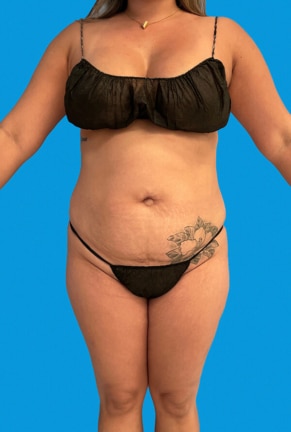
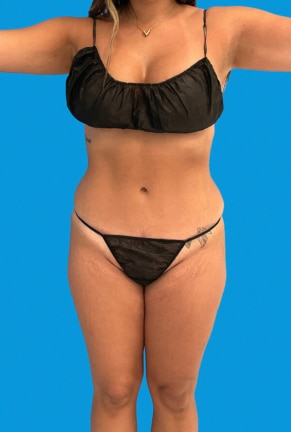
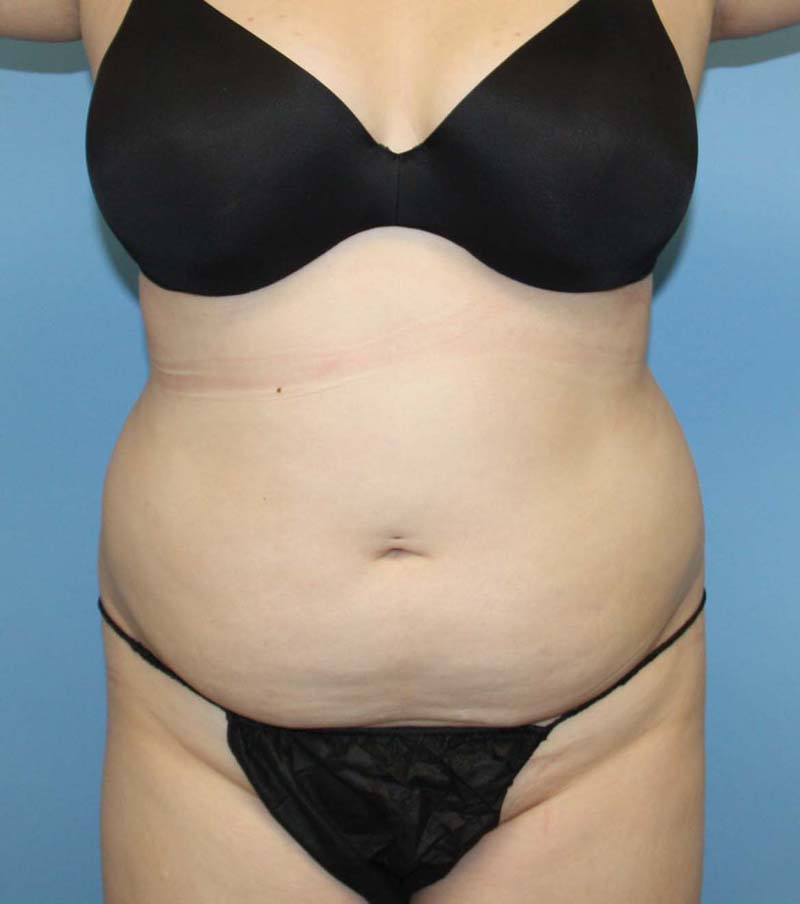
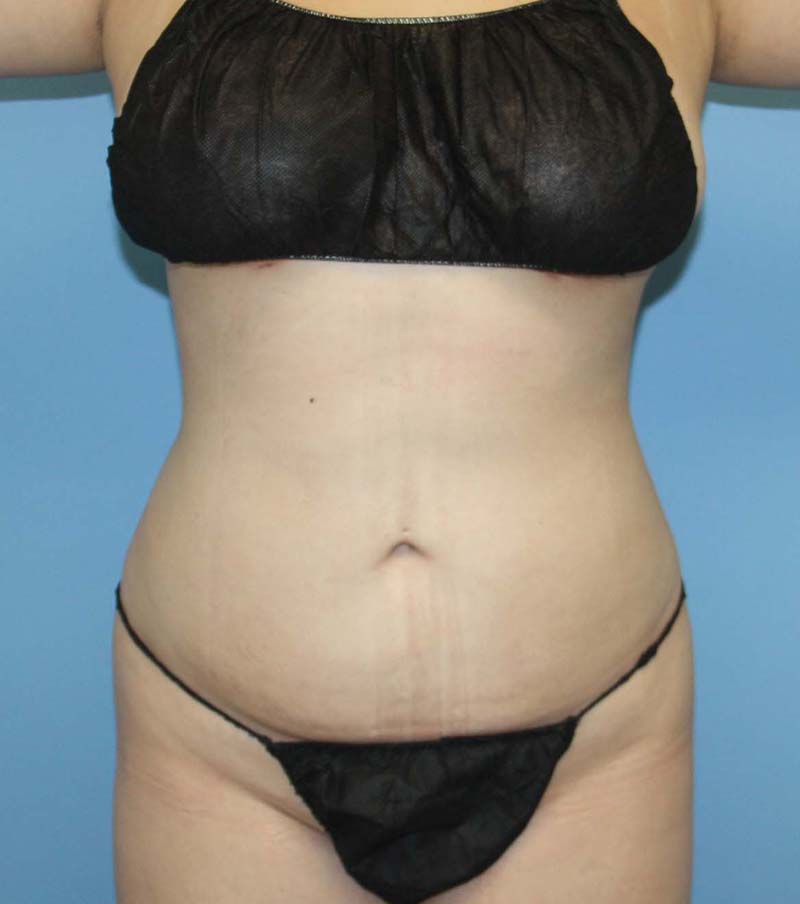
Judge a weight-loss result from the side and the back, not only the front: how low the scar sits, whether the belly button looks natural, whether the sides are as flat as the front with no fold where the incision ends, and whether the mons lies flat beneath the abdomen. In Dr. Cat's tummy tuck before and after photos, case TTK-0644 lost 70 pounds and had 18 inches of skin weighing over 9 pounds removed in an extended tummy tuck with a pubic lift, and cases TTK-0910 and TTK-0814 had a tummy tuck with a pubic lift after losing 40 pounds or more; in the thigh lift before and after photos, cases THL-TL1 and THL-0710 lost about 150 and 70 pounds before their inner thigh lifts. Dr. Cat shows photographs of patients like you at the consultation, because realistic expectations about the scars are the point.
How much does body contouring after weight loss cost in Beverly Hills?
Body contouring after weight loss with Dr. Cat is priced from its parts, in her surgeon's fees: a full tummy tuck with muscle repair $40,500 to $60,500; an extended tummy tuck, or a revision tummy tuck, $75,000 to $95,000; a mini tummy tuck $25,500 to $30,500; liposuction $10,000 for a single area on its own and $6,500 to $7,500 per area for two or more, with liposuction of the mons added to a tummy tuck $3,500; lipo 360 $45,500 to $52,500; a Brazilian butt lift or a skinny BBL $56,500 to $63,500, and fat transfer to the hips alone $35,000 to $45,000; a breast lift $35,500 to $45,500, or $55,000 to $65,500 with implants, and a breast augmentation with implants $17,500 to $22,500. Surgeon's fees are typical ranges: a more complex case can cost more, and your fee is set at your consultation and is final only in your written quote. A thigh lift is $55,500 to $82,500; a pubic lift is quoted at your consultation, as are implants and garments; the operating room and the physician anesthesiologist for each surgical day are quoted once Dr. Cat has set the operating time your surgery needs. The whole plan is quoted together, in one itemized written quote, valid for six months.
The price reflects one surgeon who performs every step herself, one major surgery per surgical day, a physician anesthesiologist and an accredited facility. Please do not shop skin removal surgery on price: a revision costs more than the surgery done well. Our tummy tuck cost guide and liposuction cost guide cover the national picture.
Consultation fee, financing and insurance
A consultation with Dr. Cat is $500, or $1,500 for a revision consultation, credited in full toward your surgery. The practice partners with Cherry, its primary financing partner, and also accepts CareCredit and Alphaeon Credit; see financing and payment plans. Body contouring after weight loss is cosmetic and self-pay: Dr. Cat's office does not accept medical insurance, though insurance may cover associated costs such as lab work. Your surgery date is reserved once the quote and pre-op paperwork are signed and the $2,500 deposit is paid.
Your consultation with Dr. Cat
It starts with a free 15-minute discovery call with our Patient Concierge, who books your consultation. Patients come to Dr. Cat for body contouring after weight loss from Beverly Hills, Los Angeles and beyond; at the consultation, in person on Rodeo Drive or, for out-of-town patients, by private video consultation through OnPatient, the HIPAA-secure patient portal, she reviews how you lost the weight and how long it has been stable, your medical history and your medications, then examines every area with the pinch test. She tells you plainly which surgeries you need, in what order and how far apart, and you leave with one itemized written quote for the whole plan.