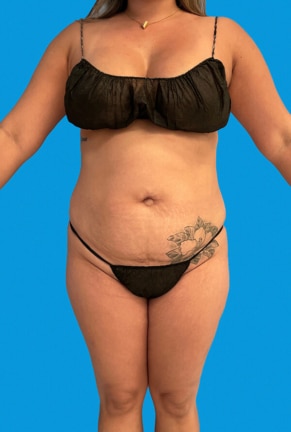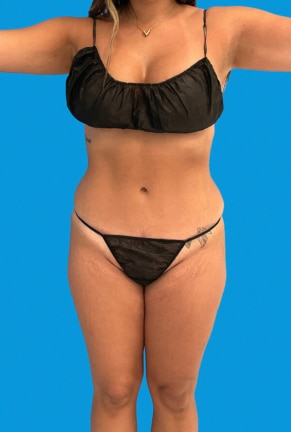


What is a tummy tuck?
Abdominoplasty, the medical term for a tummy tuck, addresses the three changes that diet and exercise cannot reverse: loose or hanging skin, stretch marks of the lower abdomen, and abdominal muscles that have separated or weakened (diastasis recti). Dr. Cat removes the excess skin and fat, repairs and tightens the abdominal wall, and reshapes the belly button so the result looks like it was never touched by surgery. Every tummy tuck is designed around the patient's own anatomy and goals, which is why no two of her surgeries are the same.
Tummy tuck benefits
- A flat, fit-looking abdomen and clothes that fit without sucking in or tucking in
- Stretch marks below the navel leave with the skin that carried them
- Core strength returns after the muscle repair, and many patients tell us their back pain improves with it
- Better pelvic support after the repair, which can help with incontinence
- A navel hernia is repaired in the same surgery when one is present
Who is a good candidate for a tummy tuck?
Most of Dr. Cat's tummy tuck patients are mothers with loose skin and a separated abdominal wall after pregnancy who want a flat tummy again. Many others have lost a lot of weight, or been through yo-yo weight changes, and are left with skin hanging over the belly button or the waistband; some had liposuction elsewhere and were left with sagging, irregular skin. The short test: if the problem is skin and muscle rather than fat, a tummy tuck is the operation. Our comparison of a tummy tuck vs liposuction explains how Dr. Cat decides.
You may be a good candidate if
- You have excess or hanging skin, stretch marks, or a lower-belly pouch that diet and exercise do not change
- Pregnancy left you with separated abdominal muscles and a belly that will not flatten no matter how much you train
- You lost a significant amount of weight and are left with loose skin over the belly button or your waistband
- Your weight is stable and within 10 to 15 pounds of your goal, with a BMI of about 30 or less
- You are in good physical, emotional and mental health, with realistic expectations
Not yet, or not the right operation, if
- You are planning a pregnancy: a future pregnancy will likely stretch the repair, and the surgery may need to be redone
- Your weight is still changing, or you are more than 10 to 15 pounds from your goal
- Your BMI is well above 30 (exceptions depend on anatomy and health, and Dr. Cat will tell you at the consultation)
- Your diabetes is not well controlled, or another medical condition has not been optimized
- You use nicotine and cannot stop for the period Dr. Cat specifies; nicotine restricts the blood supply the abdominal skin needs to heal
- You want the tummy tuck combined with 360-degree liposuction or a Brazilian butt lift on the same day (Dr. Cat does not, for the safety reasons below)
Patients should have a BMI of around 30 or less and a stable weight within 10 to 15 pounds of their goal. Dr. Cat spends a significant amount of time at the consultation on a detailed physical examination, a review of your surgical and medical history, and your aesthetic goals and expectations. Read about apron belly and loose skin after pregnancy if you are not sure which changes surgery can address.
Types of tummy tuck

Full tummy tuck with muscle repair
The traditional tummy tuck, and the most common one Dr. Cat performs. It is for patients with excess hanging skin above and below the belly button and split or loose muscles (diastasis recti), most of them after pregnancy. An incision is made hip to hip and around the belly button, the skin is elevated up to the ribs, the abdominal muscles are repaired and the abdominal wall is tightened like an internal corset, the excess skin is removed, and the abdominal skin is meticulously closed and tightened. The new Dr. Cat signature belly button is created.
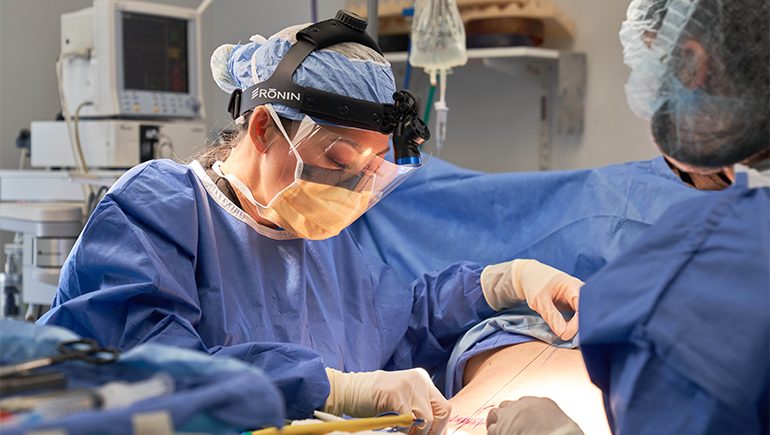
 Tummy tuck with hernia repair and pubic lift on a fit patient: surgical footage with Dr. Cat
Real surgical footage, shown with the patient's consent.
Full tummy tuck without muscle repair
The same operation without the sutures that tighten the muscle and abdominal wall. It is usually for patients who have not had children but, after weight fluctuations, have excess skin above and below the belly button with a flat tummy and good muscles underneath. The incision runs from hip to hip and around the belly button, the skin is elevated, the extra skin is removed and the incision is closed to tighten the abdominal skin, with the new belly button created as in the full tummy tuck.
Mini tummy tuck
A mini tummy tuck treats the lower abdomen only: excess skin below the navel, a pouch over a C-section or other abdominal scar, or stretch marks the patient wants removed. The incision is shorter and usually does not go around the belly button. The tissues of the lower abdomen are elevated and the extra skin is excised. Many patients who ask for a mini need a full tummy tuck to get a flat result, and the right choice is settled at the consultation.
Extended tummy tuck
An extended tummy tuck is a full tummy tuck with a much longer incision that continues toward the back, tightening the skin of the sides as well as the abdomen. It is for patients with a lot of sagging skin on the abdomen and the flanks, most of them after significant weight loss or weight loss surgery, and it includes the muscle repair, because most patients who have gained and lost a lot of weight have loosening of the abdominal wall.
Revision tummy tuck
A revision tummy tuck corrects a previous tummy tuck: a muscle repair that was incomplete or fell apart, a scar that sits too high or healed wide or irregular, residual loose skin of the abdomen or pubic area, or a belly button that is in the wrong place or looks unnatural. Dr. Cat also revises tummy tucks that did not hold after later weight changes or pregnancies, and some of the most challenging cases she sees are patients who had liposuction of loose skin elsewhere and were left thin, sagging and uneven. These are operations with scar tissue and complex anatomy that call for meticulous planning and extensive experience; our page on a botched tummy tuck describes the signs.
How Dr. Cat does it

Dr. Cat is a board-certified plastic surgeon who completed two surgical residencies, one in head and neck surgery, microvascular and facial reconstructive surgery, and advanced training in general plastic and reconstructive surgery, Harvard-educated and UCLA trained, and tummy tucks are among her favorite surgeries to perform because of how much they change patients' appearance and their lives. As a Beverly Hills tummy tuck specialist, her patients feel confident after surgery because they look fit without looking like they had surgery. These are the details that define her signature tummy tuck.
The incision: low, short and hidden
Dr. Cat's tummy tuck incision is always low and easily hidden under any underwear or bikini bottom. The most natural shape is a gentle curve where most patients already have a crease, and she spends real time at the consultation on exactly where the incision will sit; patients are welcome to bring the bikini bottom or underwear they want to hide it under. If you have a C-section scar or another abdominal scar, she places the tummy tuck scar under it and removes the old scar with the surgery. The length depends on the type of tummy tuck and the amount of hanging skin, and she always keeps it as short as possible.
The scar: thin, layered, no dog ears

Dr. Cat believes that creating the thinnest and most invisible tummy tuck scar is one of the most important parts of the surgery, and she takes her time with the closure. What defines the Dr. Cat signature incision:
- A natural curved shape, usually hidden in an existing crease, not wavy or irregular
- A meticulously layered closure, so the abdomen blends into the pubic area and the hips with no shelves or bumps
- Thin and barely visible, as short and as low as possible
- No dog ears, bunching or pleating at the ends of the incision
- See for yourself: in our tummy tuck before and after photos, patients' incisions are hidden by the thinnest strings of underwear, and Dr. Cat keeps examples on the Incisions highlight of her Instagram
Scar care starts at two weeks with silicone strips, then silicone gel; our tummy tuck scar guide covers placement, healing and what to expect month by month.
The belly button: natural, centered, no train tracks

Dr. Cat believes the belly button is one of the most important parts of a tummy tuck and takes pride in creating the most natural-looking ones. The details she adheres to:
- It is centered, where the patient's natural belly button lies. She does not use the umbilical float technique, which cuts the belly button free and pulls it abnormally low toward the pubic area
- It is an oval proportional to the patient's height and size, neither too small nor too large, with a dimple in the middle and a second, slightly depressed circle
- A hernia at the navel is repaired at the same time, so it never distorts the final shape or causes problems later
- The incision is inset deep at the base of the belly button, not at the surface where it would show
- No train tracks: she closes the belly button with a suturing technique in which no sutures cross the line
The muscle repair and the closure
The separated rectus muscles are sutured back together with a precise double-layer repair that gives secure support and strength, brought together tightly but never over-pulled, so the abdomen is contoured to look like abs rather than abnormally tight. The amount of skin removed is measured to the millimeter, as is the placement of the incision and the belly button, and the closure is custom tailored so there is no bunching, pleating or dog ears. Little to no bleeding and bruising during surgery is part of why her patients have little to no pain afterwards: most take a few Tylenol and never fill a prescription for pain medication.
One tummy tuck per surgical day
Dr. Cat schedules one tummy tuck per surgical day and nothing else, so she never rushes and every patient gets her full attention. She performs every step herself, from the markings to the muscle repair to the last suture, with a board-certified physician anesthesiologist, a physician assistant, nurses, scrub techs and medical assistants dedicated to the case, in the practice's QUAD A accredited surgery center on Rodeo Drive.
Combining a tummy tuck with other procedures
Tummy tuck with pubic lift
For patients with hanging skin of the mons pubis as well as the abdomen, Dr. Cat performs a pubic lift in the same surgery, so the skin is tightened uniformly from the top of the abdomen all the way down. The last thing you would want is a tight tummy and a drooping mons below it. The pubic tissues are lifted and carefully pulled upward, never over-pulled and never so far that the pubic hairline sits too high, and tailored to look flat, tight and natural.
Tummy tuck with liposuction
Conservative liposuction of the love handles or the mons pubis can be performed with a tummy tuck, at $6,500 to $7,500 per area in surgeon's fees ($3,500 for the mons). Dr. Cat does not perform aggressive or 360-degree liposuction of the abdomen, back and flanks in the same surgery, because the blood supply to the lifted abdominal skin travels through that fat, and aggressive liposuction can cause skin or fat necrosis. When both are needed, lipo 360 is staged on a separate day.
Tummy tuck and Brazilian butt lift
Dr. Cat does not perform a Brazilian butt lift or fat transfer to the buttocks with a tummy tuck. After a BBL, patients must sleep on their stomachs and cannot sit or put pressure on the buttocks, because pressure on the grafted fat causes fat necrosis or absorption; after a tummy tuck, pressure cannot be placed on the abdomen. The two recoveries contradict each other, so she stages the surgeries on separate days.
Mommy makeover
A mommy makeover combines a tummy tuck with breast augmentation, a breast lift, or, for many of Dr. Cat's patients, a labiaplasty. She never performs them on the same surgical day: a tummy tuck is never done on the same day as a breast augmentation with implants, a breast lift with a tummy tuck is staged, and a labiaplasty is never done on the same day as a tummy tuck. Combining surgeries extends the time under general anesthesia and makes recovery much harder: after a tummy tuck you cannot use your abdominal muscles and rely on your arms to get out of bed, and after breast surgery you cannot use your arms and rely on your core. Walking every other hour after surgery, which prevents blood clots, is easy after one surgery and hard after two.
Tummy tuck recovery timeline
Here is what recovery looks like for most of Dr. Cat's patients. For the long version, read our tummy tuck recovery guide, week by week.
- The night of surgeryYou wake up calmly in the recovery room with little to no pain. After about an hour, once you are fully awake, you are transported to a plastic surgery aftercare center, where nurses give your medication, monitor your vitals and drains, and help you walk. Yes, you walk the first night.
- Day oneThe recovery center brings you to our office for your first post-op visit, where Dr. Cat checks the surgery site and reviews the instructions with you and your caretaker. Most patients have little to no pain and no bruising, only mild swelling under a comfortable compression garment. You walk slightly bent over, so we recommend a front-wheel walker, and you need help getting out of bed so you do not use your abdominal muscles.
- One weekYour energy is returning, the incisions are healing and you can stand almost straight. Dr. Cat sees you, shows you how far you can stand, and removes all or almost all of your drains, gently. Gentle walks only.
- Two weeksYou are almost healed and standing straight, and any remaining drains come out. Out-of-town and international patients can fly home. Your new flat tummy is taking shape under some residual swelling, the incision is thin, and scar treatment starts.
- One monthYou feel strong and can resume all daily activities, social events and light exercise such as walking. Full exercise waits until six weeks, and sit-ups, planks and crunches until three months if you had a hernia repair. Silicone strips continue for six weeks.
- Three monthsThe bulge is gone; your waist is smaller and your core stronger. We review your before and after photos at your three-month visit, and scar treatment continues with silicone gel.
- Six months to one yearThe result is fully visible at six months, with the incision thin and fading. At one year it is a faded, thin white line.
Risks and safety
Every surgery carries risk, and a tummy tuck is a significant operation. Dr. Cat would rather you understand the risks clearly than hear only about results. Here is what can happen and what she does to prevent it.
What can go wrong
- A fluid collection (seroma) or a blood collection (hematoma) under the skin
- Infection at the incision or around a drain
- Delayed wound healing, or a small opening of the incision, most often at the center where the tension is highest
- Skin or fat necrosis when part of the skin or the fat under it loses its blood supply, the reason aggressive liposuction is never combined with a tummy tuck
- A scar that heals wider, raised or darker than expected, including keloids in patients prone to them
- Asymmetry, contour irregularities, residual loose skin, or a change in the shape or position of the belly button that may need a touch-up
- A blood clot in the leg (deep vein thrombosis) that can travel to the lungs: rare, serious, and the reason you walk the night of surgery
- Anesthesia risks, which the board-certified anesthesiologist reviews with you before surgery
How Dr. Cat reduces these risks
- Careful patient selection: weight stability, BMI, nicotine, diabetes control and a full review of your medical and surgical history before you are scheduled
- Medical clearance and lab work for every patient, and in some cases imaging or an evaluation by a specialist
- A detailed pre-operative appointment covering instructions, medications, and the things to avoid that can cause bleeding, infection or anesthesia complications
- Surgery in a QUAD A accredited facility with a board-certified anesthesiologist and a team dedicated to one tummy tuck that day
- Systematic attention in the operating room to positioning, padding and temperature, and technical precision: little to no bleeding, muscles brought together tightly but never over-pulled, skin removal measured to the millimeter
- No aggressive liposuction and no Brazilian butt lift in the same operation
- Walking the first night and every other hour afterward, a compression garment, drains removed gently at one to two weeks, and follow-up visits at one day, one week, two weeks, one month and three months
How much does a tummy tuck cost in Beverly Hills?
Dr. Cat's surgeon's fee for a full tummy tuck with muscle repair is $40,500 to $60,500, and $25,500 to $30,500 for a mini tummy tuck. The operating room and the board-certified physician anesthesiologist are quoted at your consultation, once Dr. Cat has examined you and set the operating time your surgery needs: operating time varies with your anatomy and with the areas treated together, so it is set by her, not by a price list. Surgeon's fees are typical ranges: a more complex case can cost more, and your fee is set at your consultation and is final only in your written quote. Conservative liposuction added to a tummy tuck is $6,500 to $7,500 per area in surgeon's fees, a pubic lift or a hernia repair adds to the quote, and extended tummy tucks after major weight loss and revision tummy tucks are $75,000 to $95,000 in surgeon's fees. Every quote is itemized in writing: the surgeon's fee, the board-certified anesthesiologist, the accredited facility, your compression garment and your follow-up visits, so there are no surprises later.
The price reflects what is behind it: one surgeon who performs every step herself, one tummy tuck per surgical day, a physician anesthesiologist for the whole case and an accredited facility. Please do not fall for cheap or fast plastic surgery. If you do not have the budget for a high-quality tummy tuck, please save and wait instead of risking your health and your result on cheap and unsafe surgery; correcting one costs more than the original surgery would have done well. Our tummy tuck cost guide explains what a quote is made of, why national averages are not your number, and the questions to ask any surgeon.
Consultation fee and financing
A consultation with Dr. Cat is $500, or $1,500 for a revision tummy tuck, and the full amount is credited toward your surgery. To pay over time, the practice partners with Cherry, its primary financing partner, and also accepts CareCredit and Alphaeon Credit; see financing and payment plans. A tummy tuck is a cosmetic procedure and is not covered by insurance; if a hernia repair is part of your surgery, we explain how it is handled at your consultation.
Your consultation with Dr. Cat
It starts with a free 15-minute discovery call with our Patient Concierge, who answers your first questions and books your consultation. At the consultation, in person on Rodeo Drive or by video with photos for out-of-town patients, Dr. Cat examines your anatomy in detail, reviews your medical and surgical history, and builds a plan around your goals: the type of tummy tuck, whether a pubic lift, hernia repair or conservative liposuction belongs in it, where the incision will sit, and what to expect at every step of the recovery. She is honest about what surgery can and cannot do, and you leave with an itemized written quote. Dr. Cat and our staff are available for every follow-up question afterwards.