

What is a labiaplasty revision?
A labiaplasty revision is a second surgery on labia that have already been operated on. A first labiaplasty reduces and reshapes the labia minora, the inner lips, so they sit within the labia majora; a revision corrects what that surgery left behind, working through scar tissue and with whatever tissue remains. The correction can be small, a dog ear smoothed, a scar straightened or a small polyp of scar removed, or it can be a complete redo of a result that was never right. Because the labia are a fine, small-scale structure that swells and moves, a millimeter decides the result, and a revision is planned in millimeters.
Whether a result is botched or still healing is a separate question, and our page on a botched labiaplasty answers it week by week: swelling, bruising and uneven sides are normal in the first month, and a result is judged only once healing is complete, at three to six months.
What a labiaplasty revision corrects
- Asymmetry: one labium longer, wider or differently shaped than the other
- Over-resection: too much tissue removed, so the labia minora are nearly absent and the vaginal opening and the urethra are exposed
- Under-resection: too little removed, so tissue still hangs and chafes in clothing, during exercise or on a bicycle seat
- Scalloped, wavy, notched or sharp edges, and dog ears at either end of the incision
- A clitoral hood left full over reduced labia, so the hood looks heavy and out of balance
- Painful, thick or sensitive scars, a nerve caught in the scar, or a wound that separated and healed with a notch
- Function changed by the first surgery: an irregular urine stream, dryness, or tightness or pulling with intercourse
Who is a good candidate for a labiaplasty revision?
The test is a healed result that is uneven, over-reduced, sharp-edged, painful or functionally worse than before the first surgery, seen at three months or later. Dr. Cat examines what remains before she says what a revision can do.
You may be a good candidate if
- Your first labiaplasty healed at least six months ago and the two sides still clearly differ, or the edge is scalloped, sharp or notched
- Too much tissue was removed and you have dryness, chafing, an irregular urine stream, or pulling or tightness with intercourse
- Tissue still hangs and chafes because too little was removed, or the clitoral hood was left full over reduced labia
- A scar hurts to touch, during intercourse or on a bicycle seat, or a wound that separated healed with a notch
- You are in good health, can stop smoking or vaping for at least two months before surgery, and expect a comfortable, natural contour rather than the original anatomy
Not yet, or a different plan, if
- Your first surgery was less than three to six months ago: swelling, bruising and uneven sides are normal while the tissue settles
- A wound has opened, or there is fever, spreading redness or foul-smelling discharge: that is treated at once, not planned as a revision
- Your labia were never operated on and are simply large: that is a first labiaplasty, and our page on enlarged labia explains when surgery helps
- The complaint is laxity at the vaginal opening rather than the labia: a perineoplasty, on its own or added to the revision, is the answer
- You want it on the same day as a tummy tuck: Dr. Cat never performs labia surgery on a tummy tuck day, because the garment and the swelling would compromise the healing labia
What a labiaplasty revision can correct
A labiaplasty gone wrong goes wrong in a few repeatable ways, and tissue that was removed does not grow back, so every revision works with what remains. Here is what Dr. Cat corrects, from the predictable refinements to the reconstruction of an over-resected result.
Asymmetry and a remaining excess
Asymmetry is the most common complaint after a labiaplasty and the most predictable correction: the longer side is reduced to match the shorter one, so the finished size is that of the smaller side. A remaining excess, tissue that still hangs and chafes because the first surgeon stopped short, is reduced the way a first labiaplasty would reduce it, with the edge sculpted so the transition into the labia majora and the clitoral hood reads as one. Both corrections need enough tissue to work with, which is why Dr. Cat measures what remains before she promises a shape.
Scalloped, wavy or sharp edges, notches and dog ears
A trim closed unevenly leaves a rim of small curves, a thin sharp edge, or notches where a stitch pulled through; a wedge closed under tension can leave a step in the outline or a gap where the suture line separated. Dog ears are small tags of tissue at either end of the incision that were not tapered. Dr. Cat re-cuts and closes the edge under 3.5X magnification operating lenses with precise layered suturing and dissolvable sutures, smooths the dog ear, and shapes the ends of the incision so the edge looks as if it was never touched.
A clitoral hood left full
Many surgeons trim only the labia, so the hood, which is formed where the inner labia meet, is left as it was and becomes the largest fold in view. A full hood over reduced labia is one of the most common reasons patients come to Dr. Cat after surgery elsewhere, and reducing it is often part of the revision plan: a clitoral hood reduction is added in the same surgery, the labia are reshaped first and the transition into the hood is shaped last, so the two heal as one contour. Her incisions stay on the excess skin of the hood, never near the clitoris or its dorsal nerve, and the hood keeps its cover over the head of the clitoris; she reduces, never strips.
Painful, thick or sensitive scars
A scar that hurts to touch, during intercourse or on a bicycle seat, a thick or bumpy suture line, or a small nerve caught in the scar that gives a sharp, localized pain, is released, straightened or excised, and the edge is closed again in fine layers. A wound that separated in the first weeks and healed on its own with a notch or a web of scar is re-cut and closed as one clean edge.
What a labiaplasty revision cannot restore
Over-resection is the one mistake that cannot be undone. When a first surgeon trimmed the labia minora so short that little remains, the result women describe as an amputation or a "Barbie" labiaplasty, the vaginal opening and the urethra are exposed, and they describe dryness, chafing, a spray when urinating, tightness or pulling with intercourse, and a look they call flat. A revision improves that; it does not recreate the original labia, and Dr. Cat says so before surgery rather than after.
What she can do depends on what the examination finds, and the options are described in general terms here because which of them applies is decided then: rebuilding an edge from the tissue that remains; borrowing from a clitoral hood that was left full; releasing scar that tethers the opening; adding a small amount of your own fat to cushion an exposed or thinned area; or reducing the labia majora so the outer and inner lips are in proportion again. The goal of a reconstruction is comfort and a natural contour, and the patient who understands that before surgery is the one who is satisfied after it.
When to have a labiaplasty revision
Most revisions wait at least six months after the first surgery, and often a year. The labia are swollen and uneven for the first month, close to their final shape by the second and third month, and settled, with the scars softened and faded, at three to six months; a revision planned before then corrects a healing result rather than the real one, and a revision cut through immature scar is harder to judge and heals less predictably. Dr. Cat assesses the healing at the consultation and sets the date for your case. Two things do not wait: a wound that has opened across the width of a labium, and an infection, are seen right away.
How Dr. Cat does it
Dr. Cat is a board-certified plastic surgeon who completed two surgical residencies, one in head and neck surgery, microvascular and facial reconstructive surgery, and advanced training in general plastic and reconstructive surgery, Harvard-educated and UCLA trained. She has performed more than 500 labiaplasties with a technique she developed, built on the trim method and refined for years, and she is sought after for correcting other surgeons' results; most of the revisions she performs are for patients whose first surgery was done elsewhere.
Planning: the revision consultation and the examination
The consultation is private and conducted by Dr. Cat herself. She asks about the first operation, what was done and when, and about function before appearance: an irregular urine stream, dryness, pain, tightness or lost sensation with intercourse, pain from a scar or a trapped nerve, and any infection or wound separation during the first healing. She examines the two sides for length and width, the edges for scalloping, sharpness and notches, the ends of the incisions for dog ears, the clitoral hood against the reduced labia, and the scars for tenderness, and she tells you which corrections are refinements and which are reconstruction, with a frank estimate of how much improvement is realistic. The plan is reviewed at your pre-op appointment and confirmed the morning of surgery with precise surgical markings, so you know exactly the size and shape of the labia before you go in.
The technique: reshaping what remains under 3.5X magnification
Dr. Cat reshapes each labium in millimeters under 3.5X magnification operating lenses, removes only what the correction needs, sculpts the transition between the labia minora, the labia majora and the clitoral hood so the three read as one, and closes with precise layered suturing and dissolvable sutures, placed to leave an edge that looks as if it was never touched. None of her incisions go near the clitoris or its dorsal nerve, she confirms before surgery that none of the tissue being removed is sensitive or involved in intimacy, and with her technique most patients report an improvement in sensation. Every stitch is placed by her, because in a labiaplasty the closure is the result.
Anesthesia, surgery day and home the same day
The surgery is performed under general anesthesia with a board-certified physician anesthesiologist in Dr. Cat's QUAD A accredited surgery center on Rodeo Drive, with a numbing solution applied as well, so you feel nothing and wake comfortable. Operating time varies greatly with the complexity of the revision: three to five hours on average, and shorter for a minor revision, an edge, a dog ear or a scar. Dr. Cat schedules one major surgery per surgical day and performs every step herself. No aftercare-facility night is needed: you go home the same day with someone to drive you and stay the first night.
Preparing for surgery
After the consultation, Dr. Cat's team gives you the pre-operative instructions: clearance and lab tests, at least two months without smoking or vaping, the medications to stop before and after surgery, a Hibiclens wash the night before, nothing to eat or drink from the night before, no makeup, skincare or jewelry on the day, and a ride home with someone who stays the first night.
Combining a labiaplasty revision with other procedures
A clitoral hood reduction, when the hood was left full, is part of the revision itself. If the opening of the vagina has changed with childbirth as well, a perineoplasty, which repairs and tightens the perineum between the vaginal opening and the anus, can be added to the same plan, under the same anesthesia and with the same recovery. Deflated or thinned labia majora can be filled with a small amount of your own fat, harvested by liposuction, when the plan calls for it. Laxity is treated with non-surgical vaginal rejuvenation, which is never done on the same day as labia surgery and starts about four weeks after it, once you have healed.
Dr. Cat never performs labia surgery on the same day as a tummy tuck: the tummy tuck garment chafes the healing labia and the swelling compounds. As part of a mommy makeover the two are staged on separate days, in the order she sets at the consultation.
Labiaplasty revision recovery, week by week
Recovery after a labiaplasty revision mirrors a first labiaplasty with Dr. Cat: swelling and minimal soreness rather than pain, managed with Tylenol, antibiotic ointment and ice. Our labiaplasty recovery timeline covers each week in detail.
- The night of surgeryHome a few hours after waking, with someone to drive you and stay the night. Expect swelling and minimal soreness rather than pain; most patients take a Tylenol the first night, with antibiotic ointment and ice, and wear loose cotton underwear.
- Days one to threeSwelling peaks and starts to settle. Shower carefully without scratching, rubbing or scrubbing the area, pat dry, and get up to walk for a few minutes every couple of hours.
- The first weekSwelling and minimal soreness, with some bruising. Most patients are back at a desk within a few days to a week. Dr. Cat checks the healing at your first follow-up visit.
- Weeks two to fourSwelling subsides steadily and bruising fades. No tight clothing, tampons, swimming, hot tubs, crossing your legs or exercise. The dissolvable sutures come away on their own at about three and a half weeks, and the incision continues to fade and become less visible.
- Four weeksYou are cleared for exercise, tampons, fitted clothing and physical work at your follow-up visit, once Dr. Cat has checked the edges.
- Six weeksIntercourse waits six weeks, until Dr. Cat clears you at a follow-up visit, as after any labia surgery with her.
- Three to six monthsThe scars fade significantly by about four months, the tissues have settled, and the contour you see at three to six months is the result.
Labiaplasty revision before and after: what to look for
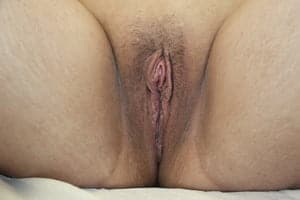
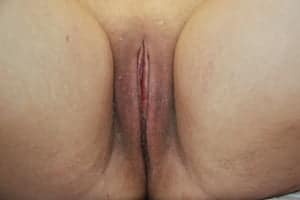
In labiaplasty revision before and after photos, look at three things: whether the two sides now match, whether the edge is one smooth line with no scallops, notches or tags, and whether the hood sits in proportion with the labia below it. The after photo should be taken at three months or later, once the swelling has gone. The case on this page, LBP-4302, is a revision of a labiaplasty done elsewhere: the first surgery had over-resected the labia centrally and left an excess anteriorly, and an improper closure had caused recurrent hematomas; the revision created a much more balanced and natural shape. Look through the practice's labiaplasty before and after photos for the starting point closest to yours; the revisions are shown among the labiaplasties.
Risks of a labiaplasty revision, and how Dr. Cat reduces them
A revision carries the risks of any labiaplasty plus the ones that scar tissue and less tissue add. Here is what can happen and what Dr. Cat does to prevent it.
What can go wrong
- Bleeding, a hematoma or an infection, as after any labia surgery
- Wound separation where a suture lets go early; a tiny separation at the edge usually heals on its own
- Changes in sensation, a recognized risk of any labial surgery
- A scar that heals thick, tender or asymmetric, the same problems a revision is meant to correct
- A result limited by how little tissue the first surgery left: a reconstruction improves comfort and contour but does not recreate the original labia
- Removing too much in the second surgery: tissue that is removed does not grow back
- Anesthesia risks, which the board-certified anesthesiologist reviews with you before surgery
How Dr. Cat reduces these risks
- Every step by Dr. Cat herself: her special technique with precise layered suturing under 3.5X magnification, so the two sides match and the closure is extremely secure
- Timing: a revision planned at least six months after the first surgery, once the swelling is gone and the scars have softened
- Conservative by rule: only what the correction needs is removed, and what can and cannot be corrected is said before surgery, not after
- Incisions that never approach the clitoris or its dorsal nerve; with Dr. Cat's technique most patients report an improvement in sensation
- A plan agreed at the consultation, reviewed at the pre-op appointment and confirmed the morning of surgery with precise surgical markings
- General anesthesia with a physician anesthesiologist in an accredited facility, no nicotine for two months, and the four-week and six-week rules
- Detailed written aftercare instructions, follow-up visits, and a team available throughout your recovery; for patients who follow the post-op instructions, complications rarely occur
How much does labiaplasty revision cost in Beverly Hills?
Dr. Cat's surgeon's fee for a labiaplasty revision is $21,500 to $25,500; the operating room and anesthesia are quoted at your consultation, because the operating time depends on your anatomy and on what is treated together. Surgeon's fees are typical ranges: a more complex case can cost more, and your fee is set at your consultation and is final only in your written quote. A revision costs more than a first labiaplasty because scar tissue, altered anatomy and less tissue to work with mean more planning and more operating time, and because some revisions are a reconstruction rather than a reduction. A clitoral hood reduction added at the same time is $2,000 to $6,000 and a perineoplasty added is $3,500, in surgeon's fees; fat grafting to the labia majora, when it is part of the plan, is quoted at your consultation. The written quote is itemized and covers the surgeon's fee, the board-certified physician anesthesiologist, the accredited facility and your follow-up visits, and it is valid for six months.
The price reflects one surgeon who performs every step herself under magnification, one major surgery per surgical day, a physician anesthesiologist for the whole case and an accredited facility. Please do not shop a revision on price: tissue removed in a second surgery is gone as surely as in the first. Our labiaplasty cost guide explains what a quote is made of and why a revision costs more than a first surgery. Insurance treats labia surgery as elective and cosmetic, so most plans do not cover a revision; Dr. Cat's office does not bill insurance but can provide the paperwork if your plan makes an exception.
Consultation fee, deposit and financing
A revision consultation with Dr. Cat is $1,500, credited in full toward your surgery; a first consultation with her is $500, credited the same way. Your surgery date is booked once the quote and the pre-op paperwork are signed and the $2,500 deposit is paid. To pay over time, the practice partners with Cherry, its primary financing partner, and also accepts CareCredit and Alphaeon Credit; see financing and payment plans.
Your revision consultation with Dr. Cat
It starts with a free 15-minute discovery call with our Patient Concierge, who books your consultation: in person on Rodeo Drive or, for out-of-town patients, a private video consultation through OnPatient, the HIPAA-secure patient portal. Bring your operative report if you have it and any photographs from before the first surgery. You look at photographs together to pin down the shape you want; Dr. Cat tells you what a revision can correct, what it can only improve, or whether the right answer for now is to wait longer; and you leave with an itemized written quote. Patients who travel for surgery stay in town until she has seen them at their first follow-up visits and cleared them to travel.