
Breast Lift Recovery at a Glance
- Surgery: two to three hours under general anesthesia with a board-certified physician anesthesiologist; home the same day
- Pain medication: Dr. Cat's prescription at first, then Tylenol
- Work: five to seven days off; a desk within one to two weeks
- Arms and lifting: below shoulder height and nothing over 10 pounds, toddlers included, for two weeks
- Scar care: silicone strips from the two-week visit, then silicone gel
- Exercise: walking from day one; moderate activity at three to four weeks; strenuous exercise at six weeks at the earliest; full activity between six and twelve weeks
- Follow-up visits: one day, one week, two weeks, one month and three months
- Final shape: three to six months; scars fade over a year; results last 10 to 15 years or more
Next step: read about a breast lift in Beverly Hills with Dr. Cat, including how she chooses the smallest scar pattern that will hold the new shape, or book a free discovery call.
Breast Lift Recovery Week by Week
Days 1 to 3
What you feel: tightness across the chest rather than sharp pain, worst on the first morning, with the breasts feeling heavy and numb, and grogginess from the anesthesia on day one. Most patients use the prescription for a day or two and then Tylenol; do not add aspirin or anti-inflammatories, which increase bleeding. Nausea on the first day is common and settles with a bland diet.
What you can do: you are up and walking within a few hours of surgery, and at home you take a short, slow walk every hour or two while awake, with someone beside you in case you feel light-headed. Rest with the upper body raised and the arms at your sides, and use them as little as possible: the less you reach, the less swelling and bruising. Dr. Cat sees you the morning after surgery and goes through the instructions with you and your helper. The first shower is about 48 hours after surgery, once she has cleared it: lukewarm water, pat the incisions dry, and the surgical bra straight back on.
What the breasts look like: high, tight and swollen, sitting higher than the final result, with surgical tape over the incisions and the marking lines still faintly visible on the chest. Bruising, when it appears, spreads toward the sides over the first three days.
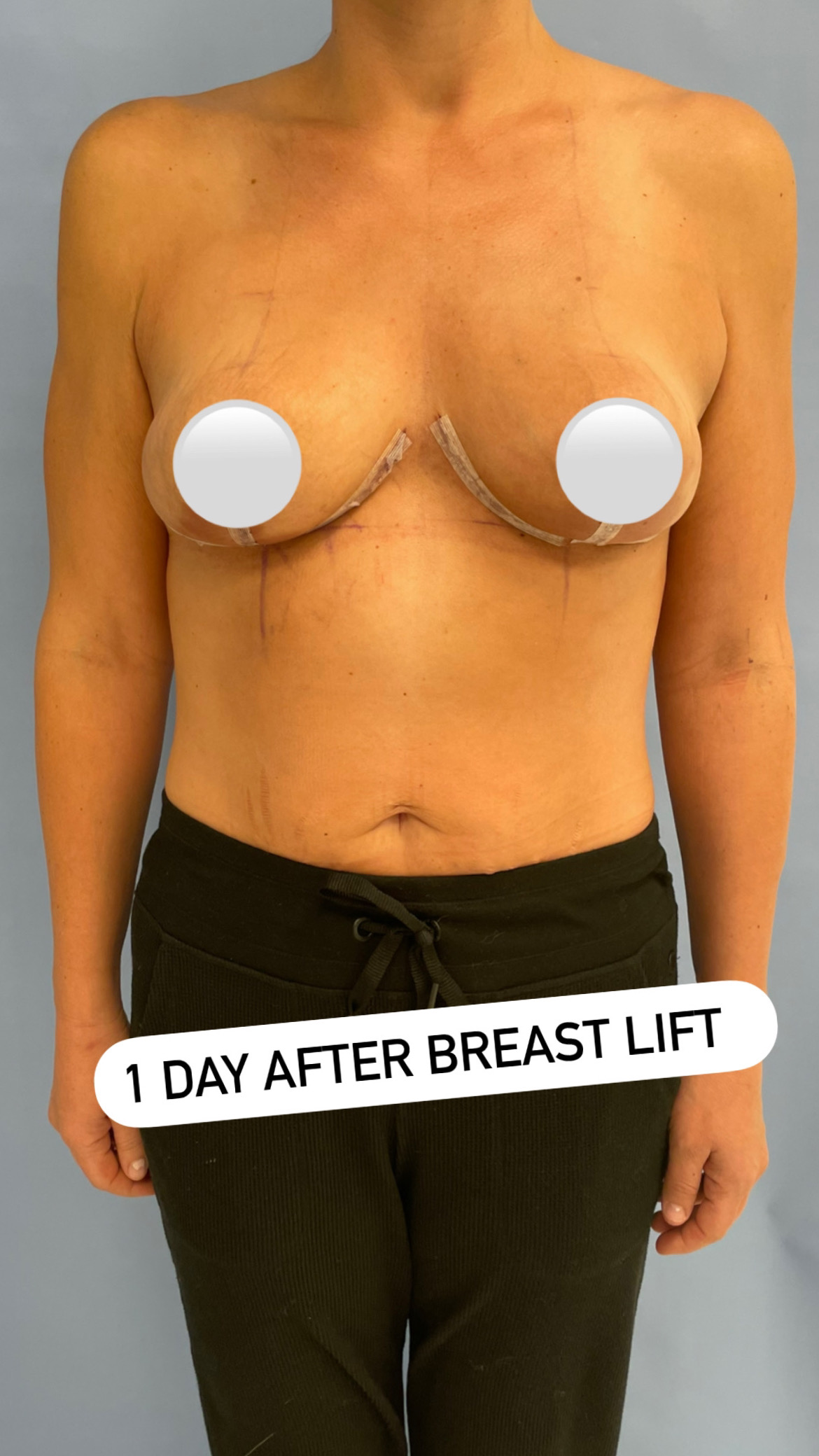
One day after a breast lift by Dr. Cat: the breasts sit high and firm, the lollipop incisions are covered with tape, and the marking lines are still visible. This is the tightest the breasts will look.
Week 1
What you feel: the tightness eases day by day and most patients are off all prescription medication by the end of the week. The breasts are numb in places and hypersensitive in others, and one side can feel more sore than the other, which is normal. Swelling peaks in the first week.
What you can do: walks that lengthen each day, and little else. The arms stay below shoulder height, nothing over 10 pounds is lifted, and dressings are changed as Dr. Cat instructs. The bra stays on around the clock, removed only to shower, and through the first month it is the only bra you wear: no sports bra and no underwire. Most patients take five to seven days off work and are back at a desk by the end of the first or second week. Dr. Cat sees you at the one-week visit.
What the breasts look like: still high and swollen, with tape along the incisions, the bruising at its most visible and starting to turn yellow at the edges, and nipples that point forward and sit at the center of the breast for the first time.
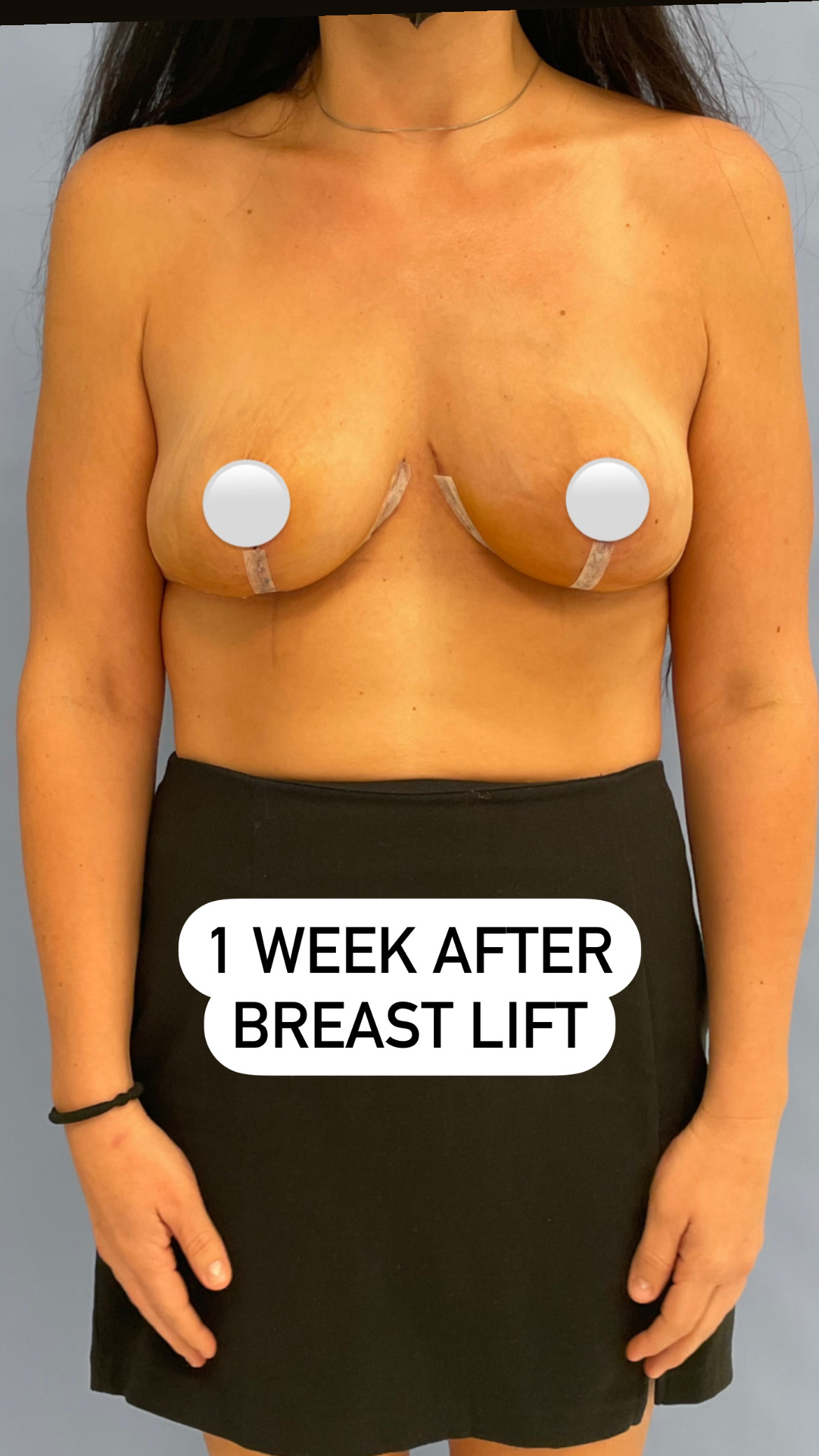
One week after a breast lift by Dr. Cat: the swelling is easing, the incisions are still taped, and the nipples sit at the center of the breast.
Week 2
What you feel: comfortable for most of the day, with tightness first thing in the morning. The numbness is patchy, and a tingling, burning or shooting electric feeling starts as the sensory nerves regrow.
What you can do: at the two-week visit Dr. Cat checks the incisions, starts your scar care with silicone strips, and ends the arm and lifting restriction. Most patients are back at a desk. Driving returns once you are off prescription medication and can turn the wheel and check your blind spot without pain; walks, not workouts. Our post on sleeping after breast surgery covers the wedge, the pillows and the first nights.
What the breasts look like: the bruising is fading to yellow, the swelling is down but the breasts are still fuller and higher than they will be, and the incisions are sealed pink lines under the silicone.
Week 3
What you feel: close to normal, with the nerve zings continuing on and off. This is the week patients feel ready to do more than they should; pushing through discomfort sets healing back.
What you can do: longer walks, light housework, errands and a full day at a desk. Moderate activity returns between three and four weeks; strenuous exercise, heavy lifting and chest work still wait. Keep the silicone strips on and the sun off the incisions.
What the breasts look like: the bruising has gone, the lower breast is starting to round out, and the shape is recognizably the final one, still a little high and firm. One breast often settles before the other, and mild differences in swelling resolve over the first few months.
Weeks 4 to 6
What you feel: yourself, with occasional tightness and the last of the tingling. The breasts feel firmer than natural tissue and soften from here.
What you can do: Dr. Cat sees you at one month, checks the incisions, reviews your scar care and tells you how much activity you may add and whether you may sleep in positions other than on your back. At six weeks, if healing is on schedule, strenuous exercise and heavy lifting return, and most patients are cleared for full activity between six and twelve weeks at a follow-up visit. Chest and shoulder work and high-impact exercise come last, in a high-support sports bra. She tells you when to move from the surgical bra to a supportive wireless bra and when an underwire is allowed.
What the breasts look like: most of the swelling has gone, the breasts have started to drop into their natural position, and the scars are entering their reddest stage.
Months 2 to 6
What you feel: no restrictions, full energy, and sensation that keeps normalizing; the nipple and areola stay on their blood supply throughout the surgery, which is why sensation is usually preserved, and a permanent change is discussed before surgery.
What you can do: train fully once cleared, keep up the silicone gel, and keep sunscreen on the scars. Dr. Cat sees you at three months and reviews your photos with you; that is when to buy bras, because the size and shape keep changing until the tissue settles.
What the breasts look like: the shape is close to final at three months and final by three to six months as the tissue settles: the nipples level and forward, the lower breast rounded, the two sides even. The scars are red and slightly raised between one and three months, their busiest healing stage, then flatten and turn pink.
One Year
The scars have faded to pale lines, at the border of the areola where the change in skin color hides them, down the front of the breast and, in an anchor lift, along the crease; they keep softening into the second year. The result you see is the one you keep, for 10 to 15 years or more in most of Dr. Cat's patients, with weight swings, pregnancy and time the things that move it again. If a lift done elsewhere has dropped, healed with wide scars or left the nipples too high, a revision breast lift corrects it.
Breast Lift Recovery Pictures: Before, During and After
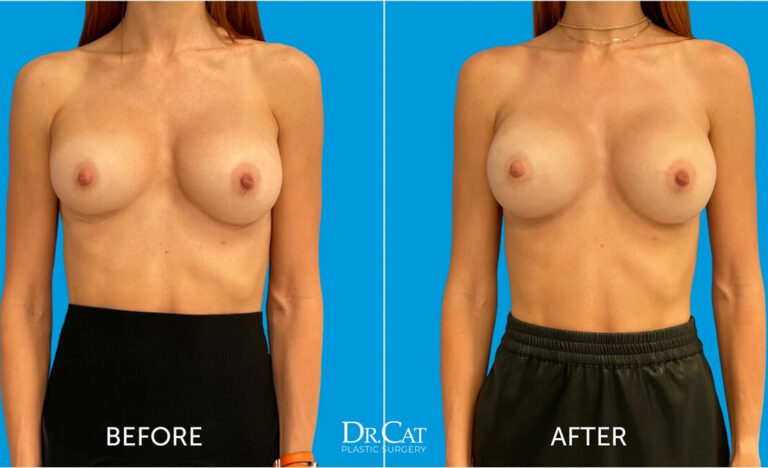
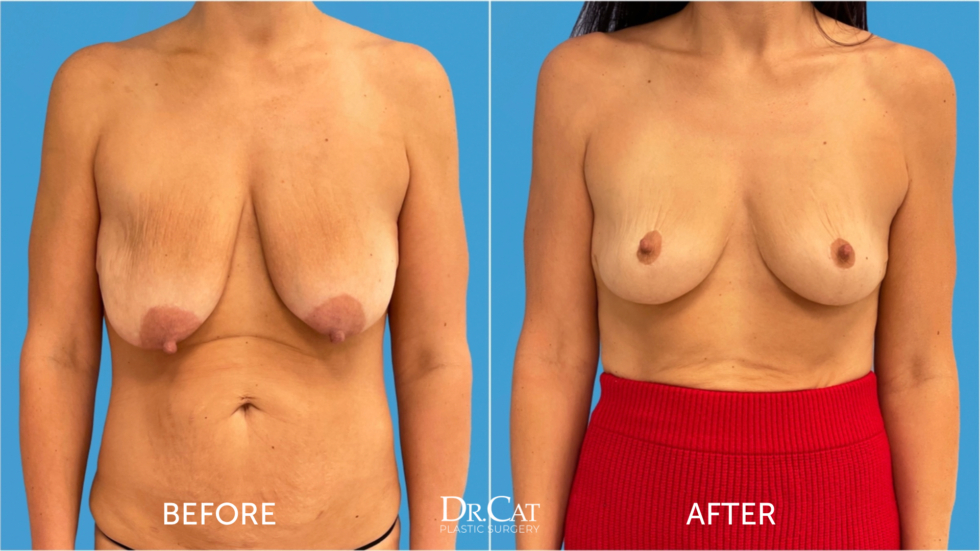
The two photos above show the first week: high, taped and swollen at day one, and settling at one week. The stage that matters most is the one you cannot photograph in the first month, the settled breast at three to six months, with the nipple centered, the lower breast filled out and the scars fading. Dr. Cat's breast lift before and after photos show her patients' settled results from the front and the side, including lifts combined with implants and with breast reduction. Judge a result at six months or later, in photos that show the scars.
Recovery After a Breast Lift With Implants, and After a Revision
A lift with implants follows the same timeline with more swelling in the first two weeks and the surgical bra worn to the longer end of its range; the six-week clearance is the same, and the implants drop and soften over three to six months on top of the lift, as our breast augmentation recovery guide describes. Dr. Cat's patients go home the same day after a breast lift and after a lift with implants; a revision breast lift with implants spends the first night in a plastic surgery aftercare center. Whether you need the lift, the implant or both is the subject of our comparison of a breast lift vs augmentation. A breast lift is never done on the same day as a tummy tuck; in a mommy makeover it has its own surgical day, at least three months after breastfeeding ends.
Dr. Cat's Rules for the First Six Weeks
- Medication: Tylenol after the first day or two; no aspirin or anti-inflammatories for two weeks before surgery and until Dr. Cat clears them after; finish any antibiotic she prescribes.
- Nicotine: none in any form for two months before surgery and none until she clears you afterward; nicotine restricts the blood supply the nipple needs, and the risk of losing part of the nipple or areola rises sharply in smokers.
- Alcohol: none for two weeks before and two weeks after surgery; it dilates blood vessels and can increase bleeding.
- Sun: scars covered or under sunscreen for a full year; ultraviolet light darkens an immature scar permanently, and it reaches the skin through a swimsuit.
- Home: a helper for the first 48 to 72 hours, front-opening tops, and everything you use within reach so you never lift your arms overhead.
When to Call Dr. Cat
Swelling, bruising, tightness, numbness, tingling and mild differences between the two sides are normal. Call the office the same day for a fever over 101 degrees, chills, or spreading redness, warmth or foul-smelling drainage at an incision; one breast suddenly larger, tighter or more painful than the other; a nipple or areola that turns dark; any opening of an incision; or bleeding that soaks a dressing. With implants, a breast that becomes firm, rides higher or looks distorted is also a call. Call 911 first, then us, for calf pain or swelling in one leg, chest pain or shortness of breath.
Talk to Dr. Cat About Your Breast Lift
Start with a free 15-minute discovery call with our Patient Concierge, who answers your first questions and books your consultation. The consultation with Dr. Cat is $500 for a first consultation and $1,500 for a revision consultation, credited in full toward your surgery; out-of-town patients consult by private video through OnPatient, the practice's HIPAA-secure patient portal. Book a free discovery call to get started.