

Saline versus silicone implants. It's one of the most commonly searched questions when it comes to breast implants. If you're wondering what the difference between saline and silicone implants is, it's a good idea to explore the benefits of both types of implants so you can feel confident in deciding which is right for you.
Dr. Cat has developed a special breast augmentation technique to achieve a natural look with minimal discomfort and a fast recovery time. She has spent decades perfecting her craft to give women full, youthful breasts that will complement their body type. Having had her own experience with breast augmentation, Dr. Cat pays special attention to the needs of each patient.
With Dr. Cat, you can be sure that your voice will be heard and you'll be given all the time and resources you need to make the decision between silicone implants and saline implants.
Silicone Breast Implants

Silicone breast implants are a popular implant option because they feel similar to natural breast tissue. Silicone is commonly used in medical implants and devices for its inert properties. It is a polymer that is gel-like in the silicone breast implant. Some silicone implants use cohesive silicone gel (sometimes called "gummy bear" implants) which is firmer but can hold its shape better.
Pros of Silicone Breast Implants
- Soft, natural look and feel — one of the most popular breast implant types.
- Can help provide volume for small breasts and is ideal for maximum size change.
- Rippling effects are not as common with silicone vs. saline.
- Often more naturally shaped and available in tear-drop shapes.
Cons of Silicone Breast Implants
- The biggest concern is implant rupture and gel leakage. While undesirable, it has not been shown to be linked to breast cancer or reproductive issues.
- Cohesive gel silicone implants are often textured on the outside, which can minimize capsular contracture but carries a slightly increased risk of BIA-ALCL, a rare and treatable lymphoma.
- Because they are pre-filled, a larger incision is needed. However, Dr. Cat always uses the smallest incision possible with techniques that minimize scarring.
Saline Breast Implants
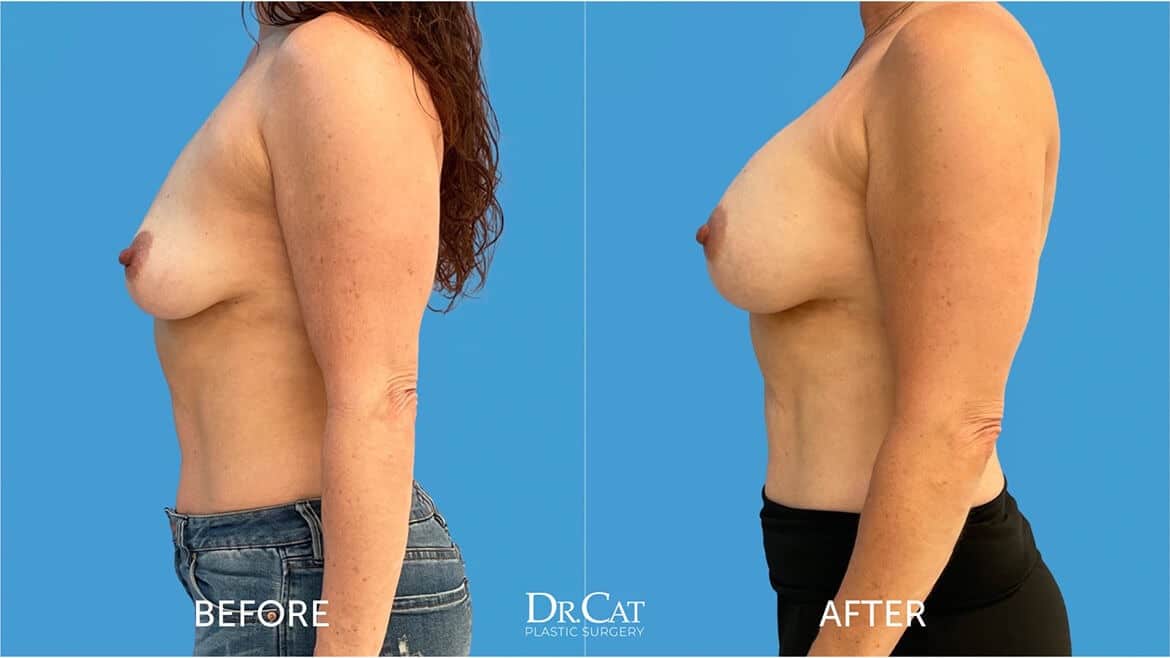
Saline breast implants use a silicone shell that is filled, after placement within the breast, with sterile salt water.
Pros of Saline Breast Implants
- The water is completely safe for the body to absorb should a rupture occur. No medical risk from contents leaking.
- Not pre-filled, allowing a much smaller incision (often around the areola) which is easier to disguise.
Cons of Saline Breast Implants
- Can feel less natural and firmer than silicone.
- More round shape; best suited to patients with enough breast tissue to conceal the shape.
- May have a shorter lifespan than silicone implants.
Which is safer, saline or silicone breast implants?

Both saline and silicone breast implants have gone through rigorous testing and study to both be approved by the FDA. Both are safe and hundreds of thousands of patients receive both types each year. Although there are some health concerns with certain types of silicone breast implants, these issues are very rare occurrences.
As Dr. Cat explains, "We have silicone exposure every day, such as in our cooking spray, deodorant, and food containers. The amount you are exposed to from implants is much less than everyday exposure. Studies measured silicone in breast milk and found it to have less silicone than baby formula and even less than cow's milk."
Saline Implants Cost vs Silicone Implant Cost
Pricing for silicone and saline implants is actually quite similar. Silicone tends to cost a bit more than saline because of the filler material. However, the cost differential is small, so this probably shouldn't be a factor when choosing the appropriate implant for your needs.
When budgeting for saline vs silicone breast implants, remember that the implant material is only one line item. Anesthesia, surgical facility fees, pre-operative imaging, post-op garments, and follow-up visits all factor into the total. In our experience, patients who choose silicone often weigh the slightly higher upfront cost against the more natural feel, while patients selecting saline appreciate the smaller incision and lower base price. We always provide a transparent, itemized quote during consultation so there are no surprises.
Key Differences Between Saline and Silicone Breast Implants
When comparing saline vs silicone breast implants, the most noticeable differences come down to feel, shape behavior, incision size, and how a rupture is detected.
Feel: Silicone gel mimics natural breast tissue closely. Saline feels firmer and can ripple, especially in thinner patients with less natural coverage.
Incision: Saline implants are inserted empty and then filled, allowing a smaller incision. Silicone implants arrive pre-filled and require a slightly longer incision.
Age requirement: Saline implants are FDA-approved for women 18 and older for augmentation. Silicone implants are approved for women 22 and older.
Rupture detection: A saline rupture is immediately obvious because the breast visibly deflates. A silicone rupture can be silent, requiring MRI or ultrasound imaging to detect. The FDA recommends regular screening for silicone implant patients.
Shape options: Silicone implants are available in both round and anatomical (teardrop) shapes. Saline implants are primarily round.
How to Choose the Right Implant for Your Body and Goals
Choosing between saline vs silicone breast implants is a personal decision shaped by your anatomy, lifestyle, and aesthetic goals. During consultation we evaluate several factors together:
Breast tissue coverage: Patients with thinner skin or minimal natural tissue typically benefit from silicone, which is less likely to show rippling.
Desired look: If you want a soft, natural slope, silicone gel tends to drape more like breast tissue. If you prefer a rounder, fuller upper pole, saline can deliver that shape.
Activity level: Both implants are durable, but submuscular placement is often recommended for active patients regardless of fill type.
Peace of mind: Some patients prefer saline because a rupture is immediately detectable. Others prefer silicone for the more natural feel and shape and accept the imaging schedule.
Recovery and Long-Term Care After Breast Augmentation
Recovery timelines are similar for both saline and silicone implants. Most patients return to desk work within 5 to 7 days, resume light activity at 2 weeks, and clear vigorous exercise at 6 weeks. Swelling settles over 2 to 3 months, and the implants typically reach their final position around the 3 to 6 month mark, a process we call drop and fluff.
Long-term, both implant types require routine monitoring. For silicone, we recommend imaging every few years to screen for silent rupture. For saline, visual inspection during annual checkups is usually sufficient since deflation is obvious. Capsular contracture, scar tissue tightening around the implant, can occur with either type and is one of the more common reasons for revision surgery.
We schedule structured follow-ups at 1 week, 6 weeks, 6 months, and annually thereafter. This cadence helps us catch any changes early and keeps you confident in the health of your implants.
Choose the Best Implant Right for You with a Beverly Hills Breast Augmentation Expert
As you can see there are benefits to each type of implant. If you are comparing silicone versus saline implants, you can feel comfortable discussing any of your questions with Dr. Cat's team before making a decision. Dr. Cat provides extremely thorough and in-depth breast augmentation consultations so that patients can make informed decisions. Patient preference, lifestyle, and anatomy all factor into the type of implant that is best. Reach out to Dr. Cat's team to learn more and find the implant that is right for you.
Frequently Asked Questions About Saline vs Silicone Breast Implants
What is the main difference between saline vs silicone breast implants?
Silicone implants are pre-filled with cohesive silicone gel that feels closer to natural breast tissue. Saline implants are filled with sterile salt water after placement, allowing a smaller incision but a firmer feel and a higher chance of visible rippling in thinner patients.
Which is safer, saline or silicone breast implants?
Both are FDA-approved and have undergone extensive safety testing. Saline ruptures are immediately visible because the breast deflates, while silicone ruptures can be silent and require imaging to detect. Neither type is considered safer overall when used as directed and monitored regularly.
How long do saline and silicone breast implants last?
Both saline and silicone breast implants typically last 10 to 20 years. They are not considered lifetime devices, and some patients need revision surgery sooner due to rupture, capsular contracture, or changes in aesthetic preference. Routine follow-up helps determine when replacement may be needed.


