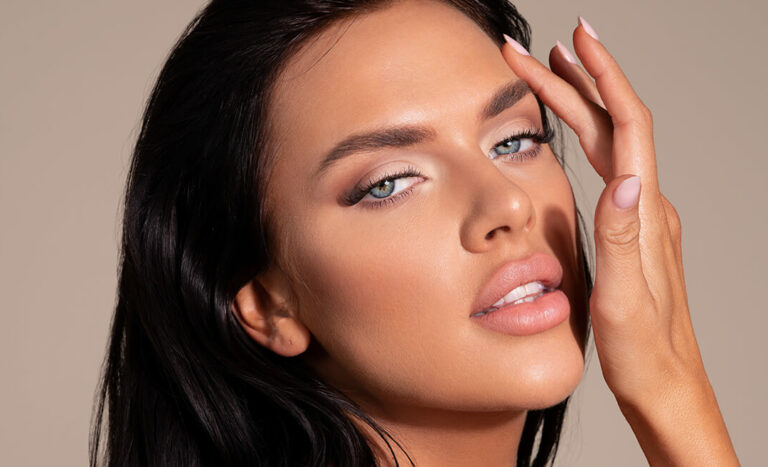


Why Every Face Is Asymmetric
The two halves of the face grow from separate halves of the embryo and never match exactly, so a small difference between the sides is the rule. Habits add to it: chewing on one side thickens that jaw muscle, sleeping on the same cheek for decades flattens it, and sun through a car window ages the driver's side faster. Aging is uneven too; the fat pads of the cheeks thin and descend at different rates, so one fold deepens first and one jowl appears before the other. A nose broken in childhood heals crooked, and a bite that is off shifts the chin.
One kind of asymmetry is not cosmetic: a sudden droop of one side of the face, a new inability to close one eye, or weakness in the arm on the same side is a nerve or vascular problem, from Bell's palsy to a stroke, and needs a physician the same day. The rest, the asymmetry that shows at rest in every photograph and bothers you, is the subject of this post.

Judge asymmetry at rest, not in expression: the differences that matter show when nothing on the face is moving.
Next step: if you want the two sides of your face balanced without an operation, read about facial fillers in Beverly Hills, which restore volume where one side has less in a single visit, or book a free discovery call to find out whether an injectable or surgery is the right answer for your face.
Can Facial Exercises Fix Asymmetry?
No. Facial exercises, face yoga and jaw tools work the muscles of expression, and those muscles are not what makes most faces uneven. A muscle worked hard gets a little bulkier, which is why chewing on one side thickens one masseter, but exercising a muscle cannot move the bone beneath it, straighten cartilage, restore a fat pad that has thinned or tighten skin that has loosened. The nose has no muscle to train at all, so the nose exercises, tapes and clips sold for a crooked or wide nose change nothing. There is no evidence that facial exercises correct asymmetry, and the practice does not prescribe them for it.
How to improve facial symmetry naturally: what does help
What you can do without treatment is stop adding to the asymmetry you have. Chew on both sides. Sleep on your back, or at least alternate sides. Wear sunscreen every day, because uneven sun damage ages one side faster. Correct a habitual head tilt, which makes a level face read as uneven, and have a bite that feels off examined by a dentist. Grooming helps at once: brows shaped to sit at the same height, a hair part moved to the fuller side, and contouring on the flatter cheek all read as symmetry from a normal distance. Beyond that, only injectables or surgery change the face itself.
Facial Asymmetry Correction Without Surgery: Botox and Fillers
The non-surgical treatments that change a face balance its soft tissue: Botox for the muscles that pull unevenly, filler for the volume one side lacks. Neither moves bone, and both are temporary, which is also their advantage: a correction can be tried, judged at two weeks and adjusted.
Botox for uneven brows, eyes and jaw
Botox relaxes the muscle it is injected into, so it treats asymmetry that a muscle causes. A brow that sits higher than the other is usually a forehead muscle working harder on that side; a few units placed in the stronger side lets the brows settle level, and the same logic evens crow's feet that fan deeper on one side. Dr. Cat performs Botox of the forehead and around the eyes herself, after watching your face raise, frown and squint to map which side pulls harder. A jaw that is bulkier on one side from a dominant chewing muscle is treated with masseter Botox, and a smile that lifts more on one side or a chin that dimples unevenly is treated in the small muscles around the mouth and chin; these areas are injected by our board-certified facial plastic surgeon. Read about Botox at Dr. Cat Plastic Surgery; the first softening shows at three to five days, the full effect at about two weeks, and the balance holds for three to four months.
Fillers to balance the lips, the folds, the cheeks, the chin and the jawline
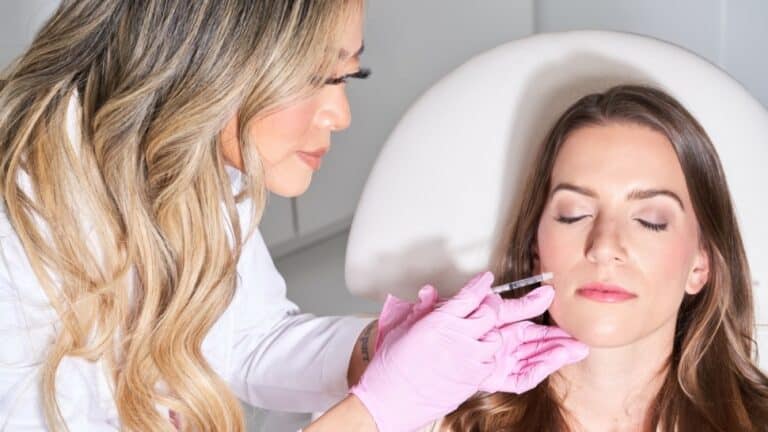
Filler adds volume where one side has less. Dr. Cat injects the lips herself, for a lip that is thinner on one side or a border that sits higher on one side, and the nasolabial folds, where one fold is deeper than the other, laying small amounts of gel in layers so the crease softens without a ridge. The cheeks, the hollows under the eyes, the temples, the chin and the jawline are injected by our facial plastic surgeon, who also performs the liquid rhinoplasty: filler placed above and below a small hump or a slight bend so the profile reads straight, which disguises a crooked nose rather than straightening it. Every syringe at the practice is placed by one of its two surgeons, never by a nurse injector or physician assistant. Juvederm and Restylane are $1,250 per syringe, in full syringes, and Botox is $25 per unit, the same whichever surgeon injects. Filler lasts 6 to 12 months in the lips, 9 to 15 months in the folds and 12 to 18 months in the cheeks, the chin and the jawline; the final look shows at about two weeks, and the gel can be dissolved if a result needs adjusting.

Lip filler before and after at Dr. Cat Plastic Surgery: the upper lip's border defined and the two sides brought level, the kind of soft-tissue asymmetry a single syringe can balance.
Skin treatments and devices
Skin-tightening treatments such as ThermiSmooth, a radiofrequency treatment offered at the practice, and medical-grade skincare improve texture and laxity across both sides of the face. They do not move a feature or add volume to one side, so they are not an asymmetry treatment.

Dr. Cat performing a ThermiSmooth treatment: radiofrequency tightens skin on both sides but does not move a feature.
The limits of non-surgical treatment
Filler only adds, so it can fill a flatter side but never reduce a fuller one. Botox only relaxes, so it cannot lift a brow that has dropped or a cheek that has fallen. Both wear off and are repeated, so over several years the cost of maintaining a correction can pass the cost of the operation that makes it permanent. A crooked nose, a chin off the midline, an eyelid that hoods more on one side and a cheek that has descended further than the other are structural, and structure is corrected with surgery.
Surgical Facial Asymmetry Treatment: What Moves Structure
Surgery changes the framework the soft tissue sits on, and the change does not wear off. Each operation below is performed by the surgeon named and planned from the whole face, because a feature is only asymmetric in relation to the features around it.
Rhinoplasty for a crooked nose
A crooked nose is bone and cartilage, often with a deviated septum behind it, and Dr. Cat straightens both in a primary rhinoplasty: the nasal bones are repositioned with controlled cuts, the septum is straightened so the airway opens, and grafts of your own cartilage hold the middle of the bridge in line. She uses the open approach for a crooked nose so the whole framework can be seen. Our post on how to fix a crooked nose covers the causes and the options, and our page on nose shape concerns explains which part of the nose sets each shape. A previous rhinoplasty that healed crooked is a revision, performed at the practice by our facial plastic surgeon.
Eyelid lift for uneven eyelids
Eyelids rarely age at the same speed: one upper lid hoods more, or one lower lid holds a bag. In an eyelid lift, which Dr. Cat performs herself, upper, lower or both, she removes a different amount of skin and fat from each side, working under 3.5X magnification operating lenses, which is how the two sides are made to match. The test she uses first is the brow: lift the tail of the lower eyebrow with a fingertip, and if the hood disappears, the brow has dropped rather than the lid, and a brow lift, performed by our facial plastic surgeon, is the operation that levels the eyes.
Fat transfer to the face for a flatter side
When one cheek, temple or under-eye hollow has less volume than the other, fat transfer to the face, which Dr. Cat performs, restores it with your own tissue. Fat harvested by liposuction from the belly, a thigh or a flank is layered in fine passes, more on the flatter side, so the two sides finish level. The fat that takes a blood supply is permanent, and in Dr. Cat's experience more than 80 to 90 percent of the transferred fat survives, which is why her patients rarely need a second round. Filler in the same areas is the temporary preview.
Chin, jaw and cheek implants
A chin that sits off center, a jaw angle that is softer on one side or a cheekbone that projects less than the other is a skeletal difference, and facial implants, placed by our facial plastic surgeon, add fixed structure against the bone where it is short. Many patients try chin filler first as a preview; our post on a chin implant vs chin filler compares the two.
Facelift and brow lift for a side that has dropped
When aging has pulled one side of the face further than the other, a jowl or a deeper fold on one side, the correction is to reposition the tissue rather than fill over it. A facelift, at the practice a face and neck lift performed by our facial plastic surgeon, lifts and resets the deeper layer of the face on each side, and a brow lift, also his, levels the brows when the forehead has descended unevenly. Filler on a fallen side only makes it heavier.
Buccal fat removal, lip lift and otoplasty
Three smaller operations correct specific asymmetries, all performed by our board-certified facial plastic surgeon: buccal fat removal for a lower cheek that is fuller on one side, a lip lift for an upper lip that is longer on one side, and otoplasty for an ear that stands further from the head than the other.
How Dr. Cat Evaluates Facial Asymmetry
The plan starts with a facial analysis, not a product. At the consultation Dr. Cat, or our facial plastic surgeon for the areas that are his, photographs your face at rest and in expression, watches which side pulls harder when you raise, frown, squint and smile, and measures the brows, the eyes, the nostrils and the corners of the mouth against the midline. Nearly every face has a stronger side. She then tells you which differences are muscle, which are volume and which are bone, and the plan is usually a map rather than a single choice: a few units of Botox on the stronger side, a syringe on the flatter side, and surgery for the one feature that cannot be balanced any other way. Expect to be told when the asymmetry you see is within the range of every face and needs nothing.
Talk to Dr. Cat About Facial Asymmetry
Start with a free 15-minute discovery call with our Patient Concierge, who books your consultation. A surgical consultation with Dr. Cat is $500 for a first consultation and $1,500 for a revision consultation, credited in full toward your surgery; out-of-town patients consult by private video through OnPatient, the practice's HIPAA-secure patient portal. Injectable visits are booked directly. Your appointment is reserved with a $500 deposit credited to your treatment; new patients are evaluated and treated at the same visit, and the $500 stays as a credit if treatment is not right for you. Book a free discovery call to get started.