


What Is 1 Unit of Botox? How Botox Is Measured
Botox is botulinum toxin type A, and it is measured in units of biological activity: one unit is a fixed amount of the drug's effect, defined by the manufacturer's potency test, so every unit in every vial relaxes the same amount of muscle. It is not a milliliter, a milligram or a drop. The drug arrives as a freeze-dried powder in vials of 50 or 100 units, and before treatment the injector reconstitutes it with sterile saline; how much saline goes in is the injector's choice, which is why the same 20 units can be 0.5 ml in one office and 1 ml in another. That is the whole reason doses are counted in units: milliliters and syringes describe the water, units describe the drug. One unit on its own does almost nothing visible; the small muscles between the brows take about 20, and a forehead 10 to 30.
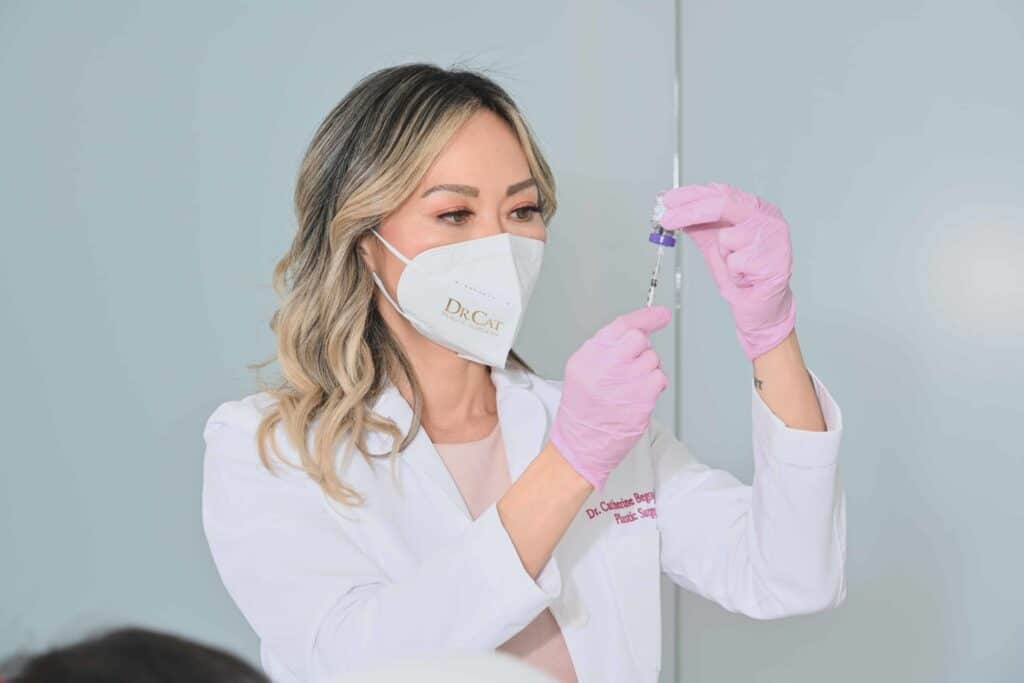
Dr. Cat drawing a dose into a syringe: the syringe holds the units her plan calls for, drawn from a 100-unit vial.
Next step: read about Botox in Beverly Hills with Dr. Cat, who injects the forehead and the area around the eyes herself, or book a free discovery call and our Patient Concierge will arrange your appointment.
How Many Units of Botox Are in a Syringe?
There is no fixed number, and a clinic that sells Botox by the syringe is selling a unit count it has not told you. The vial holds 100 units; the syringe holds whatever the injector draws from it for your plan. A first-time frown-line patient might have 10 units in the syringe, a forehead and frown lines together 40, and a full upper face 40 to 64 units, often split across more than one syringe so each area gets its own. Two syringes that look identical can carry very different doses, because one injector dilutes a vial with 1 ml of saline and another with 4 ml. So when you are quoted a syringe, ask how many units are in it and what the price per unit is; when you compare two offices, compare units per area. The pricing arithmetic, from 10 units to a full vial, is in our Botox cost guide.
How Many Units of Botox per Area
The ranges below are typical starting points; your count is set at the appointment from how your muscles move, and men usually need the higher end because their muscles are thicker. Dr. Cat performs Botox of the forehead and around the eyes; the other areas are treated by our board-certified facial plastic surgeon.
Forehead lines
About 10 to 30 units for the horizontal lines across the forehead. The forehead is one wide, flat muscle, and the aim is even softening across its width with enough movement left for the brows to lift. Dr. Cat spaces several small injections across the whole forehead rather than a few large ones, and she almost always treats the frown lines at the same visit, because relaxing the muscle that lifts the brows while leaving the muscles that pull them down can let the brows drop.

Dr. Cat placing forehead units while the patient watches in a mirror; the forehead and the eyes are the areas she injects herself.
Frown lines between the brows (the 11s)
Ten to 20 units for the vertical lines between the brows, made by the corrugator and procerus muscles pulling the brows together. Twenty units is the dose on the Botox label for this area, and it is the one area where the label dose was written for exactly these muscles; a patient with strong frown muscles may need the full 20 from the start, a first-time patient often starts lower.
Crow's feet
Five to 15 units per side, so about 10 to 30 units for both eyes. The muscle that rings the eye is thin, so small doses do a great deal, and placement matters more than the count: product drifting into the wrong fibers gives a droopy lid or a flat smile, so the injections sit a few millimeters outside the bony rim.
Bunny lines and the lip flip
A few units each: bunny lines on the sides of the nose take a small dose on each side, and a lip flip, which relaxes the muscle along the upper lip border so the lip rolls slightly outward, takes about 4 to 6 units and wears off sooner than other areas because the dose is so small. Both are treated by our facial plastic surgeon.
Masseter
Larger doses on each side, because the masseter is a thick chewing muscle: masseter Botox slims a square jaw or eases clenching over the following weeks, and the units are set by our facial plastic surgeon from the size of the muscle. The masseter is the usual reason a plan climbs toward 100 units.
Chin and platysmal neck bands
A small dose for a chin that dimples or puckers, and a larger total spread along the vertical bands of the neck, both set at the appointment by our facial plastic surgeon. Neck bands are the other area that pushes a visit's total well beyond an upper-face plan.
What 20, 40, 64 and 100 Units of Botox Cover
- 20 units: the frown lines at the label dose, or a light forehead. One area.
- 40 units: the forehead and the frown lines together, the two-area plan most patients start with.
- 64 units: the full upper face, forehead, frown lines and crow's feet, at the higher end of each range.
- 100 units: a whole vial. The upper face plus the masseter or the neck bands, or several areas in a man with strong muscles; rarely one upper-face treatment on its own.
At the practice's per-unit price those plans come to $500, $1,000, $1,600 and $2,500 respectively, and the quote is confirmed before anything is injected.
Dysport Units Are Not Botox Units
Dysport is the other neuromodulator the practice offers, and its unit is a smaller measure of the drug: about 2.5 to 3 units of Dysport do the work of one unit of Botox, so a 20-unit Botox area is about 50 to 60 units of Dysport, and the label doses for frown lines are 20 units of Botox and 50 units of Dysport. Dysport is $8.50 per unit, which sounds cheaper until the units are converted; the only fair comparison is the price of a treated area, and our Botox vs Dysport comparison does that arithmetic. If you were treated elsewhere with either product, bring the record of product and units per area so the dose can be converted rather than copied.
What Changes Your Dose
Muscle strength first: a patient who frowns hard needs more units than one with light expressions, and men usually need more than women. Then your history: a first-time patient is dosed conservatively and adjusted at the two-week check rather than overtreated on day one, and a regular patient often needs fewer units over time, because a muscle that has been relaxed for a year is smaller and weaker than it was. Age and skin thickness matter, and so does the result you want, since a forehead that still moves a little takes fewer units than one that does not. Dr. Cat maps the muscles first: she watches your face raise, frown, squint and smile, marks where each muscle actually pulls, which is rarely symmetrical, and only then sets a count for each area, with you. The first softening shows at three to five days and the full effect at about two weeks, which is when a touch-up is judged; our post on how long Botox takes to work follows it day by day. The effect holds for about three to four months.
Units do not decide the result on their own. Too many in the forehead flatten it and drop the brow; too few leave the lines. The practice's aim is a smoother forehead over a brow that can still lift, and the way to protect the dose you were given is simple: stay upright for four hours, skip strenuous exercise for 24 hours, and do not rub the treated areas. Our post on making Botox last longer covers the rest. Lines that are there when your face is completely still are not a units question at all; they are filler lines, and our Botox vs fillers comparison draws that line.
Who Injects at Dr. Cat Plastic Surgery
Dr. Cat, a board-certified plastic surgeon, injects Botox and Dysport of the forehead and around the eyes herself at the office on Rodeo Drive. The masseter, the chin, the platysmal neck bands, bunny lines, lip lines and the lip flip are treated by our board-certified facial plastic surgeon. When a nurse injector or physician assistant is engaged, they treat the forehead and around the eyes only, under the practice's supervision, and never inject filler. The price per unit is the same whichever provider injects, and it is published on our non-surgical pricing page.
Book Botox With Dr. Cat
Start with a free 15-minute discovery call with our Patient Concierge, or book a free discovery call online; injectable visits are booked directly. Your appointment is reserved with a $500 deposit credited to your treatment; new patients are evaluated and treated at the same visit, and the $500 stays as a credit if treatment is not right for you.