

What is awake liposuction?
Awake liposuction (tumescent liposuction under local anesthesia) removes a pocket of fat through incisions a few millimeters long while you are awake. A tumescent solution of saline, lidocaine and epinephrine is infused into the area first: the lidocaine numbs it, the epinephrine constricts the blood vessels so there is little bleeding and bruising, and the fluid firms the fat so it comes out evenly. Nothing else changes. The cannulas, the grid, the counted strokes and the thin cushion of fat Dr. Cat leaves under the skin are the same as in a full liposuction under general anesthesia. What differs is the anesthetic, and with it the number of areas that can be treated in one session, the length of the day and the recovery. A larger plan such as a lipo 360, seven areas of the trunk contoured in one surgery, is performed under general anesthesia.
What changes when you stay awake
- Anesthesia: local only, with no breathing tube and no general anesthetic to wake up from; IV sedation is the middle option for patients who would rather be drowsy than alert
- Scope: one or two smaller areas in one session, because the amount of local anesthetic that can be given safely at one time is limited
- Time: about an hour and a half for a single small area
- Feedback: you can tighten a muscle or turn on request, so Dr. Cat checks the contour from every angle while she works
- Recovery: home within hours, light activity within a few days, and the same six-week compression garment as any liposuction
Who is a good candidate for awake liposuction?
The best awake liposuction patient has one pocket of firm, pinchable fat that ignores diet and exercise, on a frame that is otherwise close to its goal weight: a double chin on a fit face, a bra roll, inner thighs that rub. The fat has to be firm and the skin firm enough to shrink over the new contour, because liposuction removes fat and does nothing to skin. Dr. Cat examines each area with the pinch test at the consultation and says plainly when the plan is too large for local anesthesia, or when the problem is skin rather than fat.
You may be a good candidate if
- You have one or two localized, pinchable pockets of fat: the chin and neck, the arms, the bra rolls, the inner thighs or knees, the flanks, one part of the abdomen, or the buffalo hump of the upper back
- The skin over the pocket snaps back when you pinch it and let go
- You are within about 20 pounds of your goal weight and your weight is stable
- You are in good health, and you would rather avoid general anesthesia or need to be back at work within days
- Your expectations are realistic: a smaller, smoother version of the area you have, blended into the areas around it
Not the right plan if
- You want three or more areas, a lipo 360 or a large volume removed: that plan is under general anesthesia with a board-certified physician anesthesiologist, in one surgery or staged
- The skin stays in a fold when you pinch it: emptying the fat from under loose skin leaves it looser; a tummy tuck or a lift is the operation for skin
- Pregnancy left your abdominal muscles separated, or you have a hernia
- You have a bleeding disorder, a heart condition or a medical history that calls for an anesthesiologist monitoring you throughout; Dr. Cat plans those cases differently
- You want the fat transferred to your buttocks or hips: that is a Brazilian butt lift, performed under general anesthesia
Read our guides to love handles, muffin top and stubborn fat, a double chin, arm fat or loose arm skin and FUPA for what liposuction changes in each area and what it cannot.
How Dr. Cat does it
Dr. Cat is a board-certified plastic surgeon who completed two surgical residencies, one in head and neck surgery, microvascular and facial reconstructive surgery, and advanced training in general plastic and reconstructive surgery, Harvard-educated and UCLA trained, and she approaches liposuction as sculpture, not fat removal. Her revision liposuction practice shows her every week what a rushed or over-aggressive small case leaves: dents, ridges and skin stuck to the muscle.
The numbing: a tumescent solution, placed slowly
After Dr. Cat reviews the plan with you and marks the area in detail, the tumescent solution is infused through the same small incisions the cannula will use. The lidocaine numbs the tissue, the epinephrine shrinks the blood vessels, and the dose is calculated for your weight and tracked throughout, because too much local anesthetic is the classic complication of awake liposuction and the reason the number of areas is limited. Once the area is fully numb you feel pressure and movement, not pain.
The same technique, awake or asleep
Dr. Cat uses tumescent and power-assisted liposuction with her multi-stage technique: the fat gently broken into tiny particles, removed with thin cannulas precisely and evenly along an artistic grid on which every stroke is counted, and blended a final time so the result is smooth and natural. She leaves a thin, even cushion of fat under the skin on purpose, so the surface stays smooth, the skin moves naturally over the muscle and the treated area blends into the untreated areas around it with no shelf where the liposuction stops. She does not use laser lipo, SmartLipo, Vaser, J-Plasma, AirSculpt, Renuvion or any other heat device, awake or asleep, having seen the burns, the unevenness and the scar tissue they leave behind.
Reposition, check, blend
Being awake is useful to the result. Dr. Cat can ask you to turn onto your side, lift an arm or tighten the muscle under the area so she sees the contour the way it will be seen in life, and she checks it from several angles before the last blending pass. On a chin, that means the jawline is judged with your head in its natural position.
Surgery day: about an hour and a half, home the same day
Awake liposuction takes place in Dr. Cat's QUAD A accredited surgery center on Rodeo Drive. This is not a liposuction factory: she performs one larger surgery or two smaller liposuction surgeries a day, and every pass is hers. A single small area takes about an hour and a half. The incisions are a few millimeters long and closed meticulously, a custom-measured compression garment with foam over the treated area is placed at the end of the surgery, and you walk out within hours with someone to drive you home and stay with you the first night.
Awake liposuction or general anesthesia: how Dr. Cat decides
The choice is made at the consultation, from the plan. One or two smaller areas can be treated awake; three or more areas, a lipo 360 or a large volume of fat need general anesthesia with a board-certified physician anesthesiologist, because the local anesthetic that can be given safely in one session runs out before the plan does. The area matters too: the chin and neck are the classic awake case, a short procedure with a quick recovery. And you matter. Patients who would rather not be aware, or who have a bleeding disorder or a heart condition in their history, are planned for IV sedation or general anesthesia, and Dr. Cat says so rather than stretching local anesthesia to fit. Our post on the types of anesthesia used in plastic surgery explains the three options.
Combining awake liposuction with other procedures
Awake liposuction with fat transfer: the "awake BBL"
Dr. Cat does not perform a BBL awake. A Brazilian butt lift is a liposuction 360 harvest with the fat washed and placed in the buttocks and hips in many small passes, about four to seven hours under general anesthesia with a physician anesthesiologist, one per surgical day, with the first night in a plastic surgery aftercare center. The volume of fat and the hours involved are beyond what local anesthesia covers safely. What she offers instead is the BBL as it should be done, or awake liposuction alone when the goal is one smaller area and no transfer.
Awake liposuction and a tummy tuck
Liposuction of any kind removes fat and does nothing for loose skin or separated abdominal muscles. When the pinch test shows skin that stays in a fold, the right operation is a tummy tuck, to which liposuction of the love handles or the mons pubis is sometimes added conservatively, under general anesthesia; our tummy tuck vs liposuction comparison explains how Dr. Cat separates the two.
Awake liposuction recovery timeline
Recovery after awake liposuction is measured in days for daily life and in weeks for the contour. Here is what it looks like for most of Dr. Cat's patients.
- The day of surgeryYou walk out of the surgery center within hours, in your compression garment with foam over the treated area, with someone to drive you home. The tumescent solution keeps the area numb for hours, so the first evening is comfortable.
- Days one to threeAs the numbing wears off the area feels like a deep bruise, and most patients manage with Tylenol. Light activity resumes within a few days; walk every day.
- One weekMost patients are back at a desk within a few days and at most normal activities within one to two weeks. Swelling peaks around day three and then fades.
- Two weeksDr. Cat checks the incisions and scar treatment starts with the products she prescribes. Out-of-town patients can usually fly home within days of surgery, once she has seen them.
- Three to six weeksLight exercise at about three weeks, full exercise at about six, when the garment and foam come off. There is no lymphatic massage: with the fat removed evenly there is nothing for it to do, and Dr. Cat advises against the painful massages sold elsewhere.
- Three to six monthsThe swelling resolves and the contour refines over three to six months. The fat cells removed do not come back; a balanced diet and regular activity keep the cells that remain from growing, and the scars fade to almost nothing.
Awake liposuction before and after photos
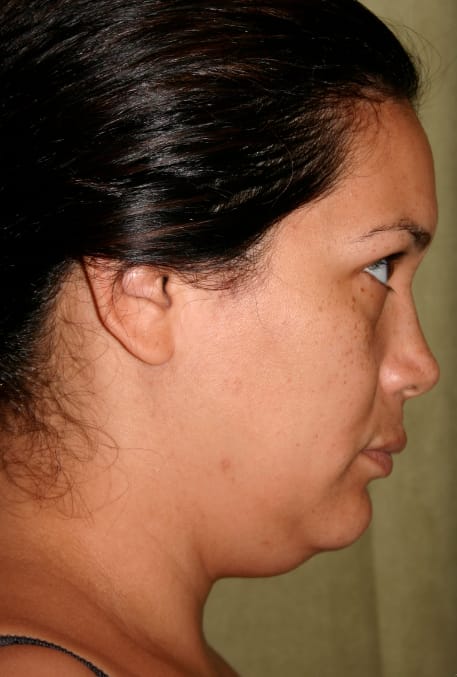
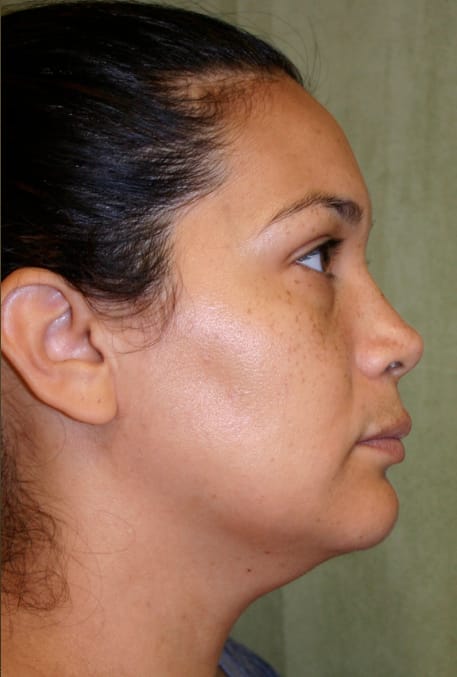
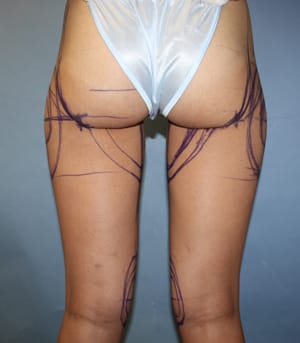
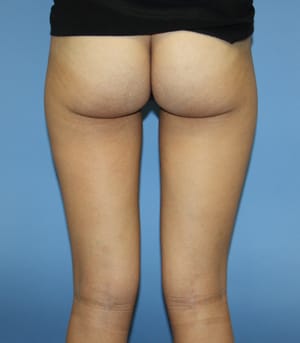
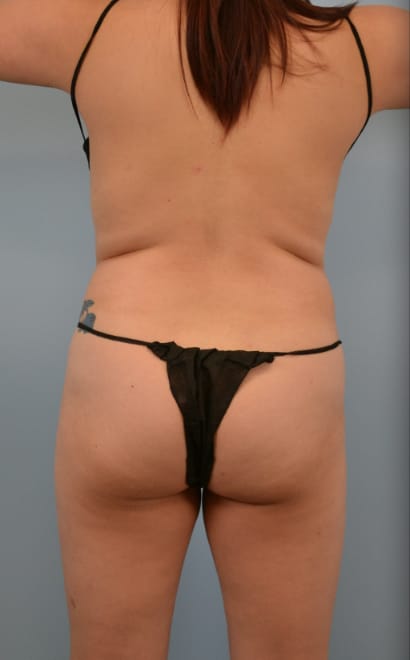
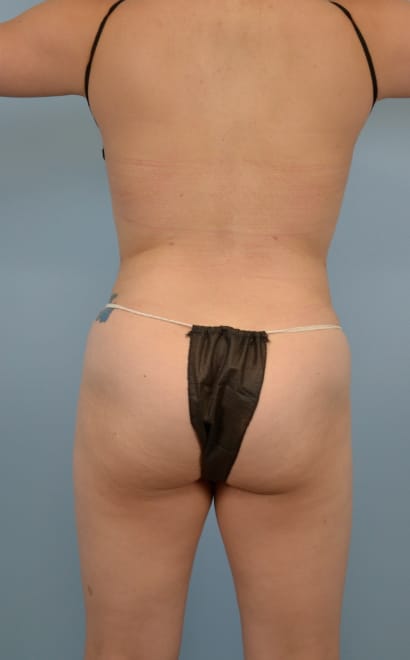
The six cases below are the kinds of area awake liposuction is planned for: LPS-0948 is chin liposuction (submental liposuction) photographed one month after surgery, with a slimmer face and a sharp jawline; LPS-2599 is liposuction of the neck; LPS-3739 treated the inner and outer thighs and the knees; LPS-2531 the inner thighs and the flanks; LPS-2528 the abdomen and flanks; and LPS-2583 the flanks alone. The gallery records the areas treated rather than the anesthesia used, so compare the areas closest to yours in the full liposuction before and after photos.
Risks and safety
Awake liposuction removes the risks of general anesthesia, and none of the others. A small case still asks for the same judgment as a large one, and Dr. Cat reviews the risks with every patient before surgery.
What can go wrong
- Bleeding under the skin (a hematoma), a pocket of fluid (a seroma), or an infection at an incision
- Irregularities where too much was taken or the passes were uneven: a dent, a ridge, or a treated area that does not match its neighbor
- Skin that hangs once the fat beneath it is gone, when it was too loose to begin with
- Patches of numbness or altered sensation, usually temporary, and swelling that takes weeks to months to leave
- Too much local anesthetic: historically the serious complication of tumescent liposuction, now rare with the dose calculated and tracked, and the reason too many areas are never attempted awake
- Burns and scar tissue with heat-based devices, which Dr. Cat does not use
- Blood clots and anesthesia reactions, rare and lower without general anesthesia
How Dr. Cat reduces these risks
- One or two smaller areas awake, never a lipo 360 or a large volume under local anesthesia; larger plans go to general anesthesia with a physician anesthesiologist
- The tumescent dose calculated for your weight and tracked throughout the case
- Every pass by Dr. Cat herself, with thin cannulas on a precise grid, each stroke counted, and a thin cushion of fat left under the skin
- No heat devices, awake or asleep
- Careful patient selection: firm skin, a stable weight, no bleeding disorder or heart condition in the history, and a tummy tuck instead when skin or muscle is the problem
- Surgery in her QUAD A accredited surgery center, with a compression garment for six weeks, no painful massages, and follow-up visits through the months the contour refines
How much does awake lipo cost in Beverly Hills?
Dr. Cat's surgeon's fee for awake liposuction is $10,000 for a single area; from two areas up it is $6,500 to $7,500 per area, so two areas are $13,000 to $15,000 in surgeon's fees. The operating room and the anesthesia are quoted at your consultation, once Dr. Cat has examined you and set the operating time your surgery needs: operating time varies with your anatomy and with the areas treated together, so it is set by her, not by a price list, and the surgery center fee reflects the shorter time and the local anesthesia. The quote is itemized, adjusted for your BMI and the amount of fat, and includes your first compression garment and every follow-up visit.
The price reflects what is behind it: one surgeon who performs every pass herself, one larger or two smaller liposuction surgeries a day, and an accredited surgery center. Published national averages for liposuction run from about $6,380 to $15,000 and leave out much of what a quote contains. Please do not fall for cheap or fast awake lipo: a small area done unevenly leaves a dent that costs far more to repair than the surgery done well. Our liposuction cost guide lists every area's price and what changes it.
Consultation fee and financing
A consultation with Dr. Cat is $500, or $1,500 for a revision consultation, credited in full toward your surgery. To pay over time, the practice partners with Cherry, its primary financing partner, and also accepts CareCredit and Alphaeon Credit; see financing and payment plans. Awake liposuction is cosmetic and is not covered by insurance.
Your consultation with Dr. Cat
It starts with a free 15-minute discovery call with our Patient Concierge, who answers your first questions and books your consultation. At the consultation, in person on Rodeo Drive or, for out-of-town patients, by private video consultation through OnPatient, the HIPAA-secure patient portal, Dr. Cat listens to what bothers you, examines each area with the pinch test, and tells you whether the area is fat or skin, whether one session awake covers your plan or general anesthesia is the safer day, and what to expect through recovery. You leave with an itemized written quote; once you are scheduled, we send your pre-operative guidelines.