

What is lipo 360?
Lipo 360, also written 360 liposuction or liposuction 360, is liposuction of the whole trunk in one surgery rather than one area at a time. A tumescent solution numbs each area and limits bleeding, and the fat is removed through incisions a few millimeters long with a thin cannula, front, sides and back, with every area blended into the next so there is no line where the suction stopped. It is the larger version of liposuction, and it is contouring rather than weight loss: the removed fat cells do not come back, and the shape lasts as long as your weight stays stable. For one or two smaller areas Dr. Cat also offers awake liposuction under local anesthesia; a 360 is always under general anesthesia.
The seven areas
- Upper abdomen
- Lower abdomen
- Flanks, the love handles
- Hips
- Upper back, including the bra rolls
- Mid back
- Lower back, above the buttocks
What lipo 360 does not do
It removes fat and does nothing to skin or muscle. Loose skin stays loose, with less underneath to fill it, and abdominal muscles that separated in pregnancy stay separated; those are tummy tuck problems, and the pinch test at the consultation decides. It is not weight loss either: the law caps fat removal at five liters in one session, roughly 8 to 10 pounds, and most patients have far less removed. "Full body liposuction" is a marketing phrase rather than a procedure; a large case is planned as a 360 and the rest staged on another day.
Who is a good candidate for lipo 360?
The typical patient is close to her goal weight and carries a muffin top that shows from every side: a waist that will not narrow however she trains, love handles, a roll under the bra and a shelf above the buttocks. The skin has to be firm enough to shrink over the new contour all the way around. Our guide to love handles, muffin top and stubborn fat calls lipo 360 the operation most muffin-top patients need.
You may be a good candidate if
- You are within about 20 pounds of your goal weight and your weight is stable
- The fat is firm and pinchable on the abdomen, the sides and the back, and the skin over it still snaps back when you let go
- You want a smaller waist from every angle, not a flatter stomach with the sides left as they were
- You are in good health, do not use nicotine, and can commit to six weeks in a compression garment
- Your expectations are realistic: a contoured version of the shape you have
Not the right operation if
- The skin stays in a fold when you pinch it: emptying the fat from under loose skin leaves it looser; a tummy tuck is the operation for skin. Read apron belly and loose skin after pregnancy
- Pregnancy left your abdominal muscles separated (diastasis recti), or you have a hernia
- You are hoping to lose weight through surgery: removal is capped at five liters in one session
- You want the 360 on the same day as a tummy tuck: Dr. Cat never combines them, for the safety reasons below
- There is too little fat to make a difference; Dr. Cat has said no to patients for that reason
The mons pubis (a FUPA), the arms or the inner thighs are not among the seven areas and can be added to the plan, each quoted per area.
How Dr. Cat does it
Dr. Cat is a board-certified plastic surgeon who completed two surgical residencies, one in head and neck surgery, microvascular and facial reconstructive surgery, and advanced training in general plastic and reconstructive surgery, Harvard-educated and UCLA trained, and to her liposuction is sculpture, not fat removal. A 360 is where that shows most, because seven areas have to read as one body.
Tumescent and power-assisted, never a heat device
Each area is infused first with a tumescent solution of saline, lidocaine and epinephrine, which numbs the tissue and limits bleeding. Most areas are then treated with power-assisted liposuction, a vibrating cannula that blends more evenly than a fixed one, in Dr. Cat's multi-stage technique: the fat gently broken into tiny particles, removed with thin cannulas precisely and evenly on a precise, artistic grid with every stroke counted, then blended a final time so the result reads as smooth and natural. She uses no laser lipo, SmartLipo, Vaser, J-Plasma, AirSculpt, Renuvion or any other heat device, because of the burns, the uneven results and the scar tissue she has seen them leave.
Seven areas as one contour
The point of a 360 is the transitions. The lower back is blended into the hips, the hips into the flanks, the flanks into the abdomen and the upper back into the bra line, so that the waist is the narrowest point from every angle, with no shelf where one area ends and the next begins. Dr. Cat maps every area before surgery and repositions you during it so the front, the sides and the back are checked as one shape; for patients who want definition, she adds natural-looking ab etching without injuring the tissues or the skin.
Why she leaves a cushion of fat
Most of the damage Dr. Cat corrects in her revision liposuction practice comes from taking too much: once the fat under the skin is gone, the skin adheres to the muscle and the surface dents and folds, and large aggressive cannulas add fibrosis and scar tissue. On a 360 that damage would run all the way around. She removes the fat symmetrically with thin cannulas and leaves an even layer of fat beneath the skin, which keeps the surface smooth and lets the skin glide over the muscle.
Surgery day: about five and a half hours, one lipo 360 per day
The surgery is performed under general anesthesia with a board-certified physician anesthesiologist, with the numbing solution in every treated area, in Dr. Cat's QUAD A accredited surgery center on Rodeo Drive, and takes about five to five and a half hours. This is not a liposuction factory: she performs one larger surgery a day, a 360 or a revision liposuction, and nothing else. A custom-measured compression garment with foam goes on at the end of the surgery, and after about an hour in recovery you are transported to a plastic surgery aftercare center for the first night.
Combining lipo 360 with other procedures
Lipo 360 with a BBL
A 360 is the harvest of a Brazilian butt lift: the fat removed from the abdomen, flanks, hips and back is washed and placed in the buttocks and hips in many small passes, in the layer above the muscle, at about $65,000 to $71,000 all in. In Dr. Cat's experience more than 80 to 90 percent of the transferred fat survives, which is why her patients rarely need a second round. A slim patient with limited donor fat is planned as a skinny BBL, harvested from the same seven areas and often the thighs. The transfer makes the surgery four to seven hours in all and adds six weeks without sitting directly on the buttocks; the fat cannot be banked, so the decision is made before surgery. Fat transfer to the hips alone treats hip dips.
Lipo 360 with natural breast augmentation
The harvested fat can also go to the breasts: a 360 with fat transfer to the breasts is a natural breast augmentation, about $65,000 to $71,000 all in, a modest increase in size from your own fat.
Lipo 360 and a tummy tuck
Dr. Cat never performs a 360 on the same day as a tummy tuck. The blood supply to the abdominal skin that a tummy tuck lifts runs through the fat beneath it, and suctioning that fat aggressively in the same operation risks skin and fat necrosis. When both are needed, she performs them on separate days, with only conservative liposuction of the love handles or the mons pubis added to the tummy tuck itself; the 360, with or without a BBL, gets its own surgical day. Our comparison of lipo 360 vs tummy tuck explains the pinch test that decides which one your body needs.
Lipo 360 recovery timeline
Here is what recovery looks like for most of Dr. Cat's patients: little bruising, little to no pain, and a contour that keeps refining for months.
- The night of surgeryYou wake in the recovery room in your compression garment with foam over every treated area, numb rather than sore from the tumescent solution. After about an hour you are transported to a plastic surgery aftercare center, where nurses monitor you overnight and get you up to walk that evening.
- Day oneThe aftercare center brings you to our office for your first visit, where Dr. Cat checks the treated areas and reviews the instructions with you and your caretaker. Expect a deep-bruise soreness across the abdomen, the sides and the back; most patients manage with Tylenol.
- The first weekSwelling peaks around day three and then fades. Walk every day and keep the garment on; most patients are back at a desk within one to two weeks.
- Two weeksDr. Cat checks the incisions and scar treatment starts with the products she prescribes. Out-of-town patients can usually fly home within days of surgery, once she has seen them.
- Three weeksLight exercise resumes at about three weeks. The waist is visibly smaller under the garment, still with some swelling.
- Six weeksThe garment and foam come off and full exercise resumes. Fat removed this evenly does not need lymphatic massage, and Dr. Cat advises against the painful massages sold elsewhere.
- Three to six monthsThe swelling resolves and the contour refines. A balanced diet and regular activity keep the fat cells that remain from growing, and the scars, a few millimeters long, fade to almost nothing with the scar treatments she prescribes.
Lipo 360 before and after photos
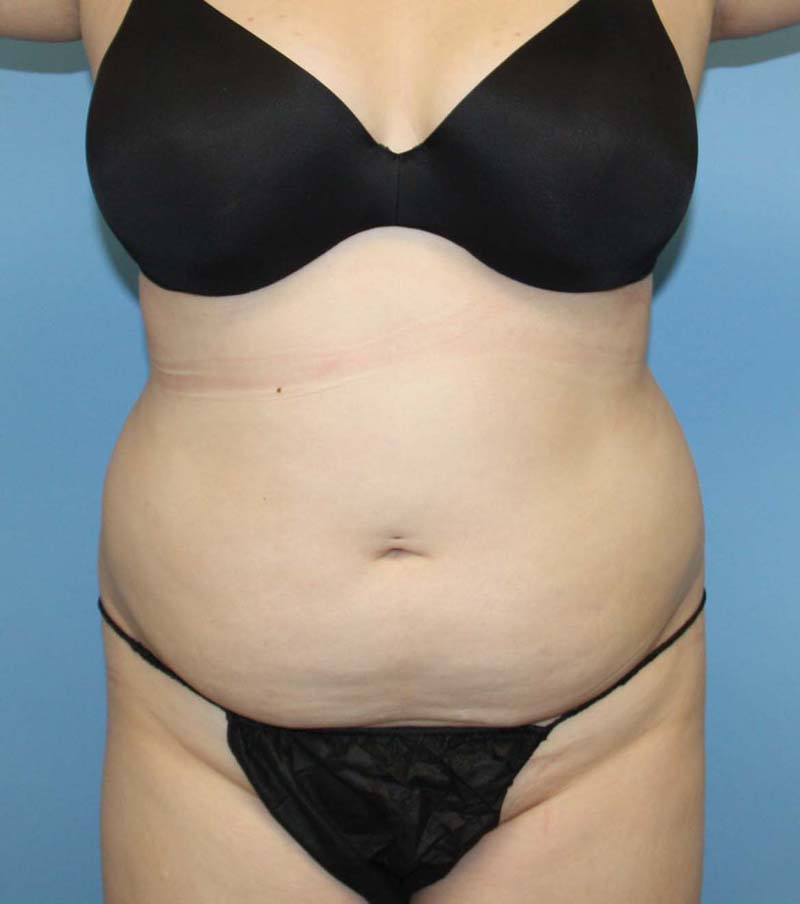
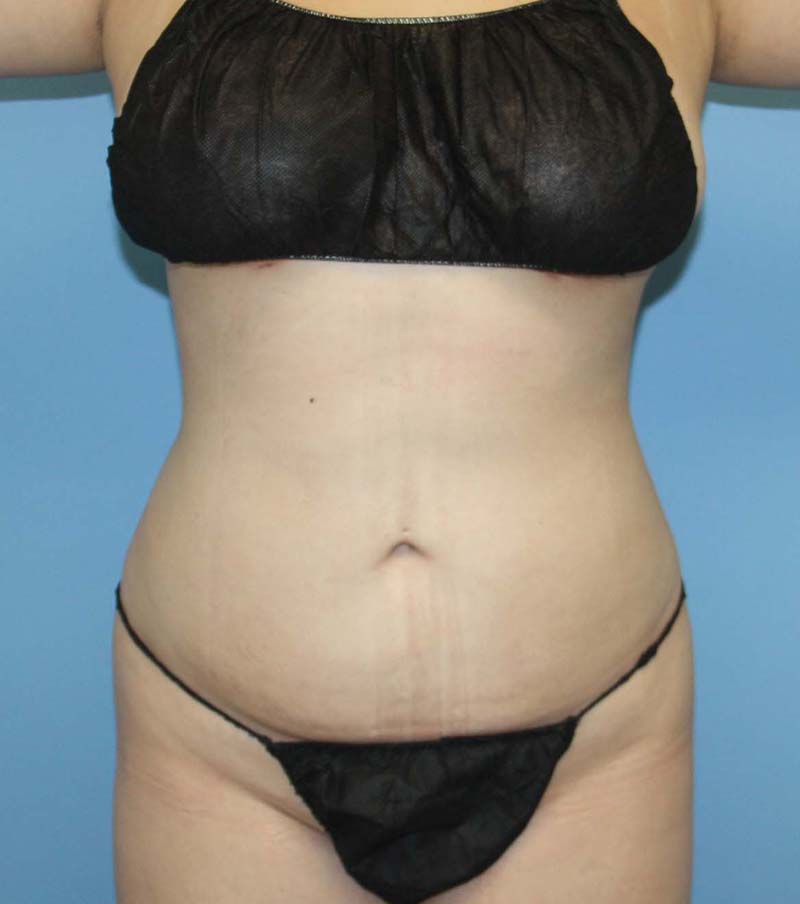
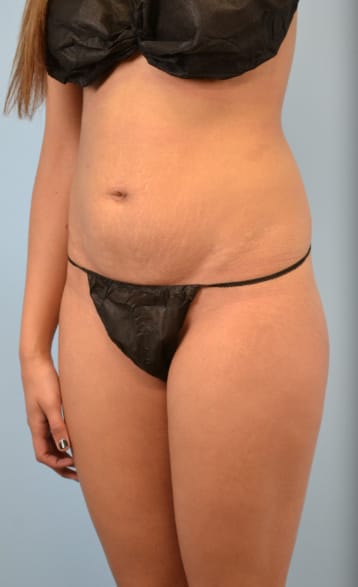
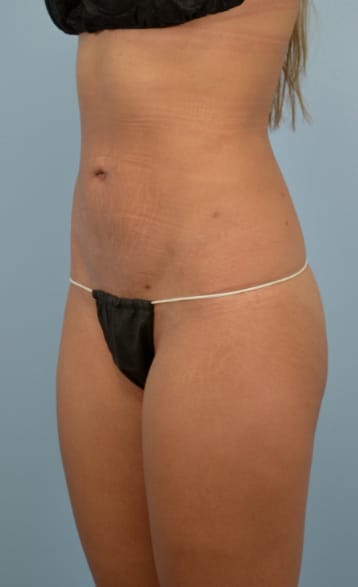
Judge a 360 from the back and the side as much as from the front, because that is where a single-area liposuction shows its limits: the line from the bra roll down through the waist to the hip should curve without a shelf. The cases below are Dr. Cat's. LPS-4326 and LPS-2576 are the trunk alone, the abdomen, hips, flanks and back, with the arms added in the first. LPS-0623, LPS-0953, LPS-0711 and BBL-0504 had the seven areas harvested with the fat transferred to the buttocks, one of them a very lean patient and one who asked for an hourglass figure. Find the starting shape closest to yours in the full liposuction before and after photos.
Risks and safety
Liposuction is safe in trained hands, and a 360 is the version where technique matters most, because every risk of a single area is spread across seven. Dr. Cat reviews the risks with every patient before surgery.
What can go wrong
- Bleeding under the skin (a hematoma), a pocket of fluid (a seroma), or an infection at an incision, each more likely across seven areas than one
- Irregularities where too much was taken or the passes were uneven: dents, ridges, waves, a shelf between two areas, or one side smaller than the other
- Skin that hangs once the fat beneath it is gone, when it was too loose to begin with, all the way around
- Patches of numbness or altered sensation, usually temporary, and swelling that takes months to leave
- Fat or skin necrosis, and burns from heat-based devices, which Dr. Cat does not use
- Reactions to anesthesia, blood clots, and, historically, complications from removing more than five liters or from too much local anesthetic; now rare
How Dr. Cat reduces these risks
- Every pass by Dr. Cat herself, each of the seven areas blended into the next and a thin cushion of fat left under the skin everywhere
- Thin cannulas rather than large aggressive ones, every area mapped before surgery and every stroke counted in each section and from each incision
- The tumescent dose and the volume removed tracked with the anesthesiologist, within the five-liter limit; when more is needed, the rest is staged
- Careful patient selection: firm skin, a stable weight, a tummy tuck instead when skin or muscle is the problem, and never a tummy tuck in the same surgery
- A board-certified physician anesthesiologist in a QUAD A accredited facility, one 360 that day, and walking the first night at the aftercare center
- A compression garment with foam for six weeks, no painful massages, and follow-up visits through the months the contour refines
Call us right away for a fever over 101°F, spreading redness, warmth or foul-smelling drainage at an incision; swelling or pain that keeps getting worse on one side; a firm, enlarging bulge; or a soft swelling that sloshes when pressed.
Call 911 first, then us, for calf pain or swelling in one leg, chest pain, or shortness of breath. And for anything that worries you: Dr. Cat and our staff are available to you throughout your recovery.
How much does lipo 360 cost in Beverly Hills?
Lipo 360 with Dr. Cat is about $53,000 to $60,000 all in: seven areas over about five and a half hours, her surgeon's fee, the operating room and the board-certified physician anesthesiologist, quoted in writing at your consultation and adjusted for your BMI and the amount of fat. With natural breast augmentation, or with fat transfer to the buttocks, it is about $65,000 to $71,000 all in. Fewer than seven areas are quoted per area, at about $6,500 to $7,500 per area in surgeon's fees plus the surgery center; two areas are about $18,000 all in. Every quote is itemized and includes your first compression garment and every follow-up visit.
The price reflects what is behind it: one surgeon who performs every stroke of all seven areas herself, one 360 per surgical day, a physician anesthesiologist for the whole case and an accredited facility. Published national averages for liposuction run from about $6,380 to $15,000 and describe a single area, not this surgery. A cheap or fast 360 is the expensive kind: rushed passes leave ridges and dents all the way around, and revision liposuction with fat grafting to correct them is about $69,000 to $104,000 with Dr. Cat. Our liposuction cost guide itemizes every area and the reasons a quote moves.
Consultation fee and financing
A consultation with Dr. Cat is $500, or $1,500 for a revision consultation, credited in full toward your surgery. To pay over time, the practice partners with Cherry, its primary financing partner, and also accepts CareCredit and Alphaeon Credit; see financing and payment plans. Lipo 360 is cosmetic and is not covered by insurance.
Your consultation with Dr. Cat
It starts with a free 15-minute discovery call with our Patient Concierge, who books your consultation. At the consultation, in person on Rodeo Drive or, for out-of-town patients, by private video consultation through OnPatient, the HIPAA-secure patient portal, Dr. Cat examines each of the seven areas with the pinch test and tells you plainly whether a 360 or a tummy tuck is your operation, whether the harvested fat should go to the buttocks, the hips or the breasts, and what recovery will ask of you. The itemized written quote comes with you, and your pre-operative guidelines follow once you are scheduled.