

A mini tummy tuck treats loose skin below the navel only, through a shorter scar, without touching the belly button or repairing the muscles. A full tummy tuck treats the whole abdomen: it removes skin from the ribs down, repairs the separated muscle wall and rebuilds the navel. A mini is not a smaller version of the same surgery; it is a surgery for a smaller problem, and most patients who ask Dr. Cat for a mini turn out to need a full tummy tuck with muscle repair, because their laxity does not stop at the navel.
This page explains what each operation does, how Dr. Cat Begovic, MD, FACS, board-certified plastic surgeon, decides between them in Beverly Hills, and how to check your own abdomen first.
What Is a Mini Tummy Tuck?
A mini tummy tuck (mini abdominoplasty) removes the excess skin between the navel and the pubic bone through a low incision about the length of a C-section scar or a little longer. Dr. Cat lifts the skin of the lower abdomen, pulls it down, trims the excess and closes with the same layered technique she uses for a full tummy tuck, so the scar is thin and sits under a bikini bottom. The belly button is not moved or cut around, and the muscles are not repaired. It suits a small pouch below the navel, a fold of skin over a C-section scar, or stretch marks confined to the lower abdomen. In Dr. Cat's words, it is best suited to patients with a small amount of excess skin limited to the area below the navel and little to no muscle laxity above the belly button.
What is a full tummy tuck?
A full tummy tuck in Beverly Hills uses a hip-to-hip incision plus an incision around the navel. Dr. Cat lifts the skin up to the ribs, sutures the separated rectus muscles back to the midline with a double-layer repair that works like an internal corset, repairs any hernia she finds, removes the excess skin from the whole abdomen and creates a new navel, inset so its scar is hidden and never pulled down with the umbilical float technique. A full tummy tuck without muscle repair exists for patients who never had children and have loose skin above and below the navel but a strong muscle wall.
Mini vs Full Tummy Tuck at a Glance
| Question | Mini tummy tuck | Full tummy tuck |
|---|---|---|
| What it fixes | Loose skin, a pouch or stretch marks below the navel only | Loose skin above and below the navel, separated muscles, stretch marks below the navel, hernias |
| Incision length | Short and low, about a C-section scar or a little longer | Hip to hip, low, hidden under a bikini bottom |
| Belly button | Left where it is, no incision around it | Rebuilt as a natural "innie" with the scar inset inside it |
| Muscle repair | None | Full-length double-layer repair of diastasis recti |
| Treats laxity above the navel | No | Yes |
| Anesthesia and time | General; about one to two hours; home the same day | General; about four to seven hours; first night in a surgical aftercare center |
| Downtime | Desk work within days; full exercise at about six weeks | Walking the first night; desk work at about two weeks; full exercise at six weeks |
| Scar | One short low scar | One long low scar plus a hidden navel scar; a thin white line at one year |
| Result lasts | While weight is stable and there is no pregnancy; skin above the navel is untreated | While weight is stable and there is no pregnancy |
| Price with Dr. Cat | Surgeon's fee $25,500 to $30,500; operating room and anesthesia quoted at your consultation (tummy tuck cost guide) | Surgeon's fee $40,500 to $60,500 with muscle repair; extended $75,000 to $95,000 in surgeon's fees; operating room and anesthesia quoted at your consultation |
How to Tell Which One You Need
Where the loose skin is
Pinch the skin above your navel standing, then sit down and look at the same area. Skin that stays flat standing and does not roll when you sit is firm, and a mini can be enough. Skin that folds above the navel when you sit, or that lifts in a pinch, is laxity a mini cannot reach, because the short incision only lets the surgeon lift the lower abdomen. That is the most common reason a patient who wants a mini needs a full, and it is the usual pattern of loose belly skin after pregnancy.
Muscle separation
Lie on your back with your fingers on the midline and lift your head. A gap of two finger widths or more, or a ridge that domes along the midline, is diastasis recti, and it runs from the ribs to the pubic bone. A mini does not repair it. A full tummy tuck does, which is why it flattens a belly that pushes forward however lean you are, and why a mini on the same belly leaves the bulge.
The belly button
If your navel has stretched, flattened, turned into an "outie" after pregnancy or sits low, only a full tummy tuck changes it, because a mini leaves the navel untouched. Dr. Cat rebuilds it centered where yours naturally sits, oval and proportional to your height, with a dimple and an inset scar that is not visible from the surface.
After pregnancy or a C-section
Pregnancy stretches the skin and the muscle wall from the ribs down, so most mothers have laxity above the navel and a separated muscle wall and need a full tummy tuck. A mini is right for the mother whose only complaint is a small pouch or a fold of skin over her C-section scar, with a firm upper abdomen and no muscle gap; Dr. Cat places the new incision under the old scar and removes it. If you plan another pregnancy, she usually advises waiting. Either operation combined with breast surgery or labiaplasty is a mommy makeover, staged on separate days: a tummy tuck is never done on the same day as a breast augmentation with implants, a breast lift with a tummy tuck is staged, and Dr. Cat never performs a labiaplasty on the same day as a tummy tuck, because the tummy tuck garment and the swelling would compromise the labiaplasty result.
After weight loss
Weight loss loosens skin everywhere, not just below the navel, so a mini is rarely the right operation after a large loss. Those patients usually need a full tummy tuck, and often the extended or fleur-de-lis versions described below. A mini fits after weight loss only when the loss was modest, the skin above the navel stayed firm and the weight has been stable for months.
Scar and downtime
A mini's appeal is the short scar and the quick recovery, and for a true mini candidate those are real advantages. They are the wrong reason to choose a mini if your skin or muscles need a full: the hip-to-hip scar hides under underwear and fades to a thin white line over a year (our tummy tuck scar guide shows the stages), and the difference in downtime is about a week and a half of desk work.
Why Most Patients Who Want a Mini Need a Full
Patients ask for a mini because it sounds smaller, cheaper and easier, and because the pouch they see is below the navel. What they usually cannot see is that the skin above the navel has also lost elasticity and the muscle wall has separated along its whole length; the pouch is the part that hangs, not the whole problem. A mini done on that anatomy removes the pouch and leaves the upper belly loose and the muscles unrepaired, so the abdomen still pushes forward and the skin above the new scar still folds when the patient sits. That result is one of the common reasons patients come to Dr. Cat for a revision tummy tuck, and a revision costs more than the full tummy tuck would have, because scar tissue makes it a longer operation. So Dr. Cat examines the whole abdomen, says plainly which operation your anatomy needs, and recommends the mini only when it will finish the job.
When Dr. Cat Recommends a Mini
She recommends a mini when the pinch test above the navel is flat, the head-lift test finds no gap, the navel is in the right place, the weight is stable and close to goal, and the complaint is a small fold or pouch below the navel, often over a C-section scar. For those patients the mini is the correct operation, not a compromise. If the only issue is fat over firm skin, neither operation is needed; that is a liposuction question, covered in tummy tuck vs liposuction.
Liposuction With a Mini or a Full Tummy Tuck
Conservative liposuction of the love handles or the mons pubis can be added to either operation when your anatomy and the total operating time allow it, priced per area on your quote. Dr. Cat does not add aggressive or 360-degree liposuction of the abdomen to a tummy tuck, because the blood supply to the abdominal skin she is lifting runs through the fat beneath it; lipo 360 is a separate surgery when both are needed. A mini is a skin operation, so a soft lower belly with loose skin may have a mini and conservative liposuction planned together.
Extended and Fleur-de-Lis Tummy Tucks
Two variants sit beyond the full tummy tuck, both for patients after major weight loss. An extended tummy tuck continues the incision around the flanks toward the back, so the loose skin of the sides is tightened as well as the front; most of Dr. Cat's extended patients have lost a large amount of weight or had weight-loss surgery, and the muscle repair is included. A fleur-de-lis tummy tuck adds a vertical incision up the midline to remove skin side to side as well as top to bottom, leaving an anchor-shaped scar; it is reserved for patients, usually after a loss of 100 pounds or more, whose flank skin meets in the middle when pinched inward. Our post on the different types of tummy tucks sets them side by side.
Results and Before and After Photos
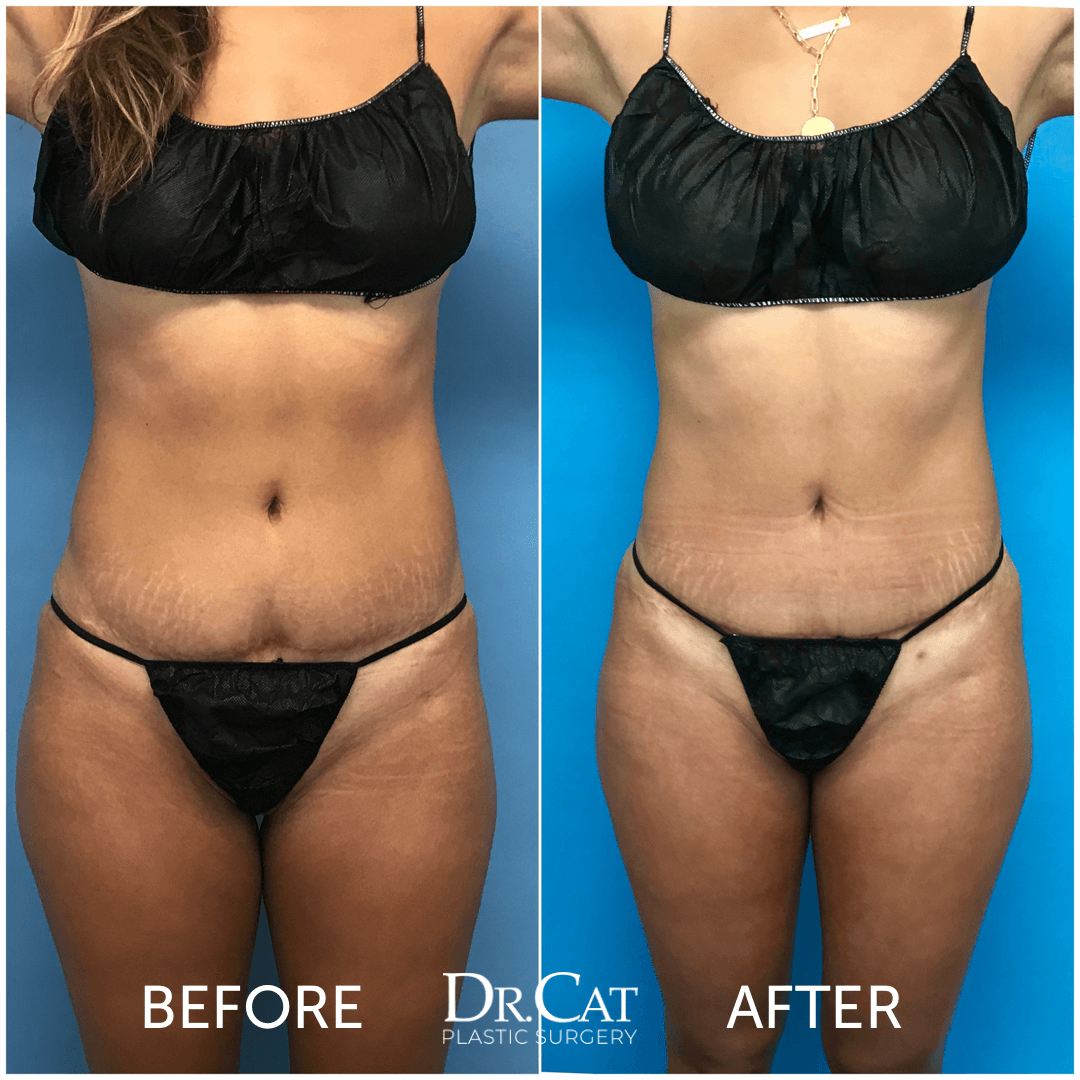

A good mini result is a flat lower abdomen with a short scar and an untouched navel; the upper abdomen looks the way it did before, which is fine only if it was firm. A good full tummy tuck result is a flat, tight abdomen from the ribs down with a smaller waist. See more in our tummy tuck before and after photos.
Recovery Side by Side
After a mini you go home the same day and are usually back at a desk within days. Dr. Cat places a generous amount of local numbing before you wake, so most patients need only Tylenol; there is usually a single drain, removed at one to two weeks, and you wear a compression garment and avoid strenuous exercise for about six weeks. After a full tummy tuck you spend the first night in a surgical aftercare center, walk that evening slightly bent over, and stand almost straight at one week, when most drains come out; the rest come out at two weeks, when scar care starts and desk work resumes. Full exercise returns at six weeks. Final results show at three to six months after a mini and six to twelve months after a full; the week-by-week detail is in our tummy tuck recovery timeline.
Cost Side by Side
The table carries Dr. Cat's ranges; the gap between a mini and a full is the difference between a one-to-two-hour operation with no muscle repair and a four-to-seven-hour one with an overnight stay, both performed by Dr. Cat herself with a board-certified anesthesiologist in an accredited facility. Price should not decide which one you have: a mini that has to be converted to a full is a revision tummy tuck, and mini revisions with Dr. Cat are $35,500 to $45,500 in surgeon's fees on top of the mini already paid for, so the wrong operation is the expensive one. Surgeon's fees are typical ranges: a more complex case can cost more, and your fee is set at your consultation and is final only in your written quote. Insurance covers neither. The tummy tuck cost guide itemizes the written quote, and financing through Cherry, CareCredit and Alphaeon Credit applies to both.
Frequently Asked Questions About Mini vs Full Tummy Tucks
What qualifies you for a mini tummy tuck?
Loose skin confined to the area below the navel, firm skin above it, no muscle separation, a stable weight close to your goal and no pregnancy planned. That describes a small minority of the patients who ask for a mini; most have laxity above the navel or a separated muscle wall and need a full tummy tuck.
How long does a mini tummy tuck last?
The removed skin does not come back, so the result lasts as long as your weight stays stable and you have no further pregnancy; a pregnancy after either operation can mean a revision. Aging still loosens the skin above the navel that a mini never treated, which is one more reason the right operation matters.
Is a mini tummy tuck less painful?
Yes: no muscle repair, less skin lifted and a one-to-two-hour surgery rather than four to seven. Dr. Cat places a generous amount of local numbing before you wake, and most of her mini patients need only Tylenol. Most of her full tummy tuck patients also manage on Tylenol, but the abdomen feels tight for the first two weeks.
How risky is a mini tummy tuck?
Lower than a full tummy tuck: a shorter anesthetic, less tissue lifted and a shorter incision mean less risk of fluid collection, wound problems and blood clots. The risk that actually catches patients is choosing a mini for anatomy that needed a full: the upper belly stays loose, the muscles stay apart, and the fix is a revision.
Do you get lipo with a mini tummy tuck?
You can. Conservative liposuction of the love handles or the mons pubis can be added to a mini or a full tummy tuck when your anatomy and operating time allow, priced per area on your quote. Dr. Cat does not add aggressive or 360-degree liposuction to either, because the blood supply to the lifted abdominal skin runs through that fat.
Are mini tummy tucks worth it?
For the right anatomy, yes: a small pouch below the navel or a fold over a C-section scar is removed through a short scar with a quick recovery. For the wrong anatomy it is the most expensive route to a full tummy tuck, because a mini that leaves the upper belly loose and the muscles unrepaired ends in a revision.
Does a mini tummy tuck fix diastasis recti?
No. Diastasis recti runs from the ribs to the pubic bone and a mini gives access to the lower abdomen only, so it does not repair the muscle wall. A gap along the midline when you lift your head, or a ridge that domes when you sit up, means you need a full tummy tuck with muscle repair.
Can a mini tummy tuck be converted to a full later?
Yes. A full tummy tuck can be done after a mini, using the same low scar and adding the muscle repair and navel work the mini left out; Dr. Cat performs these as revision tummy tucks. A revision costs more than a first full tummy tuck because of scar tissue, so the cheaper route is the right operation first.
Talk to Dr. Cat About a Mini or a Full Tummy Tuck
The right choice between these procedures depends on your anatomy, your goals, and your safety, which is why it can only be made through an in-person or virtual evaluation with a qualified surgeon, never from an article. Book a free discovery call with our team, or call (310) 858-8808; the consultation with Dr. Cat is $500, credited toward your surgery, and includes the skin and muscle examination and an itemized written quote for the operation you actually need. Until then, look through the tummy tuck gallery and the full tummy tuck page.
Medically reviewed by Dr. Cat Begovic, MD, FACS, board-certified plastic surgeon. Last reviewed September 2026.