

A tummy tuck leaves a scar: a low horizontal line that runs from hip bone to hip bone in a full tummy tuck, placed so it sits under any underwear or bikini bottom, plus a small scar hidden inside the belly button. Dr. Cat's incision is low, curved and as short as she can make it, closed in layers so the line heals thin, and it fades from red at two months to pink at six months to a thin white line at one year.
This guide follows the scar from the operating table to the third year: where it sits for each type of tummy tuck, what it looks like at each stage, the care that keeps it thin, what makes a scar worse, what a revision involves, and how to read before-and-after photos. For the operation itself, see the tummy tuck in Beverly Hills page; for the weeks around the scar, the tummy tuck recovery timeline.
What a Tummy Tuck Scar Looks Like and Where It Sits

The main scar is the price of removing loose skin: the excess between the belly button and the pubic area is cut away, and the skin above is brought down and closed along a line low on the abdomen. Dr. Cat's incision always sits low enough to hide under any underwear or bikini bottom, in a gentle curve where most patients already have a crease, never wavy or irregular. She asks patients to bring the underwear or bikini bottom they want to hide it under, and marks the incision to it. If you have a C-section scar or another abdominal scar, she places the tummy tuck incision under it and removes the old scar with the excess skin, so you end up with one line, not two. Its length depends on the type of tummy tuck and how much hanging skin there is; she keeps it as short as the skin allows.
The belly button scar
A full tummy tuck also leaves a scar around the navel, because the belly button stays on its stalk while the skin around it is lifted, moved down and re-draped through a new opening. The new belly button Dr. Cat creates is centered where your natural one sits, an oval in proportion to your height and frame, with a dimple in the middle and a second slightly depressed ring around it. She does not use the umbilical float technique, which detaches the navel and pulls it too low. She insets the belly button so the incision sits deep at its base rather than at the surface, and closes it with a suturing technique in which no stitches cross the skin, so there are no train-track marks. If there is a hernia behind the navel, she repairs it in the same surgery so it never distorts the shape.
The mini tummy tuck scar
A mini tummy tuck treats loose skin below the belly button only, through a shorter incision low on the abdomen, usually without cutting around the navel, so there is no belly button scar. The line often replaces a C-section scar and the pouch above it. A mini suits a narrow anatomy, laxity confined to below the navel; most patients who ask about one turn out to need a full tummy tuck with muscle repair, and a shorter scar is no reason to leave loose skin above the navel behind. Our comparison of a mini vs full tummy tuck sets the two scars and the two operations side by side.
The extended tummy tuck scar
An extended tummy tuck is for patients with loose skin on the sides as well as the front, most often after major weight loss. The incision is much longer, continuing past the hips toward the back so the skin of the flanks can be tightened too. It sits at the same low level and hides under underwear, but it is visible from the side when uncovered. Loose skin that started with weight loss or pregnancy is covered on our apron belly page.
The fleur-de-lis vertical scar
A fleur-de-lis tummy tuck adds a vertical incision up the midline to the usual horizontal one, making an anchor-shaped scar. It is used after massive weight loss when the skin is loose side to side as well as top to bottom, and no horizontal incision alone can remove it. The vertical scar runs up the center of the abdomen and is visible in swimwear; it is the trade for a waist that a standard tummy tuck cannot produce in that anatomy. A reverse tummy tuck, which is uncommon, places its scar in the fold under the breasts to tighten the upper abdomen.
How a Tummy Tuck Scar Changes Over Time
Scars are a process. Every incision goes through the same three stages, inflammation, collagen building and remodeling, and the scar looks worst in the middle stage, not at the start. Knowing the sequence keeps a normal two-month scar from frightening you.
Weeks 1 to 2
The incision is closed, covered and flat, pink to red, and may have a few small crusts along the line. Dr. Cat checks it the day after surgery and at one week; by two weeks it is thin and sealed and she starts your scar treatment. Normal: mild itching, a firm ridge under the line, small areas of numbness. Not normal: spreading redness, drainage that smells, an opening in the line. Call us for any of those.
Months 1 to 3: the reddest stage
This is when the scar looks its angriest. Collagen is being laid down faster than it is being organized, so the line becomes redder, firmer and slightly raised, and it can itch. In Dr. Cat's patients the incision is thin and healed at one month, but its color peaks somewhere between one and three months and stays there for a while. Normal: red or dark pink, a raised edge you can feel, itching, tightness when you stretch. Not normal: a scar that widens beyond the incision line, thickens into a rope, or grows past its original borders, which are the early signs of a hypertrophic scar or a keloid and are treated early.

Months 3 to 6
Remodeling takes over. The collagen reorganizes along the line, the raised edge flattens, the color moves from red toward pink, and the scar softens. At three months Dr. Cat sees you, reviews your photos and continues your silicone gel; at six months the incision is thin and fading and the surgical result is fully visible. Normal: a pink line that is still darker than the skin around it, occasional itching, a scar that looks better in the morning than after a long day.
One year and beyond
At one year the scar is a thin white line, hidden by the smallest underwear. It keeps maturing through the second and third year, softening further and losing the last pigment, which takes longer in darker skin. The belly button scar sits inside the navel and is hard to find. What you have at three years is what you will have at ten, provided your weight stays stable.
Scar Care by Phase
The scar is set largely on the operating table, but the year of care that follows decides how thin and pale it ends up. This is Dr. Cat's protocol, with the general rules marked as such.
Weeks 1 to 2: protect the line
Nothing goes on the incision except what we tell you. Keep the dressings dry, do not pick at crusts, and let the water run over the line in the shower rather than scrubbing it. The compression garment and the bent-over walk both keep tension off the closure, which is scar care too: an incision that is pulled while it is young widens. Some surgeons use paper tape across the line in this phase; Dr. Cat starts her treatment at the two-week visit.
Weeks 2 to 8: silicone strips
At two weeks, once the incision is sealed, Dr. Cat starts you on special silicone strips, worn for six weeks. Silicone is the one scar treatment with consistent evidence behind it: it holds moisture in the healing skin, which calms the cells that overproduce collagen, so the scar stays flatter and paler than it would on its own. Wear the strips as directed, wash and reapply them, and keep the line out of the sun.
Months 2 to 12: gel, sun and massage
After the strips you continue with silicone gel, applied to the scar and the belly button through the months when the scar is at its reddest and then fading; Dr. Cat reviews it at the one-month and three-month visits. Sun protection matters for the whole first year: ultraviolet light darkens an immature scar permanently, so keep it covered or under sunscreen whenever it is exposed. Once the line is fully healed and Dr. Cat clears it, usually around six weeks, gentle scar massage along the line for a few minutes a day softens the ridge and keeps the scar from tethering to the tissue underneath.
After the first year
Sunscreen on the scar whenever it is exposed, a stable weight, and no nicotine. If a segment stays raised or red past a year, tell us: it can be treated, and it is easier to treat early than to revise later.
Why Dr. Cat's Scars Heal Thin
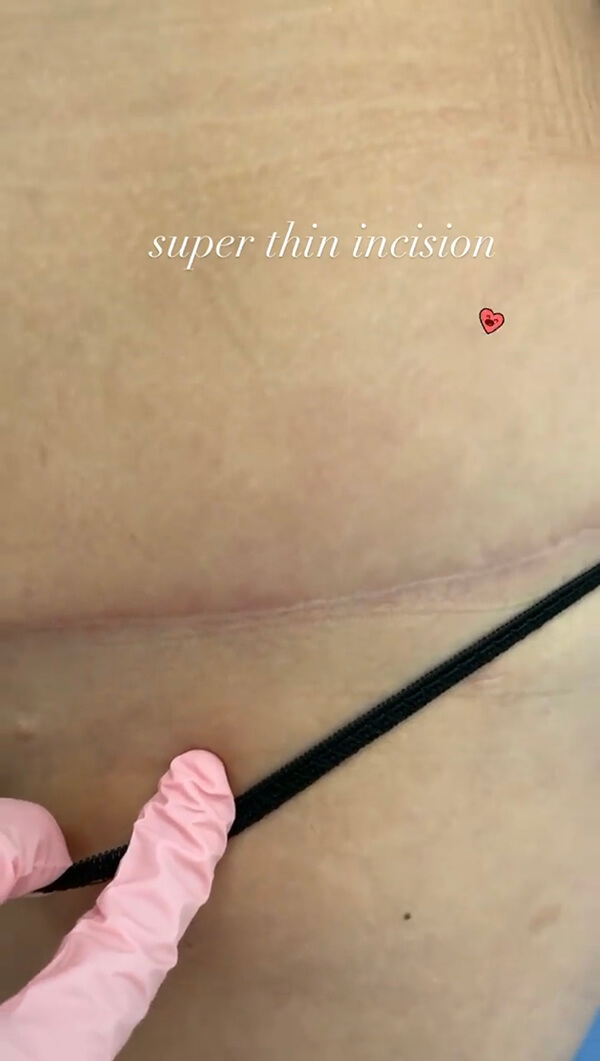
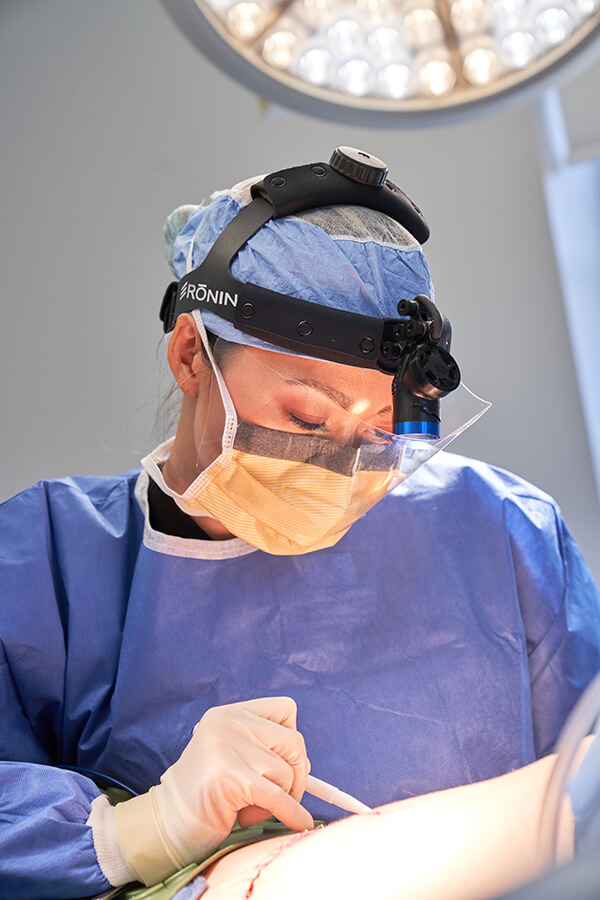
Dr. Cat considers the thinnest, least visible scar one of the most important parts of the surgery and takes her time with the closure. The incision is planned as a natural curve hidden in an existing crease, kept as short and low as possible, and closed in layers so the abdomen blends into the pubic area and hips with no shelves, bumps, dog ears, bunching or pleating. In a layered closure the deep layers carry the tension and the skin edges meet without being pulled, which is what lets the surface heal as a fine line; it takes far longer than a quick stitch-up, which is one reason she schedules only one tummy tuck per surgical day. In her words: "I believe it is important to create the best possible result and incision without any bunching, irregularities, or step-offs. I take extreme pride in my attention to detail with every single step of this surgery." No surgeon can promise an invisible scar, and your skin has a say in the final result, but the closure is the part under her control.
What Makes a Tummy Tuck Scar Worse
Tension is the enemy of a thin scar. Skin that is closed under pull, or pulled after surgery by early lifting, straightening too soon or a rapid weight gain, responds by widening the line and laying down extra collagen. Nicotine in any form narrows the small vessels that feed the healing skin, which delays closure and raises the risk of wound separation, and a scar that opened and healed a second time is always wider. Sun on an immature scar fixes brown pigment into it. An infection or a seroma under the incision stretches and inflames the line. And genetics matter: skin type, ethnicity and how your previous scars healed predict how this one will, which is why Dr. Cat asks about every old scar at the consultation.
Keloids and hypertrophic scars
A hypertrophic scar is raised and thick but stays within the line of the incision; a keloid grows beyond it, into skin that was never cut, and can keep growing for months. People with darker skin tones, a family history of keloids, a previous keloid or hypertrophic scar, or age under 30 are more prone to both, and a previous surgery that scarred badly is the clearest warning. As Dr. Cat tells patients who ask, some patients are more prone to keloids than others, but she has had many keloid-prone patients who have not keloided with her meticulous incision closure technique. Tell her before surgery. Silicone from two weeks, strict sun protection and prompt treatment of any raised segment (steroid injections or laser for a raised or red scar are the usual tools) are the rest of the plan.
Stretch Marks and the Scar
The stretch marks below the belly button are usually removed with the excess skin, because that is the skin that is cut away. The ones above the navel stay, though they move lower and often look less obvious once the skin is re-draped; Dr. Cat has this conversation with almost every tummy tuck patient so there are no surprises. New stretch marks are possible when the remaining skin has poor elasticity and is closed under tension, most often between the navel and the incision. Our post on stretch marks after a tummy tuck covers prevention and the treatments that help.
Tummy Tuck Scar Revision

There is no such thing as tummy tuck scar removal; a scar can be faded, or it can be revised into a better scar. Revision is for a scar from a previous surgery that sits too high to hide, is too wide, raised, uneven or wavy, has dog ears at the hips, or a step-off where the closure did not line up. Dr. Cat performs scar revisions on patients operated on elsewhere. She excises the old scar and the scar tissue beneath it, removes any residual excess skin so the new line can sit lower, and closes in layers, the same closure she uses for a first tummy tuck. When the belly button is misplaced or the muscles were never repaired, the scar is corrected as part of a full revision tummy tuck. Revision waits until the original scar has matured, at least a year after surgery, because a scar that is still red will keep changing on its own. A raised or red scar that sits in the right place may not need surgery at all; steroid injections and laser resurfacing flatten and fade many of them. Dr. Cat examines the scar at a revision consultation ($1,500, credited toward surgery) and tells you which it is. See scar revision before and after photos, and if your concern is wider than the scar, signs of a bad tummy tuck.
Tummy Tuck Scar Tattoos
Some patients tattoo over a healed scar, either with decorative artwork that uses the line or with paramedical skin-tone tattooing that blends it into the surrounding skin. Two rules: wait until the scar is fully mature, about 12 to 18 months, because tattoo pigment behaves unpredictably in a scar that is still remodeling, and use an artist experienced with scar tissue, which takes pigment differently from normal skin. A tattoo is camouflage for a scar you already have; it is not a substitute for an incision placed low enough that no camouflage is needed.
Before and After Photos of Tummy Tuck Scars
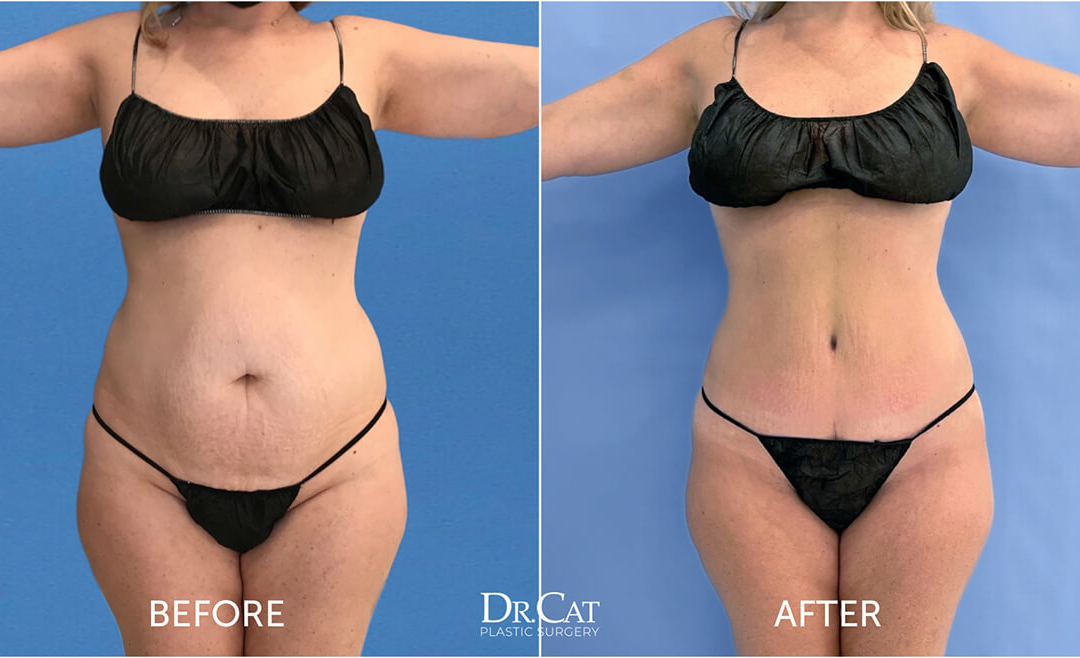
When you compare surgeons, ask to see the scar itself, at several points in healing, in small underwear. Photos taken on the operating table, photos at one year only, or photos in thick high-waisted underwear tell you nothing about the incision. Dr. Cat's tummy tuck before and after photos show her patients' incisions hidden under tiny strings of underwear, and her Instagram highlight labelled Incisions shows many more.
Frequently Asked Questions About Tummy Tuck Scars
Does a tummy tuck leave a scar?
Yes. Removing loose skin needs an incision, so every tummy tuck leaves a scar: a low horizontal line from hip bone to hip bone in a full tummy tuck, plus a scar hidden inside the belly button. The goal is a thin, flat, pale line that sits under any underwear or bikini bottom, not a scar that does not exist.
Do tummy tuck scars ever go away?
No scar disappears completely. A well-placed, well-closed tummy tuck scar fades to a thin white line by about one year and keeps softening for another year or two, at which point it is hard to see under underwear. Placement, closure technique, silicone and sun protection decide how close to invisible it gets.
What does a tummy tuck scar look like after 6 months?
Thin, flat and fading. The red, slightly raised stage of months one to three has passed, the line is pink rather than red, and it is softening. In Dr. Cat's patients the incision is thin and fading at six months and the surgical result is fully visible; most of the remaining color leaves over the next six months.
What does a tummy tuck scar look like after 1 year?
A thin white line. At one year Dr. Cat's patients have a faded incision that is hidden by the smallest underwear, and the belly button scar sits inside the navel. The scar keeps maturing into the second and third year, especially in darker skin, where pigment can take longer to settle.
Does the belly button scar show?
Not when the belly button is inset the way Dr. Cat does it: the incision sits deep at the base of the navel rather than on the surface, no sutures cross the skin, and the new navel is an oval in proportion to your frame with a natural dimple. A mini tummy tuck usually has no belly button incision at all.
Can a bad or high tummy tuck scar be fixed?
Usually, yes. A scar that is too high, wide, raised, uneven or has dog ears at the hips can be revised: the old scar is excised, any residual excess skin removed, and the incision re-closed in layers, lower and thinner. Raised or red scars sometimes improve with steroid injections or laser. Revision waits until the scar has matured, at least a year after surgery.
Can I tattoo over my tummy tuck scar?
Yes, once the scar is fully mature, about 12 to 18 months after surgery, and with an artist experienced in scar tissue. Decorative tattoos and skin-tone camouflage tattooing both work on a flat, healed scar; neither is a substitute for a well-placed incision.
What happens 10 years after a tummy tuck?
The scar is a mature pale line and stays that way. The flat abdomen and the muscle repair hold as long as your weight stays stable; a large weight gain or a pregnancy stretches the skin and the repair again, and some patients then choose a redo. The skin ages normally, so the abdomen at ten years looks like your abdomen at that age, minus the loose skin.
On a scale of 1 to 10, how painful is a tummy tuck?
Most of Dr. Cat's patients describe tightness rather than pain, take a few Tylenol and no prescription pain medication, and are walking the evening of surgery. The first three days are the peak and it falls from there. The week-by-week detail is in the tummy tuck recovery timeline.
What if I am prone to keloids?
Tell Dr. Cat before surgery. Some patients are more prone to keloids than others, but Dr. Cat has had many keloid-prone patients who have not keloided with her meticulous incision closure technique. Silicone from two weeks, strict sun protection and early treatment of any raised segment are the rest of the plan.
What helps a tummy tuck scar heal best?
A low, tension-free, layered closure on the day of surgery, then silicone strips from two weeks for six weeks and silicone gel after that, sun protection for the first year, scar massage once cleared, no nicotine, a stable weight, and following the recovery rules so the incision is never pulled while it is young.
Talk to Dr. Cat About Your Tummy Tuck Scar
If the scar is the thing holding you back from a tummy tuck, or you have a scar from a previous surgery that you want fixed, start with a free discovery call with our team, or call (310) 858-8808. The consultation with Dr. Cat is $500, or $1,500 for a revision consultation, credited toward your surgery. See the tummy tuck before and after photos, the tummy tuck in Beverly Hills page, the tummy tuck cost guide, the pre-op instructions, and the out-of-town patients page if you are traveling to us. Our other patient guides cover recovery, costs and muscle repair for diastasis recti.
Medically reviewed by Dr. Cat Begovic, MD, FACS, board-certified plastic surgeon. Last reviewed September 2026.