

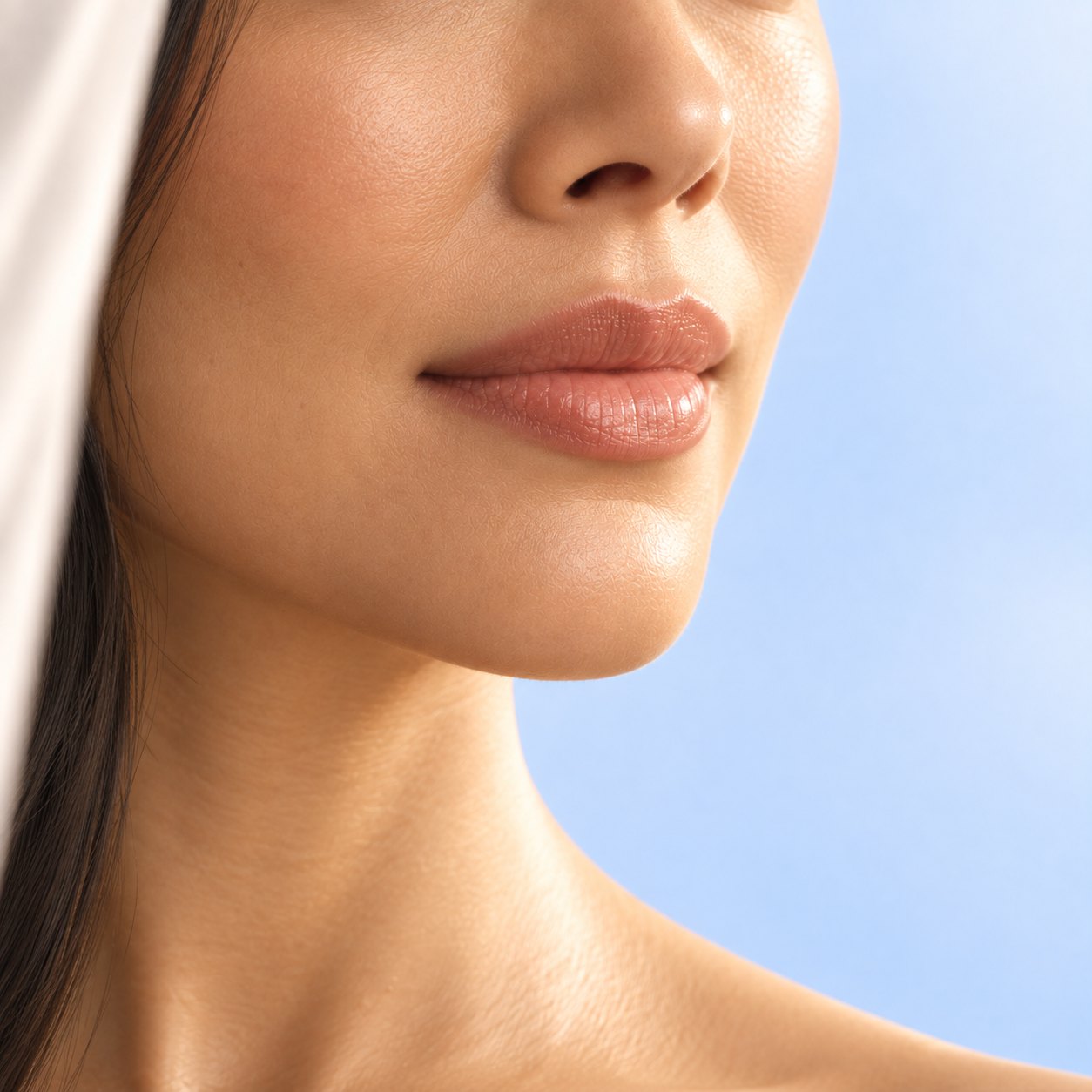
What is Restylane?
Restylane is a family of hyaluronic acid dermal fillers made by Galderma; the original Restylane was the first hyaluronic acid filler the FDA approved, in 2003. Hyaluronic acid is a sugar the skin makes to hold water, cross-linked here into a gel that keeps its shape for months. It is one of the facial fillers Dr. Cat uses, with Juvederm, Radiesse and Sculptra.
A filler treats what is there when your face is still: a thin lip, a flat cheek, a fold beside the mouth. A line that shows only when you frown or squint is muscle, and Botox treats it; our page on Botox or filler explains the mirror test. Because Restylane is hyaluronic acid, it can be dissolved with hyaluronidase.
The Restylane family: Restylane-L, Lyft, Kysse, Refyne, Defyne and Contour
The manufacturer makes Restylane in two textures. Restylane-L and Lyft, the original line, are firmer, structured gels that hold a shape and lift; Kysse, Refyne, Defyne and Contour are flexible gels that move with the face. Restylane-L treats the folds and the lips, Refyne and Defyne the nasolabial folds and marionette lines (Defyne the deeper ones and the chin), Contour the cheeks. Every gel carries lidocaine. Which gel goes where is decided at your consultation, by the area and by your tissue.
Restylane Kysse for the lips
Restylane Kysse is the manufacturer's lip product, FDA-approved for lip fullness and the fine lines above the upper lip. The lips keep their movement when you speak and smile, and hold their shape at rest.
Restylane Lyft for the cheeks, folds and hands
Restylane Lyft is the firmest gel in the range, FDA-approved for the cheeks and midface, the nasolabial folds and the backs of the hands, where it was the first hyaluronic acid filler the FDA approved. Placed deep over the cheekbone it lifts as well as fills. For volume built slowly from your own collagen, Sculptra is the third option, and it cannot be dissolved.
How Dr. Cat injects Restylane
Dr. Cat is a board-certified plastic surgeon, trained in both head and neck surgery and plastic and reconstructive surgery, Harvard-educated and UCLA trained. She gives an injection the attention to detail of an operation, having seen what careless filler looks like: an overstuffed upper lip, a lumpy cheek.
The analysis and your photographs
The first visit starts with a detailed facial analysis: your anatomy, the corrections you want, any asymmetry, the look you prefer, and any event on your calendar, because swelling keeps its own schedule. She asks you to bring photographs of looks you like and looks you do not; natural means something different to everyone.
Small amounts, in layers, from several directions
Her multi-layer, multi-directional technique places small amounts of Restylane in more than one plane and from more than one angle, with a very thin needle, so the gel blends into the tissue rather than sitting in a line. That gentle technique is why her patients bruise and swell less. Numbing cream sits for 15 to 30 minutes, ice and a probe reduce the sting, and most patients feel pressure rather than pain. The skin is cleansed with more than one solution before a needle touches it. A treatment takes 30 to 60 minutes in Dr. Cat's office on Rodeo Drive.
Who injects at the practice
Every syringe at the practice is placed by one of its two surgeons; a nurse injector or physician assistant never injects filler here, by Dr. Cat's rule. The lips, the nasolabial folds and the neck lines are hers. The cheeks, the under-eye hollows, the jawline, the chin and the temples are treated by our board-certified facial plastic surgeon, alongside her for more than ten years, at the same $1,250 per syringe.
Where Restylane is used
The durations are the practice's published figures by area.
- Lips: fullness, shape and a defined border; 6 to 12 months, the shortest, because the lips move constantly.
- Cheeks: volume and lift over the cheekbone; 12 to 18 months.
- Under the eyes (the tear trough): 12 to 18 months.
- Nasolabial folds and marionette lines: 9 to 15 months.
- Chin and jawline: projection, an edge along the jaw, the hollow in front of an early jowl; 12 to 18 months.
- Temples: hollowing beside the brow.
- Neck lines: the horizontal lines across the neck.
- Hands: the backs of the hands; ask at your consultation.
Restylane lips: fuller, in your own shape
Dr. Cat fills lips to look naturally fuller and never into the duck shape: the border defined, the body filled in proportion, no gel outside the lip line. Very thin lips start with about 1 ml, with more at a later visit; our post on filler for thin lips explains why. A long upper lip is a different problem: filler lengthens it, and a lip lift shortens it.
Restylane under the eyes
A small amount of a thin gel laid deep along the tear trough lifts the shadow that reads as tired, for 12 to 18 months. The rule there is conservative: an overfilled trough looks puffy, and gel too close to the surface under thin skin shows as a bluish tint. A bag of fat under the eye needs a lower eyelid lift, not filler, and a face that has emptied in several areas is often better served by fat transfer to the face.
How long does Restylane last?
Restylane lasts 6 to 18 months, depending on the product, the area and your metabolism: lips 6 to 12 months, folds 9 to 15, cheeks, chin, jawline and under the eyes 12 to 18. The change is visible before you leave, looks a little larger than the final result for a few days, and settles at about two weeks.
Dr. Cat writes a personalized maintenance schedule for each patient, and a touch-up on it usually needs less gel than the first visit. Sunscreen, hydration and no intense heat in the first days stretch a syringe; see our post on making dermal filler results last longer.
Restylane vs Juvederm: which one does Dr. Cat use?
Both. Patients ask it both ways, Restylane vs Juvederm and Juvederm vs Restylane, and the answer is the same: both are hyaluronic acid, both FDA-approved, both dissolvable, both $1,250 per syringe here, both lasting 6 to 18 months by area. Neither is the better filler.
Restylane
- Made by Galderma; the first hyaluronic acid filler the FDA approved, in 2003
- Firmer, structured gels (Restylane-L, Lyft) that hold a shape and lift; flexible gels (Kysse, Refyne, Defyne, Contour) that move with expression
- Tends to draw in less water, so early swelling is often milder
- A gel approved for the backs of the hands
Juvederm
- Made by Allergan Aesthetics; smoother, more cohesive gels that spread evenly
- One family of increasing thickness: Volbella for the lips, Vollure for the folds, Voluma for the cheeks
- Draws in more water, for a soft, full look and a little more early swelling
- Described on its own page
The choice is made at your consultation: the area first (a lip that has to move, a cheek that needs lift), then your tissue (thin skin wants a thin, flexible gel; a deep fold a firmer one), then your history, since a gel that has lasted well in you is the one to stay with. The Juvederm page describes that range.
Restylane before and after photos
Our filler before and after photos show lips, cheeks and folds treated by Dr. Cat; the cases labeled by product there are Juvederm, so this page carries no case grid. Restylane results are shown at your consultation. In a good filler photo, at rest, nothing looks added.
Restylane recovery timeline
There is no downtime after Restylane. Here is what the days after look like.
- The consultationThe consultation and facial analysis with Dr. Cat, where the areas, the gel and the number of syringes are agreed. For a week before: no aspirin, anti-inflammatories, alcohol or herbal supplements.
- Treatment dayNumbing cream, ice and the probe, a cleanse, then 30 to 60 minutes of injection.
- The first 24 hoursNo makeup or anything that could carry bacteria onto the skin, no strenuous exercise; ice if directed, head raised for two nights.
- Days 2 to 7Lip swelling peaks at 24 to 48 hours, then settles with any bruise over 3 to 7 days. No saunas or intense heat.
- Two weeksThe final shape. Your follow-up visit checks the two sides; a touch-up, if needed, is done then.
- 6 to 18 monthsThe maintenance visit, by area; a touch-up usually needs less gel.
Risks and safety
Restylane is FDA-approved, and an injection still goes into a face full of arteries.
What can go wrong
- Bruising and swelling for 3 to 7 days; the lips swell most
- Asymmetry, corrected at the two-week visit
- Lumps, and rarely nodules months later
- Migration, gel drifting beyond the area, most often above the lip line
- Infection, uncommon, and a cold sore flare after lip injections
- Vascular occlusion, rare and serious: gel blocking an artery, which can cost skin and, near the eye, sight
How the practice reduces these risks
- A surgeon injects every syringe; Dr. Cat trained in head and neck surgery and knows where the arteries run
- Small amounts, injected slowly, in layers and from several directions
- A conservative plan, with volume added at the follow-up rather than forced into one visit; no filler in the forehead
- Cleansing with more than one solution, the week-before list, and an antiviral for a cold sore history
- Hyaluronidase in the room: Restylane can be dissolved within a day, at once if the skin blanches; Radiesse and Sculptra cannot
Who is a good candidate for Restylane?
The right candidate has a specific change in mind that volume can make.
You may be a good candidate if
- Your lips are thin, uneven or have lost their border
- Your cheeks have flattened or the folds beside your mouth have deepened
- The hollows under your eyes read as tired, with no bag of fat beneath them
- You want an edge along the jaw or projection at the chin without an implant
- You are an adult in good health with no active skin infection in the area
Not yet, or a different plan, if
- You are pregnant or breastfeeding
- You have an active skin infection, a cold sore or a rash in the area
- You take a prescribed blood thinner without clearance from the prescribing doctor
- Your lines appear only when you frown or squint: that is muscle, and Botox is the treatment
- Jowls, a loose neck or hooded eyelids are the complaint: filler does not lift skin; a facelift or an eyelid lift does
How much does Restylane cost in Beverly Hills?
Restylane costs $1,250 per syringe with Dr. Cat, the price on our published non-surgical price list, whichever of the two surgeons injects it. It is sold in full syringes: most areas take one or two, the lips often one, the cheeks or the jawline more. The number for each area is fixed at your consultation.
Botox and filler fees are per unit and per syringe: if movement lines are treated at the same visit, Botox is $25 per unit and Dysport $8.50 per unit; our comparison of Botox and Dysport explains the units. The fee buys the analysis, the gel, the technique and the surgeon.
Consultation fee, insurance and financing
Your appointment is reserved with a $500 deposit credited to your treatment; new patients are evaluated and treated at the same visit, and the $500 stays as a credit if treatment is not right for you. The $500 surgical consultation fee and its credit toward surgery are a separate arrangement. The practice partners with Cherry, its primary financing partner, and also accepts CareCredit and Alphaeon Credit; see financing and payment plans. Restylane is cosmetic and not covered by insurance; Dr. Cat's office does not bill insurance.
Your consultation with Dr. Cat
It starts with a free 15-minute discovery call with our Patient Concierge, who books your consultation. The consultation and facial analysis are with Dr. Cat herself, in person on Rodeo Drive or, for out-of-town patients, by private video consultation through OnPatient, the HIPAA-secure patient portal. She examines each area, goes through your photographs, and tells you which gel and how many syringes.

