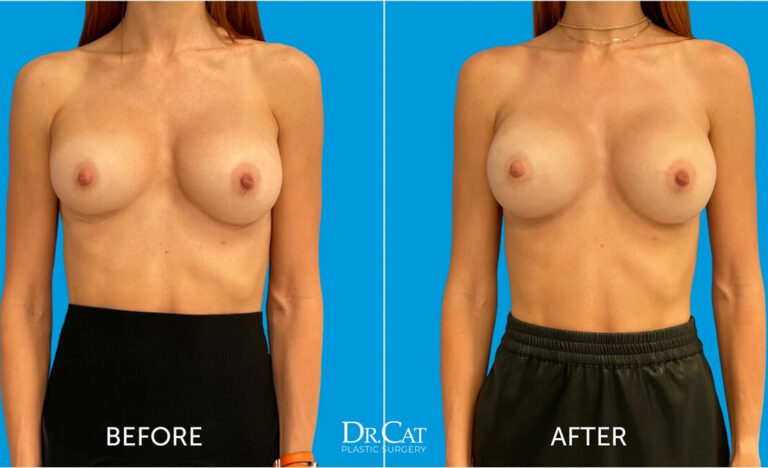


Key Takeaways
- Most breast implants settle fully within 3 to 6 months after surgery
- Initial dropping starts around weeks 2 to 6, with fluffing continuing through month 6
- Larger implants and silicone implants typically settle faster than smaller or saline options
- Wearing a supportive surgical bra and avoiding underwire speeds the process
- Final breast shape, softness, and symmetry appear between months 4 and 6
- If one side settles faster than the other, this is normal during the first 12 weeks
Next step: how implants settle depends on the implant, the pocket and the technique chosen before surgery. Read about breast augmentation in Beverly Hills with Dr. Cat, or book a free discovery call.
The Typical Breast Implant Settling Timeline
When patients ask how long does it take for breast implants to settle, the honest answer is 3 to 6 months for most patients, with some cases extending to 9 months depending on implant size, placement, and tissue characteristics. Right after surgery, implants sit noticeably high on the chest and feel firm. This is expected. The pectoral muscle is tight, swelling is significant, and the skin hasn't stretched to accommodate the new volume.
The timeline follows a fairly predictable pattern. During the first two weeks, implants remain high and tight. Between weeks 2 and 6, gravity and muscle relaxation begin the drop phase. By months 2 to 3, most patients see the major positional shift. The final softening and lower-pole fill-out (the fluff) completes over months 3 to 6.
"I always tell patients: the result you see at six weeks is not your final result. Your body needs time to relax around the implant, and that process unfolds on its own schedule. Most of my patients are genuinely surprised by how different their breasts look at month four compared to month one."
Dr. Cat Begovic, MD, FACS, board-certified plastic surgeon, Beverly Hills
What Drop and Fluff Actually Means
Drop and fluff is the two-part process every patient goes through after augmentation. Understanding both phases helps set realistic expectations during recovery. The implant itself doesn't change; it stays the same size and shape throughout. What changes is how your body accommodates it: how the muscle relaxes, how the skin stretches, and how fluid from swelling gradually resolves.
The Drop Phase
Dropping refers to the implant descending from its initial high position on the chest into the natural breast pocket. This happens because the pectoral muscle, which was tightened during surgery, gradually relaxes. The implant moves downward by a few centimeters, which sounds small but makes a dramatic visual difference. Dropping is mostly complete by week 8 to 12 for most patients.
The Fluff Phase
Fluffing is the softening and rounding that follows dropping. As swelling resolves and the skin envelope adjusts, the lower portion of the breast fills out, creating that natural teardrop shape. Breasts feel softer, appear slightly larger, and develop better cleavage. Fluffing can continue subtly through month 9 in some cases.
Factors That Affect How Long Settling Takes
No two recoveries look identical. Several variables influence your personal timeline, and knowing them helps explain why your friend's implants settled in 10 weeks while yours are still adjusting at month 4.
Implant placement: Submuscular implants (under the pectoral muscle) take longer to settle, typically 4 to 6 months, because the muscle must stretch and relax. Subglandular implants often settle in 2 to 3 months.
Implant size and profile: Larger implants drop faster due to gravity. Higher-profile implants may take longer to fluff because they project more and require more skin accommodation.
Implant type: Silicone gel implants tend to settle slightly faster than saline because of their natural weight distribution.
Tissue elasticity: Younger patients and those who haven't had children often have tighter skin, which slows settling. Patients with looser tissue see faster drop and fluff.
Muscle tone: Athletic patients with strong pec muscles frequently experience slower dropping because the muscle resists relaxation longer.
"Athletic patients are often the most impatient during recovery, and ironically, their strength is exactly what slows the process. A well-developed pectoral muscle doesn't relax overnight. I reassure these patients that their final result is worth waiting for, and that their muscle tone will actually support the implant beautifully long-term."
Dr. Cat Begovic, MD, FACS
How to Help Your Breast Implants Settle Properly
While you can't dramatically speed biology, certain habits genuinely support the settling process, and others slow it down.
Wear your surgical bra consistently. For the first 4 to 6 weeks, a soft surgical bra without underwire provides the support implants need while allowing them to settle downward naturally. Underwire can push implants upward and delay dropping.
Perform gentle massage if approved. We instruct many patients to do implant displacement exercises starting around week 2. These encourage the pocket to stay open and the implants to move into position. Only do these if specifically recommended; some implant types shouldn't be massaged.
Avoid chest workouts for 6 to 8 weeks. Pec activation tightens the muscle back up, which works against settling. Light walking is encouraged early; upper body strength training waits.
Sleep elevated for the first 2 weeks. This reduces swelling and supports circulation. When you do start side-sleeping again, a pillow beside the chest helps.
Stay hydrated and avoid smoking. Both affect tissue healing and can prolong swelling. Nicotine in particular restricts blood flow to healing tissue.
What to Expect Month by Month After Surgery
Having a rough map of what each phase looks like helps reduce anxiety when something seems off but is actually normal.
Weeks 1 to 2: Implants sit high, feel hard, and may look square or overly full at the top. Significant swelling, bruising, and tightness. Sleeping upright is typical.
Weeks 3 to 6: Noticeable softening begins. Implants start descending. One side may move faster than the other, which almost always evens out. Most patients return to desk work during this window.
Months 2 to 3: Major dropping has occurred. Breasts start looking more natural from the front, though the lower pole may still feel underdeveloped. Many patients resume light exercise.
Months 4 to 6: Fluffing creates the soft, rounded shape you expected. Scars are maturing. Sensitivity normalizes. This is when most patients finally shop for new bras, not before, since sizing shifts significantly during settling.
Months 6 to 12: Fine-tuning. Subtle softening continues, scars fade, and the result you see at one year is your long-term outcome.
"I ask patients to wait until at least month five before buying new bras. I've seen patients buy a whole drawer of bras at week eight and then need completely different sizes by month six. The shape is still changing. Give it time before you invest in your new wardrobe."
Dr. Cat Begovic, MD, FACS
According to the American Society of Plastic Surgeons, most breast implants complete the drop and fluff process within 3 to 6 months after augmentation surgery.