
Why Stomach Skin Sags: Weight Loss, Pregnancy and Age
The dermis, the middle layer of the skin, holds its shape with two proteins: collagen, which gives it strength, and elastin, which lets it stretch and recoil. Stretch that layer far enough or long enough and the fibers stop recoiling. Pregnancy does it in months: the growing uterus pushes the skin, the connective tissue and the abdominal muscles outward while pregnancy hormones soften the connective tissue, more so with twins, a large baby or pregnancies close together. Weight does it slowly, and weight loss reveals it: skin expanded over years cannot contract once the fat beneath it is gone, and the faster the loss, including on GLP-1 medications such as semaglutide and tirzepatide, the less the skin recovers. Age and genetics set the ceiling, because collagen and elastin decline over time and some skin simply has less recoil, which is why two women with the same pregnancies end up with different bellies.

Before and after a full tummy tuck by Dr. Cat, front view: skin stretched by pregnancy does not recoil on its own, so the loose skin and the stretch marks below the navel were removed with the surgery.
Next step: once skin has lost its elasticity, only surgery removes it. Read about a tummy tuck in Beverly Hills with Dr. Cat, or book a free discovery call to find out how much loose skin you really have.
The Pinch Test: How Much Loose Skin Do You Really Have?
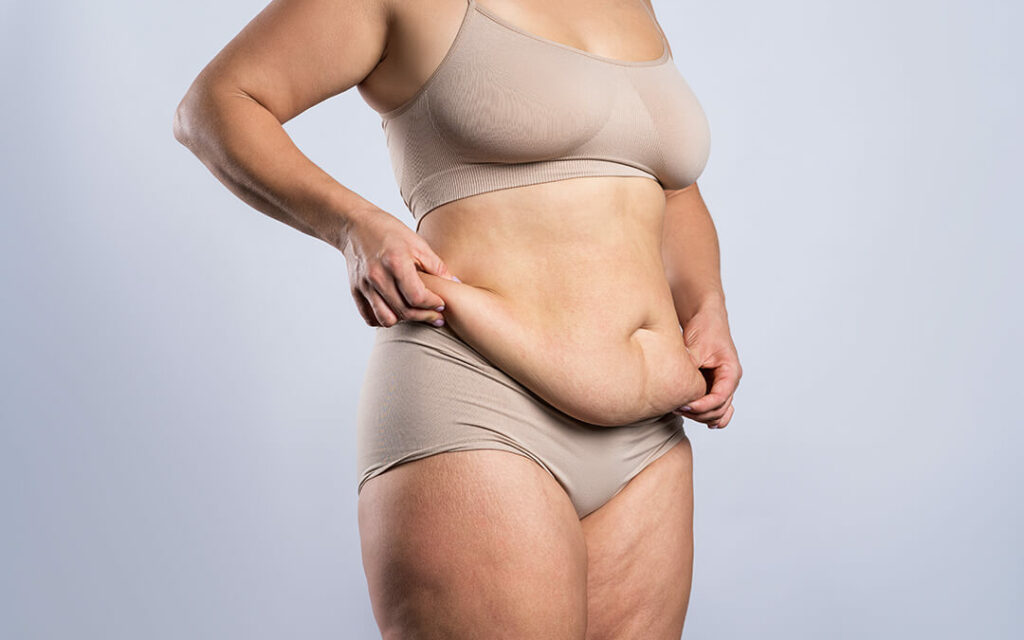
Stand upright and pinch the skin below your belly button, then let go. Skin that snaps back flat still has elasticity: that is mild laxity, and it is the kind non-surgical treatments and training can improve. Skin that stays in a fold, hangs over a waistband, or crinkles like tissue paper when you bend has lost its recoil, and that is the laxity a tummy tuck treats. Now sit down and look above the navel: skin that folds there when you sit is laxity a mini tummy tuck cannot reach. Stretch marks are the third clue. A stretch mark is a tear in the dermis, so creams and exercise cannot restore elasticity where they are; the ones below the navel leave with the skin in a tummy tuck. An in-person examination gives the clearest answer, and photographing your stomach in the same light every few weeks shows you what is changing and what is not.

Stretch marks are torn dermis, which is why creams cannot tighten skin that carries them. In this tummy tuck by Dr. Cat, the marked skin below the navel was removed.
Is It Fat, Skin or Muscle?
A belly that will not flatten has one of three causes, and each has a different fix. Fat over firm skin is a liposuction problem when diet has stopped moving it, and a weight problem when it has not; lie flat, and if the belly flattens, fat and skin are what you are looking at. Skin that fails the pinch test is a tummy tuck problem, because liposuction empties the fat from under loose skin and leaves it looser. Separated abdominal muscles are the third: lie on your back with your fingers on the midline and lift your head, and a gap of two finger widths or a ridge that domes down the center is diastasis recti, the muscle separation pregnancy leaves behind and the reason a lean woman's stomach can push forward however hard she trains. Our comparison of a tummy tuck vs liposuction explains how Dr. Cat separates the three at the consultation. Most mothers have all three, and a full tummy tuck treats all three.
What Creams, Exercise and Weight Loss Can and Cannot Do
Creams hydrate the surface, and firming products with retinoids can improve texture and fine crepiness; nothing applied to the skin reaches the stretched fibers in the dermis or shortens them. Exercise builds the muscle beneath the skin and burns the fat inside a fold, which can make mild sagging less visible, and it cannot do a third thing: shorten skin or close a muscle gap. Crunches and planks can even push a diastasis bulge outward. Gradual weight loss, about one to two pounds a week, gives the skin time to contract as the fat shrinks; water, protein, vitamin C and healthy fats support collagen while you do it, and nicotine does the opposite. Compression garments hold the fold without shortening it. None of this reverses skin that already hangs, and all of it makes you a better surgical candidate, so keep training.
Non-Surgical Skin Tightening at Dr. Cat's Practice: ThermiSmooth Body
For mild laxity and crepey skin on the abdomen, Dr. Cat's practice offers ThermiSmooth Body, a radiofrequency treatment that heats the dermis to a controlled temperature with a handheld device and stimulates new collagen and elastin over the months that follow. A session takes one to two hours depending on the areas treated, feels like a hot stone massage, and has no downtime; the initial course is three to four sessions spaced four to eight weeks apart, with the firming building over three to six months. It is not for patients with a significant amount of excess weight, it does not lift an overhang, and it is not used with implanted devices such as pacemakers, defibrillators, neurostimulators or metal IUDs. Where the skin is loose rather than lax, a tummy tuck is the better answer, and the consultation decides.
When a Saggy Belly Needs a Tummy Tuck
A full tummy tuck with muscle repair is the operation for skin that hangs, folds or carries stretch marks, and for the separated muscles usually found beneath it. Through a low, curved incision that hides under any underwear or bikini bottom, Dr. Cat lifts the abdominal skin up to the ribs, sutures the separated rectus muscles back together with a precise double-layer repair that tightens the wall like an internal corset, repairs a navel hernia when one is present, removes the excess skin from hip to hip, and creates a natural "innie" belly button, centered and inset so its scar is hidden. Stretch marks below the navel leave with the skin, and an old C-section scar is removed with it. She schedules one tummy tuck per surgical day and performs every step herself.

Before and after a full tummy tuck with muscle repair by Dr. Cat: the fold of sagging skin is gone and the incision sits under the bikini line.
Candidates are within 10 to 15 pounds of a stable goal weight with a BMI of about 30 or less, healthy, off nicotine, and done having children, because a later pregnancy stretches the repair. Recovery follows a set path: you walk the evening of surgery, most patients take a few Tylenol and no prescription pain medication, the drains come out at one to two weeks, desk work resumes at about two weeks, full exercise at six weeks, the result is fully visible at six months, and the scar fades to a thin white line by one year; our tummy tuck recovery guide has the week-by-week detail.
Dr. Cat's surgeon's fee for a full tummy tuck with muscle repair is $40,500 to $60,500 and $25,500 to $30,500 for a mini tummy tuck; the operating room and anesthesia are quoted at your consultation. Surgeon's fees are typical ranges: a more complex case can cost more, and your fee is set at your consultation and is final only in your written quote. Our tummy tuck cost guide explains what is in the quote, and financing through Cherry, CareCredit and Alphaeon Credit is available.
Mini tummy tuck
A mini suits a narrow anatomy: loose skin below the navel only, firm skin above it, no real muscle separation, often a small pouch over a C-section scar. The incision is shorter and the belly button is left alone. It cannot repair a diastasis or tighten skin above the navel, which is why most patients who ask Dr. Cat for a mini turn out to need a full tummy tuck; our comparison of a mini vs full tummy tuck walks through the decision.
Extended tummy tuck
After a large weight loss the loose skin does not stop at the hips; it continues around the sides toward the back. An extended tummy tuck carries the incision past the hip bones so the skin of the flanks is tightened with the front, includes the muscle repair, and takes about nine hours. When the skin is loose side to side as well as top to bottom, usually after a loss of 100 pounds or more, a vertical incision is added in a fleur-de-lis tummy tuck.

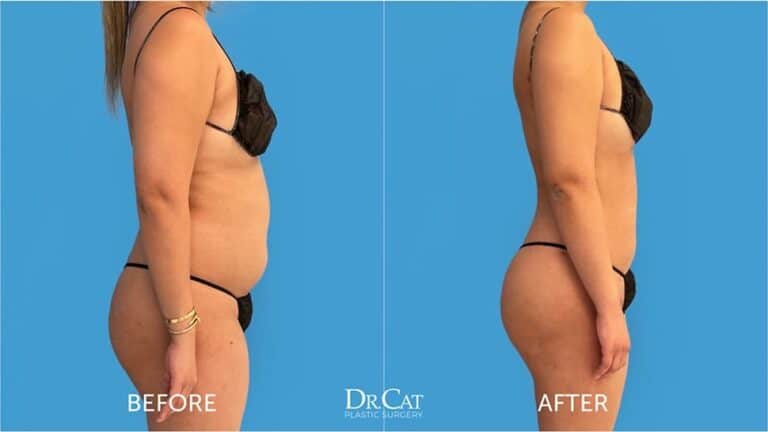
Side view before and after a tummy tuck by Dr. Cat: the side view is where a hanging fold shows most, and where the difference between tightening and removing skin is clearest.
When the loose skin hangs in a fold
A fold of skin and fat that hangs from the lower abdomen over the pubic area is a pannus, and our page on apron belly and loose skin after pregnancy covers it in full. It is removed rather than tightened: for most women that operation is a tummy tuck with muscle repair, and for a heavy fold after massive weight loss, when rashes under it are the main problem, a panniculectomy removes the fold alone. Radiofrequency devices firm mild laxity; they do not lift an overhang.
Sagging Belly After Pregnancy vs After Weight Loss
After pregnancy the laxity usually runs above and below the navel with a separated abdominal wall beneath it, and a C-section scar can tether the skin so a shelf forms over it; most mothers need a full tummy tuck, which removes the old scar with the skin. Wait until your family is complete and at least four to six months after delivery; if the breasts have changed too, ask about a mommy makeover, which Dr. Cat stages on separate surgical days. After weight loss the skin is loose everywhere, not only below the navel, so a mini is rarely right and an extended tummy tuck often is. Reach a stable weight and hold it for several months first, because skin tightened now loosens again if another 30 pounds come off later, and tell us if you take a GLP-1 medication, because it slows stomach emptying and the anesthesiologist plans around it.
What Tightened Stomach Skin Looks Like

Before and after a tummy tuck by Dr. Cat: a flat lower abdomen, a smaller waist and a natural belly button, with the scar placed under the bikini line.
Photos answer what words cannot: how low the scar sits, whether the belly button looks natural, and what a flat lower abdomen looks like on a body like yours. Find your starting point in our tummy tuck before and after photos, where many cases note how much skin was removed and how much muscle separation was repaired, and study the side views, where sagging skin shows most.
Talk to Dr. Cat About Loose Stomach Skin
Start with a free 15-minute discovery call with our Patient Concierge, who answers your first questions and books your consultation. At the consultation Dr. Cat pinches the skin, measures any muscle separation, checks the navel for a hernia, and tells you plainly whether ThermiSmooth, a mini, a full or an extended tummy tuck fits your anatomy, or whether the answer is to wait. The consultation with Dr. Cat is $500 for a first consultation and $1,500 for a revision consultation, credited in full toward your surgery; out-of-town patients consult by private video through OnPatient, the practice's HIPAA-secure patient portal. Book a free discovery call to get started.