

What the Internal Stitches in a Tummy Tuck Hold Together
A full tummy tuck has three layers of sutures, and they do different jobs. Deepest are the muscle repair sutures: the rectus muscles that separated in pregnancy or with weight changes (diastasis recti) are sewn back to the midline with permanent sutures in a precise double-layer repair that tightens the abdominal wall like an internal corset, brought together tightly but never over-pulled. Above them, the layered closure of the incision uses deeper sutures that carry the tension so the skin edges meet without pull, which is what lets the scar heal thin. The skin and the belly button are closed last, and no sutures cross the belly button line. When people search for the symptoms of torn internal stitches, it is almost always the muscle repair they are worried about, and it is the layer that matters most for the result.
The repair holds from the day of surgery, and over the following weeks scar tissue forms along the sutured line and takes over. That is why Dr. Cat's patients walk slightly bent for the first week, stand straight at two weeks and wait until six weeks for full exercise: the sutures are strongest once the tissue around them has healed. Our post on a tummy tuck with muscle repair explains who needs the repair and why a mini tummy tuck cannot do it.

Front view before and after a full tummy tuck with muscle repair by Dr. Cat: the flat result on the right depends on the internal sutures holding the abdominal wall together while it heals.
Next step: if you are planning surgery and want to understand how the muscle repair is done, read about a tummy tuck in Beverly Hills with Dr. Cat, or book a free discovery call; if you had surgery elsewhere and something feels wrong, the same call is the fastest way to be seen.
Symptoms of Torn Internal Stitches After a Tummy Tuck
These are the signs that point to an internal suture giving way rather than to ordinary healing:
- A sudden, sharp pain in one spot of the abdomen during a strain, a lift, a fall, a hard cough or a sneeze, distinct from the even tightness of the first two weeks
- A popping, snapping or tearing sensation at that moment, sometimes described as something shifting inside
- A new bulge, ridge or asymmetry along the midline or on one side that appears after the event and shows more when you strain or sit up
- Pain at that spot that keeps getting worse over the following days instead of easing
- Less often, bruising that spreads across the area, or a change in the shape or position of the belly button
Fever, chills, spreading redness, warmth or foul-smelling drainage at the incision are signs of infection, a different problem with the same instruction: call the same day. An incision that opens is a skin problem rather than a muscle repair problem, and it is also treated at once.
How to Tell if You Ripped Internal Stitches or Are Healing Normally
Normal healing after a tummy tuck feels tight and sore across the whole lower abdomen, like the end of a hard core workout, worst in the first three days and mostly gone by two weeks. Swelling is even, comes and goes, and is worse in the evening for months. A torn suture is different in two ways: there is an event, and there is a change in shape afterward. If nothing happened and the abdomen looks the same as it did yesterday, a twinge or a pulling feeling is almost always a small nerve waking up or the repair being used, not a tear.
Three things are mistaken for torn stitches more than anything else. A seroma is a pocket of fluid under the skin: it feels soft, may slosh when pressed, and appears in the first weeks without a painful event; it is drained in the office. Evening swelling above the incision is symmetrical and goes down overnight. A dissolving suture surfacing at the incision looks like a small thread or a tiny pimple on the line and is trimmed at a visit. None of these means the muscle repair has failed. Our page on a botched tummy tuck separates normal healing from a real problem month by month.
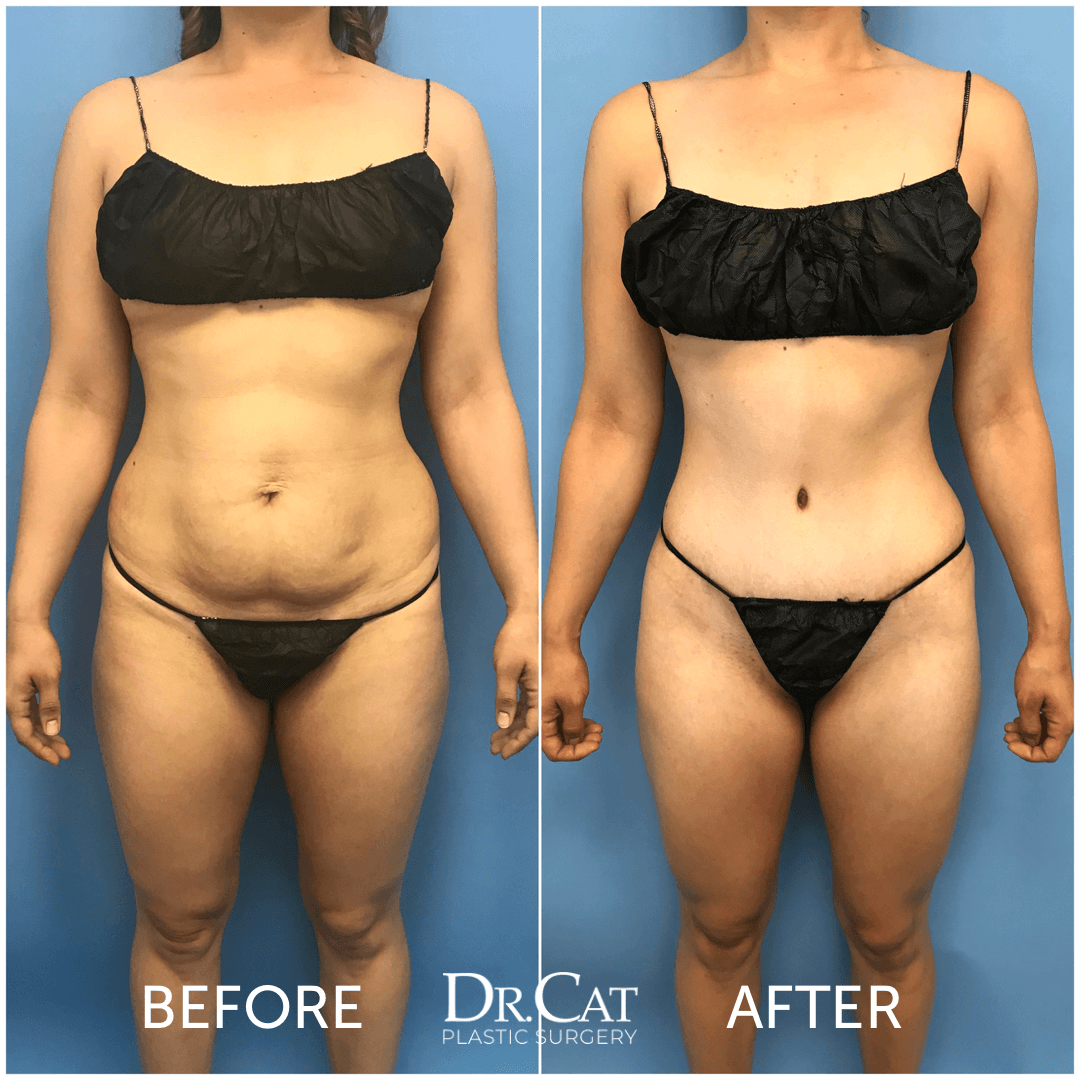
Tummy tuck before and after by Dr. Cat, front view: the even, flat contour on the right is the repaired abdominal wall. A bulge that appears on one side after a painful event is the change to call about.
What Happens if You Tear Internal Stitches
It depends on how much has given way. One suture pulling through in one spot leaves a small area of the repair without support; the sutures around it and the scar tissue that has already formed usually hold the wall, and the surgeon may decide to watch it, with the garment on and no straining, and reassess as the swelling settles. If a length of the repair opens, the muscles drift apart again at that point, the bulge stays, and the abdominal wall is weaker there. A repair that has come apart does not knit itself back together, so that is corrected surgically. The skin closure is a separate layer: a deep skin suture giving way can let the incision widen or open, which is treated promptly so the scar does not heal wide.
Timing follows the problem. An open incision, an infection or a fast-growing bulge is treated at once. A loosened muscle repair that is stable is usually re-done once the swelling has settled, so the surgeon is correcting your final shape rather than one that is still changing. Dr. Cat tells you which applies after she has examined you.
Can a Tummy Tuck Come Undone?
Not in the way the phrase suggests. The skin that was removed does not come back, and the incision, once healed, stays closed. Two things can loosen a result: the muscle repair can give way at a point, as above, and the remaining skin and the repaired wall can stretch again with a large weight gain or a pregnancy. That is why Dr. Cat operates on patients within 10 to 15 pounds of a stable goal weight with a BMI of about 30 or less, and asks that your family be complete; a later pregnancy will likely stretch the repair and can call for a revision. Our page on diastasis recti explains why the repair is designed to be permanent and what a later pregnancy does to it.
What to Do the Same Day if You Think a Stitch Has Torn
- Stop what you are doing, sit or lie back in the reclined position, and keep the compression garment on; it supports the repair.
- Call your surgeon's office the same day and describe the event, the pain and any change in shape; send a photo if asked. Dr. Cat and her staff are available to her patients throughout recovery.
- Take Tylenol for the pain if you need it. Do not take ibuprofen, naproxen or another anti-inflammatory unless your surgeon has told you to, because they increase bleeding.
- Do not massage, press on or test the area, and do not lift, twist or attempt a sit-up to see whether it is really torn.
- Go to an emergency room first, then call, for calf pain or swelling in one leg, chest pain, shortness of breath, bleeding that does not stop with gentle pressure, or a hard swelling that is growing quickly.
How Rare It Is, and What Makes a Tear More Likely
A torn muscle repair is uncommon. Published reviews of abdominoplasty report overall complication rates of roughly 10 to 20 percent, most of them minor, with seroma and small wound-healing problems at the top of the list; failure of the muscle repair sits far down it. What raises the risk is familiar:
- Doing too much too soon: lifting, sit-ups, twisting, heavy housework or a workout before the six-week clearance
- Not following the post-operative instructions: skipping the garment, straightening up in the first week, sleeping flat
- Poor wound healing from nicotine, uncontrolled diabetes, an infection, or a large seroma stretching the repair
- Technique: sutures placed under too much tension, too few of them, a single layer, or a material that does not suit the tissue
- A fall, a car accident, or a violent bout of coughing or vomiting in the early weeks
Dr. Cat's technique is built around the fourth item: a double-layer repair with permanent sutures, muscles brought together firmly without over-pulling, little to no bleeding during surgery, and one tummy tuck per surgical day so no step is rushed. She performs every step herself, from the markings to the muscle repair to the last suture.
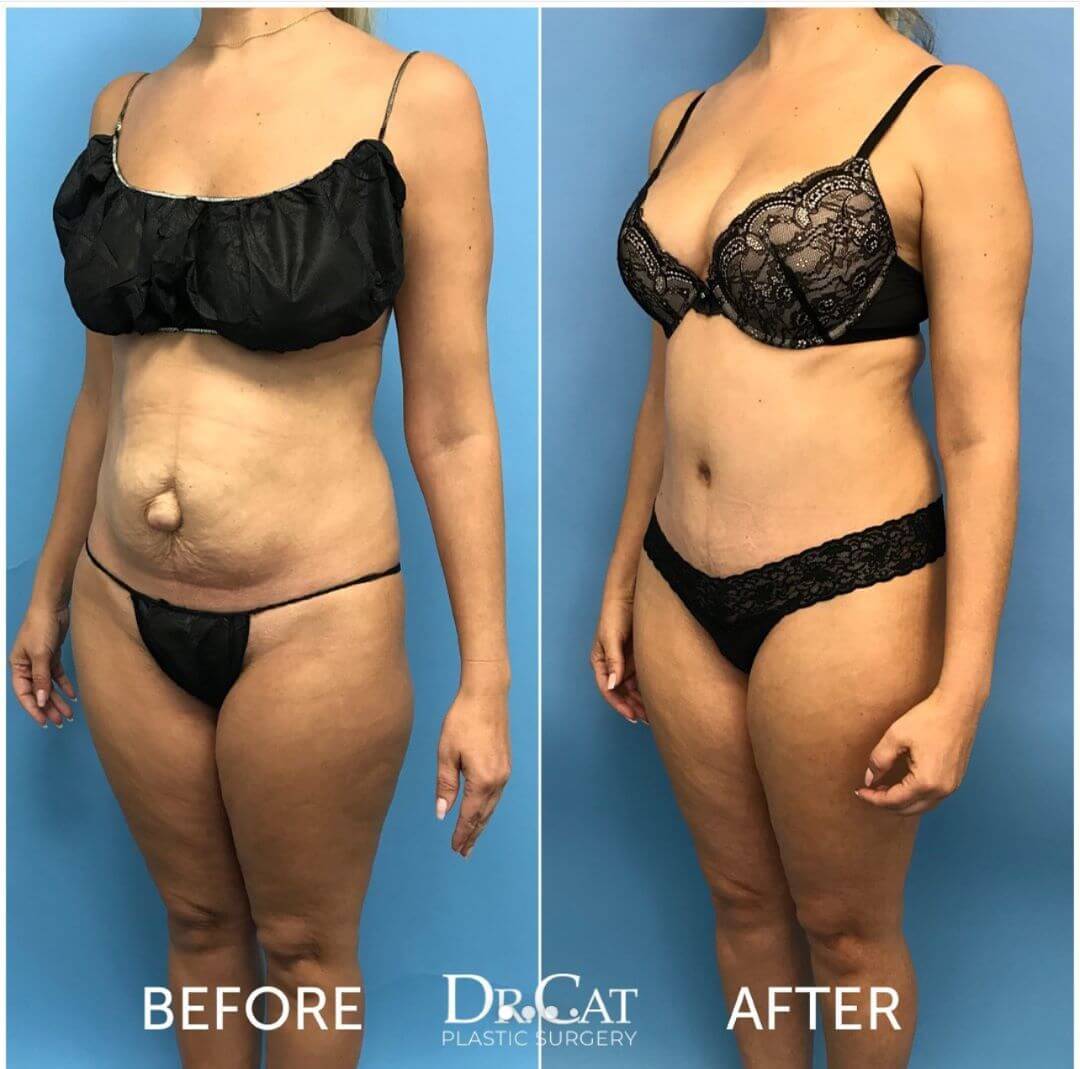
Three-quarter view before and after a tummy tuck by Dr. Cat: the muscle repair and the layered closure are what hold this contour through the first weeks, when the tissue is still gaining strength.
How to Protect the Repair While It Heals
- Walk the evening of surgery and every other hour while awake, slightly bent, with a front-wheel walker for the first week
- Use your arms, never your abdominal muscles, to get in and out of bed, and have someone help you for the first days
- Sleep on your back, reclined at about 45 degrees with your knees bent, for at least three weeks
- Wear the compression garment continuously for about six weeks
- No lifting, including small children, until the six-week clearance; light exercise such as walking at one month, full exercise at six weeks, and sit-ups, planks and crunches at three months if a hernia was repaired, as our post on exercise after a tummy tuck sets out
- Skip lymphatic massage; Dr. Cat advises against it after a tummy tuck
- Eat protein at every meal, drink water through the day and keep salt low so swelling stays down
- Keep every follow-up visit: day one, one week, two weeks, one month and three months
The week-by-week detail, including what is normal and when to call, is in our tummy tuck recovery guide.
What Dr. Cat Does if the Repair Has Given Way
She examines you: the midline lying down and sitting up, the bulge when you strain, the incision and the belly button, and she reviews the operative note when the first surgery was done elsewhere. If the muscle repair has separated, the correction is a revision tummy tuck: through the same low incision, she lifts the skin, repairs the stretched or loosened muscles with her double-layer technique, corrects any irregularity of the abdominal wall, removes residual excess skin and closes so the scar stays thin and low. She works under 3.5X magnification operating lenses, the surgery takes four to seven hours under general anesthesia, and you spend the first night in a plastic surgery aftercare center. Many of her revision patients had their first surgery elsewhere.
Talk to Dr. Cat About Your Tummy Tuck
Start with a free 15-minute discovery call with our Patient Concierge, who answers your first questions and books your consultation. The consultation with Dr. Cat is $500 for a first consultation and $1,500 for a revision consultation, credited in full toward your surgery; out-of-town patients consult by private video through OnPatient, the practice's HIPAA-secure patient portal. Book a free discovery call to get started.