

A botched tummy tuck is one whose result is still wrong after healing is complete: a scar that sits too high or runs uneven, dog ears at its ends, a belly button that looks operated on, loose skin above the navel, a bulge because the muscles were never repaired, steps in the contour, or a heavy mons under a flat tummy. Most of these can be corrected with a revision tummy tuck, including for patients whose first surgery was done elsewhere. The first job is telling a problem from healing, because a tummy tuck looks worse at two months than at twelve.
The Signs of a Botched Tummy Tuck
A High, Uneven or Wide Scar
A well-placed scar sits low enough to hide under a bikini bottom and runs level side to side. A high scar means the incision was marked high or too little skin was removed to bring it down; an uneven one was marked or closed unevenly; one that widened or stayed raised was closed under too much tension or healed poorly, which smoking and genetics make more likely. Our tummy tuck scar guide shows what a scar should look like at each stage.
Dog Ears at the Ends of the Incision
Dog ears are puckers of skin and fat at each end of the scar, formed when the incision is too short for the skin removed or its ends were not tapered. Small ones flatten over the first six months; those still standing at six months are removed by extending the scar slightly and thinning the fat beneath.
A "Fake" Belly Button
A natural navel is a small vertical oval with a slight hood above it and the scar hidden inside. A "fake" one is round, a flat slit, a hole with a visible circular scar, too large, or sitting too low. The last is called umbilical float: in one of Dr. Cat's revision cases, the first surgeon had cut the navel free and pulled the skin down, leaving it just above a high scar. Each is a technical error, not a healing problem, and each can be revised.
Loose Skin Above the Navel
A full tummy tuck lifts the skin to the ribs so the upper abdomen tightens as well as the lower. When the skin is not lifted high enough or too little is removed, the lower belly is flat and the upper belly still folds when you sit. This is how a "mini" done on the wrong anatomy disappoints; most patients who ask about a mini need a full tummy tuck with muscle repair.
The Bulge That Stays
If the belly still rounds out after healing, one of four things is true: the muscles were never repaired, the repair loosened or tore (our post on torn internal stitches after a tummy tuck covers the signs), there is a hernia, or the fullness is fat around the organs, which no tummy tuck removes. Our page on diastasis recti explains what the repair is meant to do.
Steps and Contour Irregularities
A step at the scar line, where the upper skin sits proud of the lower, comes from uneven closure or fat left thicker on one side. Dents and waves in the flanks come from aggressive or uneven liposuction, and too much liposuction over the abdominal flap can starve the skin of blood.
A Mons Left Behind
The mons pubis loosens with the rest of the lower belly, and a tummy tuck that ignores it leaves a flat abdomen above a heavy, low mound. The fix is mons liposuction and, when the skin has dropped, a pubic lift, both done with the revision.
Normal Healing Against a Problem, Month by Month
In the first two weeks you are swollen, tight and walking bent forward, the lower belly is numb, and the scar is red and raised; a seroma, a pocket of fluid that sloshes under the skin, can appear in these weeks and is drained in the office. From weeks three to eight the swelling settles into a bulge above the scar and in the lower belly, worse in the evening, and the scar is at its reddest around two months. By three months most of that bulge has gone, the scar flattens and lightens over the next three, feeling returns slowly, and by twelve months the scar is a thin pale line and the shape is final. Our tummy tuck recovery guide covers this week by week.
Against that timeline, these are problems: darkened or hard skin along the incision in the first two weeks, a wound that opens, spreading redness or fever, fluid that keeps collecting after drainage, a dog ear or a step still there at six months, a navel that is a slit or a hole or sits too low, a bulge that grows when you strain, and a scar still thick or dark at a year. Published reviews of abdominoplasty report overall complication rates of roughly 10 to 20 percent, most of them minor; seroma is the most common, then small wound-healing problems and infection. A complication is not a botched result; it becomes one when it is missed, mismanaged, or leaves a contour no one goes back to fix.
Why It Happens
Most botched tummy tucks are technique. The skin was not lifted high enough or not enough was removed; the incision was marked high, uneven, or closed under too much tension; the muscles were left unrepaired or repaired unevenly; the navel was brought out through a large round hole; liposuction was too aggressive; the incision ends were not tapered; the mons was ignored. A surgeon working fast, or doing several tummy tucks a day, makes these errors more often, which is why so many revisions we see come from high-volume clinics and surgery abroad. The American Society of Plastic Surgeons and the CDC have both warned about medical tourism complications, and a revision costs more than the original surgery; our post on plastic surgery tourism sets out the arithmetic.
Some results are undone afterward rather than botched. Smoking starves healing skin of blood and widens scars; uncontrolled diabetes, autoimmune conditions and poor wound healing raise the risk of infection; weight loss after surgery brings new loose skin, weight gain stretches the repair, and a pregnancy can reverse it, which is why we ask that your family be complete and your weight stable. None of this makes the result your fault, but all of it belongs in the revision plan.
When a Revision Is Possible and What It Involves
The timing rule is six to twelve months after the first operation, or about a year when the scar is the main problem, so that Dr. Cat is correcting your final result rather than one still changing; a complication is treated at once. At the consultation she reviews the operative note from your first surgery, examines the scar, skin, abdominal wall and navel, and tells you plainly whether a revision will help; if it will not, she says so.
A revision tummy tuck in Beverly Hills takes four to seven hours under general anesthesia. Working under 3.5x magnification, Dr. Cat makes a low curved incision that follows the first scar and removes it, lifts the skin and fat off the abdominal wall, repairs stretched or loosened muscles, corrects irregularities in the wall, removes the remaining excess skin, re-creates a natural "innie" belly button, and closes so the new scar is thin and low. Dog ears and the mons are treated at the same time. You spend the first night in the aftercare center, scar treatment starts at about two weeks, and the scar fades over about a year.
Not every problem needs the full operation. A scar that is only high or wide can be revised on its own once it has matured, which our post on tummy tuck scar revision covers; a dog ear alone is a small procedure; a belly button can be reshaped without redoing the abdomen. No revision erases a scar or restores tissue that was over-removed, and in Dr. Cat's words, sometimes the damage is so great that not every error can be repaired. If the problem is an apron belly that returned after weight gain rather than a surgical error, a full tummy tuck may be the answer.
Cost in One Line
Dr. Cat's surgeon's fee for an extended or revision full tummy tuck is $75,000 to $95,000, and $35,500 to $45,500 for a mini revision; the operating room and anesthesia are quoted at your consultation; the $1,500 revision consultation fee is credited toward surgery, our tummy tuck cost guide explains what moves the price, and financing is available. Surgeon's fees are typical ranges: a more complex case can cost more, and your fee is set at your consultation and is final only in your written quote.
Before and After

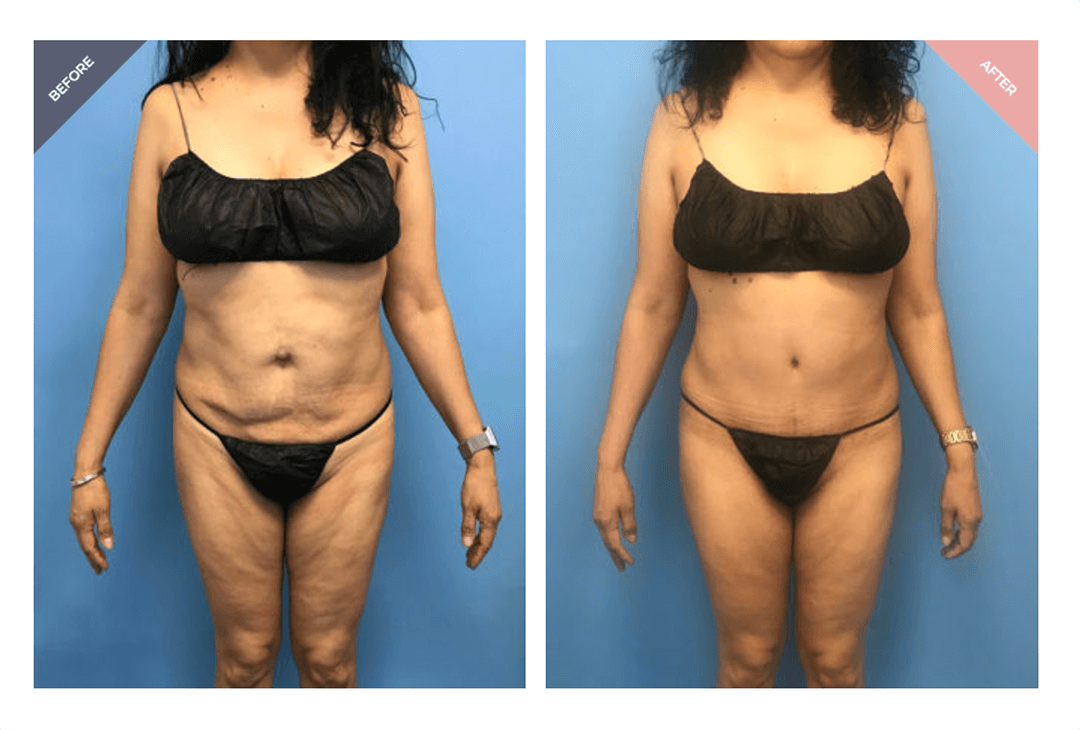
Study the revision tummy tuck before and after photos for three details: how low and level the scar sits, whether the navel looks like it was always there, and whether the upper abdomen is as flat as the lower.
The Revision Consultation
A revision consultation with Dr. Cat is $1,500, credited toward surgery, and the discovery call before it is free. Bring the operative note if you can get it and any photos from before the first surgery. Regret after a bad result is normal, and most patients tell us the weight lifted once they had a plan. Patients outside Los Angeles can start with a video consultation.
Frequently Asked Questions About a Botched Tummy Tuck
What does a botched tummy tuck look like?
A scar that sits high, runs uneven or has widened; puckers of skin at its ends; a belly button that is round, slit-like or pulled too low; loose skin above the navel; a bulge because the muscles were never repaired; steps in the contour; a heavy mons under a flat tummy.
What are the signs of a tummy tuck gone wrong?
Early: darkened or hard skin at the incision, a wound that opens, fever, spreading redness, or fluid sloshing under the skin. Late: a scar still thick or dark at a year, dog ears or a step at six months, an unnatural navel, a bulge that grows when you strain, loose skin above the navel.
What is the most common complication associated with a tummy tuck?
A seroma, a pocket of fluid under the skin flap, which is drained in the office and usually resolves. Small wound-healing problems at the incision come next. Both heal; they become a botched result only when they leave a wide scar or contour that no one goes back to fix.
How common are botched tummy tucks?
Published reviews of abdominoplasty report overall complication rates of roughly 10 to 20 percent, most of them minor and healing without a trace. A result bad enough to need a revision is far rarer and clusters around inexperienced surgeons, high-volume clinics and surgery abroad.
Is it normal to have a bulge after a tummy tuck?
In the first three months, yes: swelling collects above the scar and in the lower belly, worse in the evening, and goes down with time and the garment. A bulge still there at six months, or one that grows when you strain, points to a loosened repair, no repair at all, or a hernia.
Can a high or bad tummy tuck scar be fixed?
Usually. A scar revision can lower, narrow or straighten it once it has matured at about a year, and raised scars respond to silicone, steroid injections and laser first. Lowering a scar means removing skin above it, so it is often part of a full revision.
How long should I wait before a tummy tuck revision?
Six to twelve months, and about a year when the scar is the problem, so that swelling has resolved, the scar has matured and Dr. Cat is correcting your final result. A complication such as a seroma or an open wound is treated at once.
What does a tummy tuck look like after 10 years?
Flat, with a pale thin scar, if your weight has stayed stable and there has been no pregnancy. Skin still ages and loses collagen, so some softening is normal. Large weight swings or a pregnancy can stretch the skin and the repair again.
Will you take me if another surgeon did my tummy tuck?
Yes. Revision tummy tucks are a specialty of Dr. Cat's, and many of her revision patients had their first surgery elsewhere, often in another city or country. Request the operative note from the first surgeon before your consultation.
Talk to Dr. Cat About Your Tummy Tuck
If you have healed and the result is still not right, you are not stuck with it. Start with a free discovery call or call (310) 858-8808, and before you visit look through the revision tummy tuck before and after photos and the revision tummy tuck in Beverly Hills page.
Medically reviewed by Dr. Cat Begovic, MD, FACS, board-certified plastic surgeon. Last reviewed September 2026.