

Dr. Cat recommends silicone implants for most patients: the cohesive gel feels closest to breast tissue, drapes with a natural slope, and ripples less, which matters most in a slim patient with little tissue to cover the implant. Saline implants suit a patient who wants the smallest incision, a leak she can see for herself (a saline implant deflates within a day or two, while a silicone rupture can be silent for years), and a lower price for the implant itself. Gummy bear implants are not a third choice; they are a firmer, form-stable type of silicone implant. Both fillings are FDA-approved, both sit inside the same silicone shell, both go through the same incisions into the same pockets, and both recover on the same timeline, so the decision is about feel, look, monitoring and age, not about safety.
Dr. Cat Begovic places both (she uses Mentor implants), has had implants herself, and revises implants that have rippled or ruptured. At her consultation you hold a saline and a silicone implant in your hands before you choose. Here is what she wants you to know first.
Saline vs Silicone Implants at a Glance
| Question | Silicone gel implant | Saline implant |
|---|---|---|
| Filled with | Cohesive silicone gel, sealed inside a silicone shell by the manufacturer. | Sterile salt water, added through a valve after the empty silicone shell is placed. |
| Feel | Closest to natural breast tissue: soft, and it moves with the breast. | Firmer, closer to a water balloon under thin cover; less noticeable under generous tissue or the muscle. |
| Look and rippling | Drapes with a natural slope; round and teardrop shapes; ripples least. | Rounder, with more fullness at the top; round shapes only; can show rippling or a wavy edge in a thin patient, at the side and toward the cleavage. |
| Incision size | A little longer, because the implant goes in already filled; usually in the fold under the breast. | Shorter, because the shell goes in empty; the edge of the areola is an option. |
| Rupture detection | Often silent: the gel stays inside the scar capsule, so a rupture is found on ultrasound or MRI, or as a change in shape or firmness. | Obvious: the breast deflates over a day or two and the body absorbs the salt water; the shell is then exchanged. |
| FDA minimum age (cosmetic augmentation) | 22 | 18 |
| Screening | The FDA recommends an ultrasound or MRI five to six years after surgery and every two to three years after that, even without symptoms. | No imaging for the implant itself; a look in the mirror is the check. |
| Downtime | The same for both: desk work at about one week; all exercise and no restrictions at six weeks. | The same. |
| Price | The implants are their own line on the quote, and silicone costs more than saline; the surgery, anesthesia and facility cost the same. Quoted at your consultation. | The lower implant price; the rest of the quote is identical. Quoted at your consultation; the range is in the cost section below. |
| Longevity | Not lifetime devices. Dr. Cat recommends an exchange on a schedule, about every 8 to 10 years, to reduce the chance of a silent leak; sooner if a problem or a change of preference calls for it. | Not lifetime devices. A leak declares itself by deflating, and the implant is exchanged when that happens or when you want a change. |
What a Silicone Implant Is
A silicone implant is a silicone shell filled at the factory with cohesive silicone gel, a gel that holds together rather than running, so that even a torn shell keeps most of its contents in place. It goes in already filled, through an incision in the fold under the breast or along the lower edge of the areola, in breast augmentation in Beverly Hills exactly as a saline implant does: general anesthesia with local anesthetic in the breast, a no-touch technique, a pocket over the chest muscle when there is enough tissue to cover the implant and under it when there is not, and three to four hours in surgery depending on complexity. The gel comes in several degrees of firmness, in round and teardrop shapes, and with smooth or textured surfaces, all covered in the breast implant shapes post. Its case is feel and look: it is lighter than saline for the same volume, it moves more like breast tissue, and it ripples least.
What a Saline Implant Is
A saline implant is the same silicone shell, placed empty and rolled, then filled with sterile salt water through a valve once it is in the pocket. That is the source of every one of its advantages: the incision can be shorter, the fill can be adjusted on the table to match two sides that differ, and a leak is harmless, because the body absorbs salt water and the breast simply deflates, which tells you and Dr. Cat that the shell needs exchanging. It is also the source of its disadvantages. Water does not behave like gel: the implant feels firmer, sits rounder with more fullness at the top, and in a slim patient the folds of the shell can be seen or felt as rippling at the side of the breast and toward the cleavage. Saline suits a patient with enough of her own tissue to cover the implant, or an implant placed under the muscle. The FDA has approved saline implants for cosmetic augmentation from age 18 and silicone from 22, which makes saline the FDA-approved option for a patient of 18 to 21.
Gummy Bear Implants Are a Type of Silicone Implant
"Gummy bear" is a nickname for form-stable silicone implants: the gel is more tightly cross-linked, so it holds its shape when the implant is cut in half, the way a gummy candy does. Every modern silicone implant is cohesive to some degree; the nickname is used for the firmest grades, including the teardrop (anatomical) implants that keep a shaped profile, with more volume low and a taper at the top. The trade is firmness: a gummy bear implant feels firmer than a softer gel, shows less rippling, and holds its upper pole rather than settling into a natural slope, and a shaped one needs a textured surface to stop it rotating, which brings the textured-implant questions below into the decision. Gummy bear vs silicone is therefore a choice between grades of the same silicone implant, and gummy bear vs saline is the widest gap on this page in feel and price. Round, smooth silicone gel in the moderate to high profiles described in the breast implant sizes guide is what most augmentation patients nationally end up with.
How They Look: Saline vs Silicone Before and After
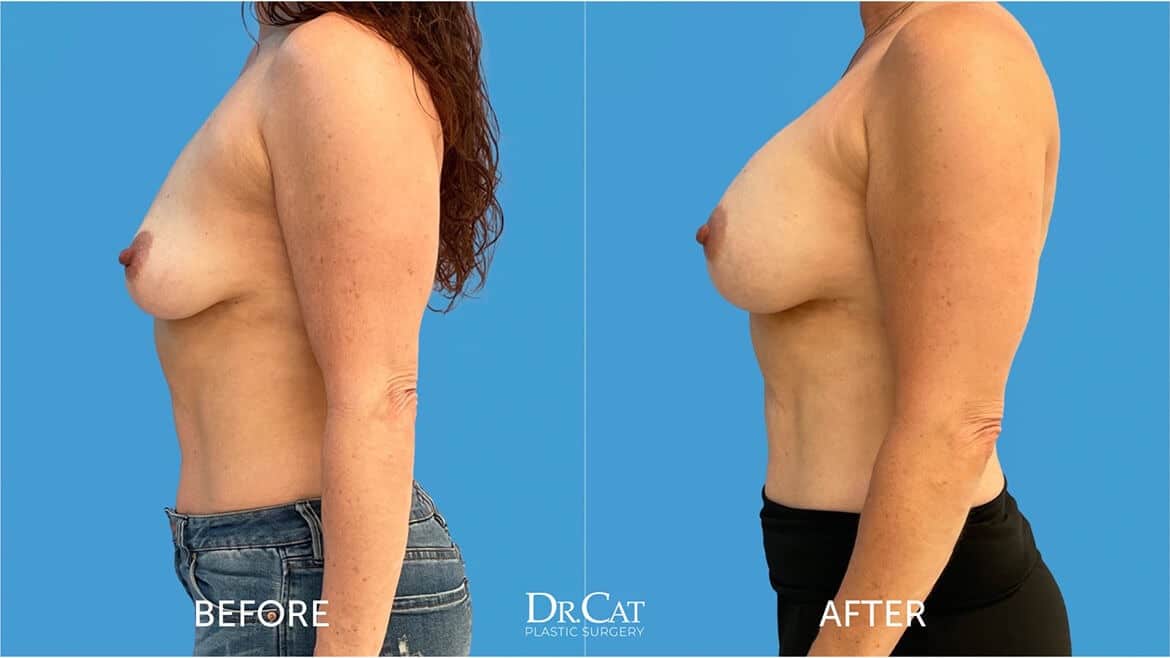
In a patient with enough tissue and a moderate implant placed under the muscle, a saline result and a silicone result can look alike from the front; the difference shows at the edges and over time. Saline sits rounder and fuller at the top and holds that shape; silicone drapes with a softer slope and follows the breast when the patient leans forward or lies down. In a thin patient the difference is not subtle: saline shows rippling at the side and between the breasts, most visibly when she bends, and silicone does not. Neither filling lifts a nipple that has dropped; that is the subject of breast lift vs augmentation. The two cases below are Dr. Cat's patients, from the post this page replaces, and the breast implant before and after photos show many more, with the implant type and size noted on many of the cases.

How to Decide: The Factors That Tip It
Thin tissue and rippling
Rippling is the implant's shell folding where tissue does not support it, and it is seen where there is too little tissue over the implant. The thinner the patient, the more the filling matters, because saline folds more than gel. Dr. Cat measures the tissue over the upper breast with a pinch test at the consultation; under about two centimeters, the implant goes under the muscle, and the case for silicone gets stronger. A patient with a generous natural B cup and thick skin can cover either filling and can choose on feel and price alone.
An athletic frame
Lean, muscular women have the least tissue to hide an implant and the most reason to think about the pocket. Under the muscle, the pectoralis moves the implant when it contracts, which shows during chest exercises; over the muscle, nothing softens the edge. Silicone hides the edge that an over-the-muscle pocket would show, and a firmer gel holds its upper pole through training and weight changes. Saline in an athletic frame is the combination most likely to show a wavy edge.
Over or under the muscle
Placement is a separate decision from filling, and the two interact. Under the muscle (submuscular) adds a layer over the upper part of the implant, softens its edge, reduces rippling and capsular contracture, and makes mammograms easier to read, at the cost of a sorer first week; over the muscle (subglandular) recovers faster and can look fuller at the top, but only with enough natural tissue to cover the implant. Dr. Cat chooses the pocket from the tissue she measures, and a patient with little coverage gets a submuscular pocket and, in most cases, silicone. The full trade is in breast implant placement over or under the muscle.
Screening: MRI and ultrasound for silicone
Because a silicone rupture can be silent, the FDA's current labeling recommends that a woman with silicone implants have an ultrasound or MRI five to six years after surgery and every two to three years after that, even with no symptoms, and sooner if the breast changes in shape, firmness or comfort. Those scans are not covered by insurance for a cosmetic implant and belong in the budget. The silent rupture is also why Dr. Cat recommends exchanging silicone implants on a schedule, about every 8 to 10 years, to reduce the chance of a leak. A saline implant needs no imaging for its own sake, because deflation is visible, and it is replaced when that happens or when you want a change. Neither type excuses you from routine breast screening; tell the mammography center you have implants so it takes the extra views. Dr. Cat's practice sees implant patients at one week, six weeks and six months, then yearly.
Breast implant illness, BIA-ALCL and the boxed warning
The FDA requires a boxed warning on every breast implant, saline and silicone, that names two things. The first is BIA-ALCL, a rare lymphoma of the scar capsule associated mainly with textured implants (some of which have been withdrawn from the US market); it is treated by removing the implant and its capsule, and it is the reason smooth implants are the default. The second is a set of systemic symptoms that some women report with implants of either type, fatigue, joint pain, brain fog, rashes and others, which patients call breast implant illness. It has no test, research has not established that implants cause it, and some women with the symptoms improve after breast implant removal with the capsules while others do not. Dr. Cat goes through the warning at every implant consultation, and of the material itself she has said: "We have silicone exposure every day, such as in our cooking spray, deodorant, and food containers. The amount you are exposed to from implants is much less than everyday exposure." Saline does not avoid the question, because its shell is silicone; a patient who wants no silicone in her body is a candidate for breast augmentation with fat transfer, compared in implants vs fat transfer. A patient who already has implants and symptoms, or a hardening breast, starts at breast implant problems, with the capsular contracture and breast implant illness posts behind it.
When Dr. Cat Recommends Each
On her breast augmentation page Dr. Cat describes silicone as the implant that most closely mimics natural breast tissue, offered in a range of shapes including the teardrop, with rupture rare and silicone not linked to serious health issues; and saline as the implant whose contents the body absorbs harmlessly if the shell fails, at the price of a firmer, less natural feel. So she recommends silicone when the natural look and feel is the goal, and saline when a patient wants a rupture to be self-evident and harmless, or when she is 18 to 21 and only saline is approved. The pocket follows the tissue: over the muscle when there is ample breast tissue to cover and smooth the implant, under it when there is not. She asks about family plans, because pregnancy changes the breast and the timing of surgery, and she tests different sizes during surgery when the two sides differ. Whichever way you lean, you will hold both implants and try sizers in a bra before anything is decided.
Recovery: The Same for Both
The filling does not change recovery; the pocket does. Dr. Cat's patients are back at desk work at about one week and at six weeks all exercise is allowed with no restrictions, whether the implant is saline or silicone. Tightness and soreness in the first days are managed with Tylenol, swelling subsides over about a month, a supportive bra is worn for up to two months, and the implants settle into their final position over four to six months, the drop that turns a high, tight early result into the finished one. An implant under the muscle is sorer for the first days than one over it, regardless of what it is filled with. The week-by-week detail is in the breast augmentation recovery guide.
Cost Side by Side
The implants are one line on the quote. Silicone implants cost more than saline, while Dr. Cat's fee, the board-certified anesthesiologist and the accredited facility are identical, so the filling moves the quote by a small share and should not decide it. Dr. Cat's surgeon's fee for a breast augmentation with implants is $17,500 to $22,500; the implants, the operating room and anesthesia are quoted at your consultation, and the breast augmentation cost guide itemizes the quote. Surgeon's fees are typical ranges: a more complex case can cost more, and your fee is set at your consultation and is final only in your written quote. Budget for the silicone screening scans over the years and for the exchange, which is a real future cost with either filling: Dr. Cat recommends replacing silicone implants about every 8 to 10 years, a saline implant is replaced when it deflates, and an exchange with her is a simple implant removal and replacement, with a surgeon's fee of $19,500 to $21,500 and the operating room and anesthesia quoted at the consultation, as the breast revision cost guide explains. Financing through Cherry, CareCredit or Alphaeon is on the financing page.
Frequently Asked Questions About Saline vs Silicone Implants
Is it better to get silicone or saline breast implants?
Silicone for most patients, because cohesive gel feels and drapes more like breast tissue and ripples less; saline when you want the smallest incision, a leak you can see for yourself, the lower implant price, or you are 18 to 21, the ages at which only saline is FDA-approved for cosmetic augmentation. Both are FDA-approved and neither is safer than the other when placed and monitored properly; the differences are feel, look, monitoring and age. Dr. Cat has you hold both at the consultation before you decide.
What happens if an implant ruptures?
A saline implant deflates over a day or two; the salt water is absorbed harmlessly and the shell is exchanged in a short operation. A silicone rupture is often silent: the cohesive gel stays inside the scar capsule and is found on ultrasound or MRI, or as a change in shape, firmness or comfort; the implant and any free gel are removed, usually with the capsule, and a new implant is placed. Neither is an emergency, and both are a breast revision rather than a repeat augmentation.
What lasts longer, silicone or saline implants?
Neither is built to outlast the other, and neither is a lifetime device; the chance of a shell failing rises with every year for both. What differs is how failure shows: a saline leak is visible, so the implant is replaced when it deflates or when you want a change, while a silicone rupture may go unnoticed for years, which is why the FDA asks for screening scans and why Dr. Cat recommends exchanging silicone implants on a schedule, about every 8 to 10 years.
Do silicone implants look better than saline?
In a patient with enough tissue and a moderate implant under the muscle, the two can look alike from the front. Silicone drapes with a softer slope and moves with the breast; saline sits rounder and fuller at the top, which some patients prefer, and in a thin patient it shows rippling at the side and toward the cleavage that silicone does not. Compare thin patients with thin patients in a gallery, and ask for the implant type on each case.
Do people still get saline breast implants?
Yes, though they are the minority. Saline is chosen by patients aged 18 to 21, for whom silicone is not FDA-approved for cosmetic augmentation; by patients who want a leak to be obvious and harmless; by patients who want the shortest incision or an incision at the areola; and by patients for whom the lower implant price matters. Most patients nationally choose silicone; the American Society of Plastic Surgeons describes it as by far the more popular choice today.
Do saline implants ripple more?
Yes. A saline implant is a shell of water, and where tissue does not support it the shell folds, and the folds show or can be felt at the side of the breast and toward the cleavage, most in thin patients and with an over-the-muscle pocket. Cohesive silicone gel holds the shell out and ripples least. Filling a saline implant to the top of its range and placing it under the muscle reduce rippling but do not remove the difference.
How often do implants need replacing?
Silicone implants on a schedule, saline implants when they tell you. Dr. Cat recommends exchanging silicone implants about every 8 to 10 years to reduce the chance of a leak, because a silicone rupture is often silent; the FDA screening scans check the shell in between. A saline implant announces a leak by deflating and is replaced when that happens or when you want a different size. Capsular contracture, a change in the breast after pregnancy or weight change, or a wish for a different size brings either exchange forward.
Talk to Dr. Cat About Saline or Silicone Implants
The right choice between these procedures depends on your anatomy, your goals and your safety, which is why it can only be made through an in-person or virtual evaluation with a qualified surgeon, never from an article. Book a free discovery call or call (310) 858-8808; the consultation with Dr. Cat is $500, credited toward your surgery, and it is where you feel both implants and try sizers. Before you call, look through the breast augmentation gallery and read the breast augmentation page.
Medically reviewed by Dr. Cat Begovic, MD, FACS, board-certified plastic surgeon. Last reviewed September 2026.